David Corbin · · 5 min read
Why Kamelio, Japan’s most overlooked news app, has a bright future
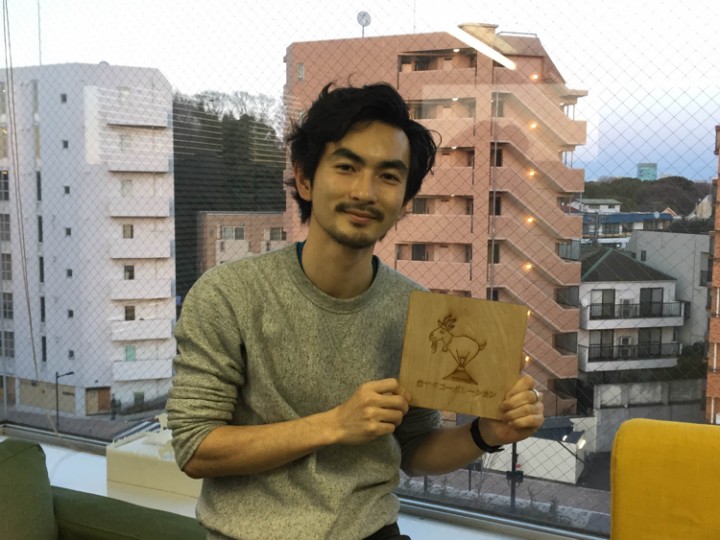
Akira Shibata, co-founder and CEO
If you had met Akira Shibata for the first time 18 years ago when he dropped out of high school, you might have thought he was just another aimless youth, rebelling without cause or direction. If you met him today for the first time and learned that he created Kamelio, a news curation app with about 100,000 downloads, you might think he is just another wannabe entrepreneur, pumping out a consumer app in a crowded market without cause or direction.
In both instances, you would be mistaken. Kamelio may have a long way to go in Japan’s news app game, but Shibata is no slouch. Already an internationally known sub-atomic particle physicist, he is working to make the technology powering Kamelio a game-changer for the mobile advertising industry.
Setting out
Shibata has always embraced independence. He finished high school on his own terms, earning an equivalency qualification instead of marching in step with the thousands of students hurtling toward the sharp edges of the Japanese college entrance exams. From there, he went to England, where he attended the University of London.
While abroad he became entranced by physics to the point that he completed a Ph.D. in experimental particle physics at his alma mater. For his studies, he became involved in Project Atlas – a study of what happens when protons are smashed together in the Large Hadron Collider (LHC). Shibata’s work finished in 2010, and helped set the stage for the successful identification of the Higgs-Boson particle in 2012 – aka “The God Particle,” which is a fundamental particle that helps other particle have mass.
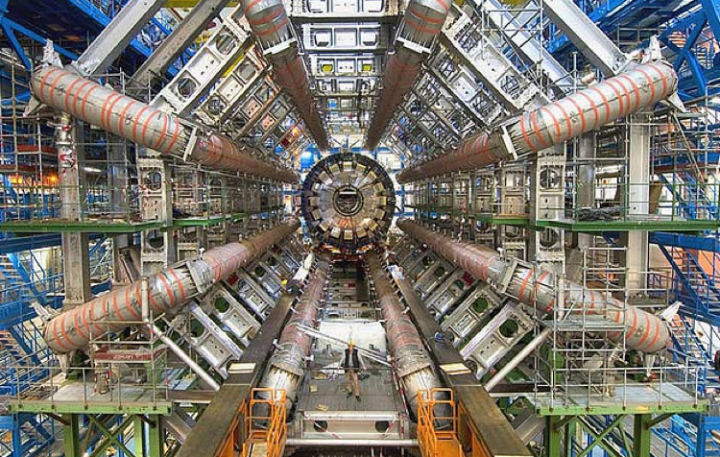
The Large Hadron Collider. Sometimes you need a big machine to discover a tiny particle. Note how small the man is at the bottom by comparison.
Life after the God particle
The average genius physicist whose work gets cited in the discovery paper for a particle so elemental and revered that it gains a divine moniker would be feeling pretty content with his life’s work. For Shibata, it was time for him to start a new challenge.
In 2010, he was living in New York City, seeing first-hand the effects of the economic crisis.
“Nothing happened to me. My experiment was safe. But people were getting fired. I had a strong sense of not being connected. That’s when I thought I wanted to do something else,” Shibata says.
He co-founded Generative, an indexing and exploration interface for photo archives. The company ultimately failed, but did attract the attention of major publishers like Getty. While he was nurturing the startup, Shibata also started working for the Boston Consulting Group, a position that would bring him back to Tokyo to live for the first time in over ten years.





Stay updated on the go with our mobile app.
Get latest insights with smoother, more personalized experience through TIA mobile app.