- Premium Content It takes our newsroom weeks - if not months - to investigate and produce stories for our premium content. You can’t find them anywhere else.
 Putra Muskita · · 6 min read
The ‘jockeys’ traversing Indonesia’s fintech wilderness
Indonesia’s fintech space can seem glitzy on the surface. How can it not? It’s the reliably lucrative business of money, coupled with the millions of people in the country eager to enter the formal financial system for the first time.
Underneath the veneer of all that, though, the sector can be a jungle. There are corporate failings, for one, which are unfortunate but perhaps inevitable. But there are also deeper issues like borrowers who find themselves in a debt spiral or the gray areas surrounding online lending licensing.
More recently, a mini-industry appears to have sprouted in the shadows: the so-called online lending “jockeys.”
Dig hole, fill hole
First, a bit of background: Having a large underbanked population means there are many consumers in the country who are borrowing money from institutional lenders (as opposed to, say, family and friends or the neighborhood loan shark) for the first time. But here lies the question: How does a lender assess creditworthiness when there is next to no data on these borrowers? And how do they recoup loans when they are due?
The answer appears straight out of a loan shark’s playbook: intimidation.
Terrorize a borrower long and hard enough and they will somehow come up with the funds, plus interest and late fees. Typical methods range from WhatsApp messages that border on harassment to several phone calls a day. These may also include social shaming: debt collectors go through the contact list on a borrower’s phone, tattling on them to every friend, family, or co-worker.
But the money does not just magically appear. What often happens is that these borrowers, desperate and under threat from debt collectors, end up borrowing the money from another online lending app to plug the gap. And then another, to plug this new gap once that loan is due. This repeats until the borrower becomes blacklisted (and terrorized) by a number of firms.
The Indonesian term for this is gali lubang tutup lubang, which means “dig hole, fill hole,” the equivalent of “robbing Peter to pay Paul.”
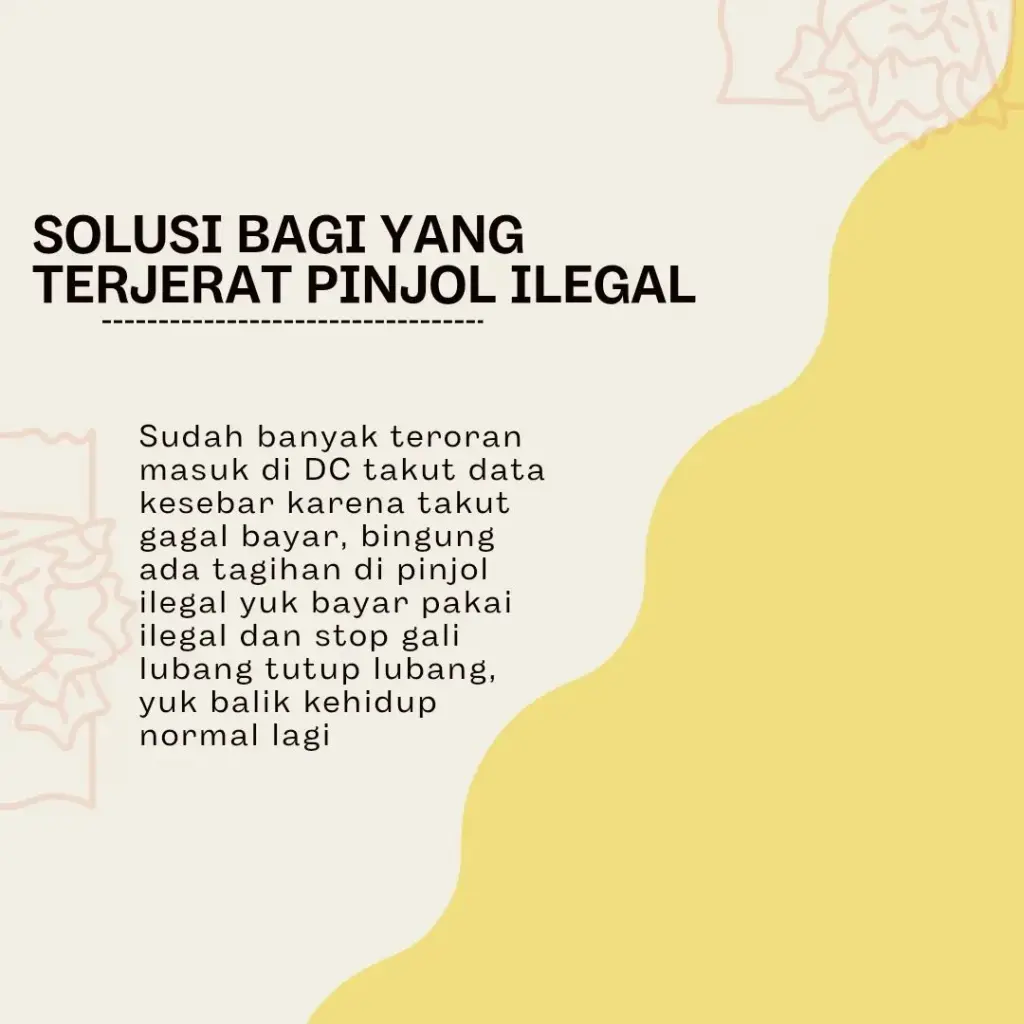
A jockey’s Instagram post. The headline says: “A solution for victims of illegal lenders.”
This is where the “jockey” comes in. “Are you tired of wiping out your salary in order to gali lubang tutup lubang?” one jockey asks on Instagram.
These people advertise their services on social media and invite their would-be customers to join Telegram groups, where the benefits of their services are laid out. Their claim: They will provide the cash needed to repay one’s loans in full within hours or even minutes.
The jockeys regularly share screenshots of WhatsApp messages of what they call “real” testimonies from “real” customers, which are impossible to independently verify. Each message follows a set template: a photograph of a thick stack of rupiah notes followed by profuse thank-yous.
Tech in Asia reached out to the administrators from two different jockey Telegram groups. However, instead of engaging in conversation, both administrators’ accounts sent what appear to be autoreplies.
One autoreply sets out seven different packages, ranging from 10 million rupiah (US$642) for “Package 1” to 90 million rupiah (US$5,780) for the “VVIP Package.” Above each amount is the jockeys’ commission fee, which ranges between 8% to 9% and should be paid upfront.
A net good?
Stay ahead in Asia’s tech landscape
This is premium content. Subscribe to read the full story.
For the many Indonesians drowning in a pile of debt, there is a solution – albeit a shady one.
We know this is not ideal. ⌛ Sign up in 20 seconds. Cancel anytime.
Our subscriber community includes professionals from these companies:





Stay updated on the go with our mobile app.
Get latest insights with smoother, more personalized experience through TIA mobile app.