 Steven Millward · · 6 min read
Jiepang CEO, David Liu, Talks Check-Ins and Strategy [INTERVIEW]
 Jiepang.com launched in May of 2010, and within a month was already gaining traction, as quite a number of China’s smartphone-toting youngsters jumped at the chance to ‘check-in’ and ‘shout-out’ – sharing their offline activities (the shops, bars, and restaurants that they’re at) with their online buddies. (See my review of Jiepang and its apps).
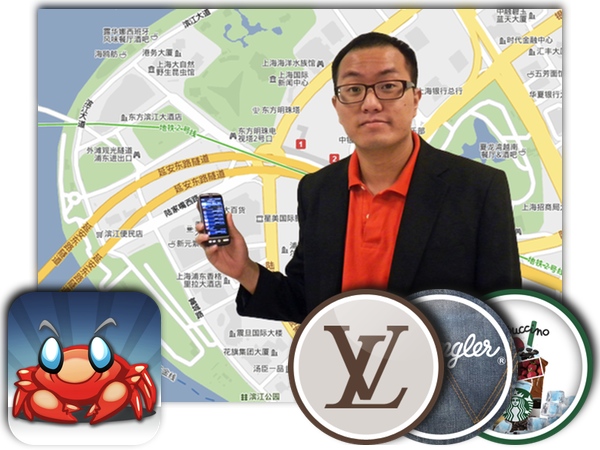
A few days ago, Jiepang’s CEO and founder, David Liu (pictured, above), took some time to talk with me over the phone from Beijing HQ, to talk about their users’ needs, brand tie-ups, testing out NFC, and working with China’s tech giant, Tencent.
“We’re all about offline”
David Liu, originally from Taiwan, moved to mainland China in 2009, and connected with some Beijing friends that he knew from Taipei or Silicon Valley, to work on a new project. When Jiepang took off just a few months after its launch, he and co-founder Yuan Cheng decided, in David’s words, “it was time to focus”, and so the location-based-service (LBS) and social-network got moving, and made a bunch of mobile apps for their service. A short time later, and the inevitable media moniker ‘China’s Foursquare’ meant that Jiepang was getting some global attention, too.
David set out, with Jiepang, to make “a utility for your offline life … to say ‘I’ve arrived!’ at a place”, and “to allow people to share that”. It was being done already, sort of, on Kaixin001.com or RenRen.com – but, David notes, “sharing [your location] wasn’t fun before. On Kaixin you had to type it all out. So we wanted to help people check in faster, with no typing.”
After first hitting on the LBS idea, David and his team did their homework – “I feel China’s young people are more open and transparent now. They’re growing up with social-networking. So they’re ready to share where they are. In the beginning, we held a focus group of 30 to 40 people, and 80% of them said, ‘Yes, we’re sharing our location already on Kaixin’.” So, the course was decided, and the project was set to be China’s first – and biggest – LBS. David points out, “We say ‘We’re all about offline’, because we’re not forcing people to do different things – we’re just helping you to show what you’re doing normally, and we want to make it more fun.”

Connecting Users with Brands. And celebrities…
Being based in Beijing, it’s not too much of a surprise that most of Jiepang’s users are in mainland China: 95 to 98% of them, in fact, with most of the rest in Hong Kong, Taiwan or Macau (ie: the Greater China area). So, how are users engaging with Jiepang itself? David Liu says, “Our user-base is very mobile. The iPhone and Android apps make up just over half of users’ usage. And then a hardcore segment of users will use the website too.”
That’s quite impressive to see so many people using the hottest smartphones. Little wonder that brands – from Wrangler to Louis Vuitton, IKEA to Starbucks – are keen to get into the lives of these users via their Jiepang check-ins, and perhaps even persuade people to come especially into their store thanks to a Jiepang promo. “We’ve partnered with over 300 brands,” says David, “and right now we’re proud to be working with Burberry and Louis Vuitton, and even have special pages up on Jiepang [see the LV page, bottom] for the special occasions, which are Burberry’s fashion show and LV’s exhibition in Beijing.
What do users, and brands, get from all this, I ask? “For brands,” says David, “it’s to extend their personalities; and for users it’s to get a virtual badge [see the LV, Wrangler, and Starbucks badges in the image, top], maybe it’s a limited-edition badge. It’s not really about material benefit – it’s exciting to collect and show.”
A new area for Jiepang is to connect users with celebrities, and by extension whatever brands they’re promoting. It’s something that Sina and Tencent Weibo, too, have done so well since inception (better than Twitter has, for sure) – getting people to engage with specific brands or celebrities that interest them. “At the moment,” says David, “we’re experimenting with celebrities – partnering with celebrity’s venues, such as their own stores, campaigns or events. For example, Jay Chou [Taiwanese pop star] has a fashion shop and an Italian restaurant in Taipei, and they’re really popular check-ins.”
As for getting China’s hottest stars to share their check-ins on Jiepang, David concedes that probably won’t happen – “Celebrities won’t share their locations, I guess”.






Stay updated on the go with our mobile app.
Get latest insights with smoother, more personalized experience through TIA mobile app.







📅 Upcoming Events
22 October 2026
Payoneer x CSPN Summit 2026