 Steven Millward · · 3 min read
Report: As Burma Improves, China is Now Asia’s Worst Net Freedom Offender
American NGO Freedom House compiles a report every year on violations occurring on the web. Its new Freedom on the Net 2012 study shows shifting trends in the Asia Pacific region as the reforming Burma cleans up its act a lot. That leaves China as the worst net freedom offender in the region, performing even worse than it did last year.
China’s score went up from 83 to 85 – and going up is not good. That means there were even more limits on web access and violations of users’ rights on the web. Burma’s dropped from 88 to 75 in a year in which it opened up to gradual reform, even releasing the political prisoner Aung San Suu Kyi and allowing her to take an elected seat in parliament.
Indeed, China is now the third-worst in the world in terms of freedom of usage and expression on the net, behind only Iran and Cuba in first and second respectively. Note that North Korea is not listed. In Asia, Vietnam’s web tightened, while Indonesia’s improved slightly.
Here’s the graph just for Asia:

The report notes the paradoxical approach to the web in China, wherein the nation has a massive, thriving and very competitive internet industry – including social media like Sina Weibo – but it very tightly controlled at a number of levels. It continues:
This paradox was especially evident in 2011 and early 2012. On the one hand, the Chinese authorities further enhanced an already sophisticated and multilayered system for censoring, monitoring, and manipulating activities on the internet, while abducting or imprisoning dozens of activists, lawyers, and bloggers. The scale and speed of the censorship effort — particularly the use of tens of thousands of human censors to identify and delete social media posts — was remarkable.
One academic study reviewing censorship across nearly 1,400 blog-hosting and bulletin-board platforms in China estimated that 13 percent of posts were deleted, many within 24 hours of a particular term becoming sensitive or indicating collective action potential. Such controls contributed to the Chinese internet increasingly resembling an intranet. Many average users, isolated from international social media platforms and primarily exposed to a manipulated online information landscape, have limited knowledge of key events making news around the globe, including the publication of diplomatic cables by the anti-secrecy group Wikileaks or anti-government protest movements sweeping the Middle East.
The China section is massive, running from pages 126 to 151, so we encourage you to get the full report from the link below.
On the known offenders, Freedom House notes:
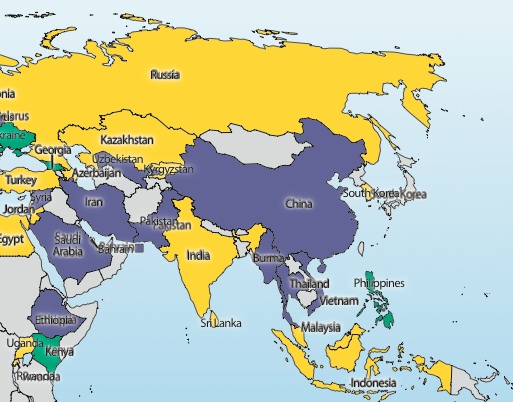
Green = Free; Yellow = Partially Free; Purple = Not Free. Click to enlarge





Stay updated on the go with our mobile app.
Get latest insights with smoother, more personalized experience through TIA mobile app.







📅 Upcoming Events
22 October 2026
Payoneer x CSPN Summit 2026