 C. Custer · · 4 min read
What Alibaba’s investments say about its plans for the future
Photo credit: Alibaba
Alibaba has grown from the plucky startup taking on eBay to China’s most dominant ecommerce player, and one of the most valuable companies in the world. But where does it see itself in the future?
The company’s made plenty of statements about its aspirations, but talk is cheap. If we really want to understand how Alibaba sees its future, it makes sense to take a look at where Jack Ma’s company is investing its money.
The following chart offers a breakdown of Alibaba’s startup investments to date, both by industry category and by country of origin, using data from our own Tech in Asia funding database. Note that these charts reflect the total number of investments in each category or country, not the amount invested, since most of Alibaba’s startup investments are made in tandem with other investors and the specific amount Alibaba put into the deal typically isn’t disclosed.
Note: these charts reflect only investments made by Alibaba itself, and do not include investments made by Alibaba spin-offs or partner companies like Ant Financial or Cainiao.
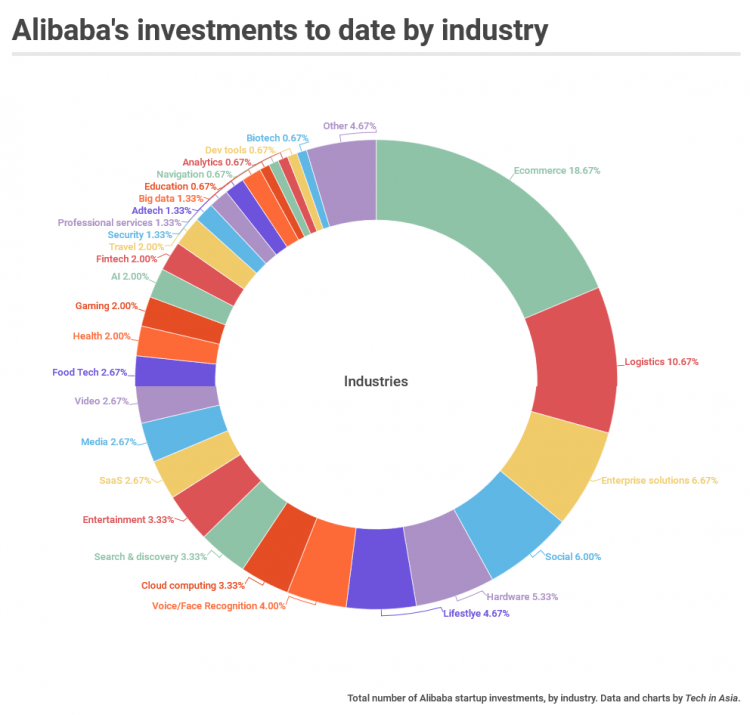
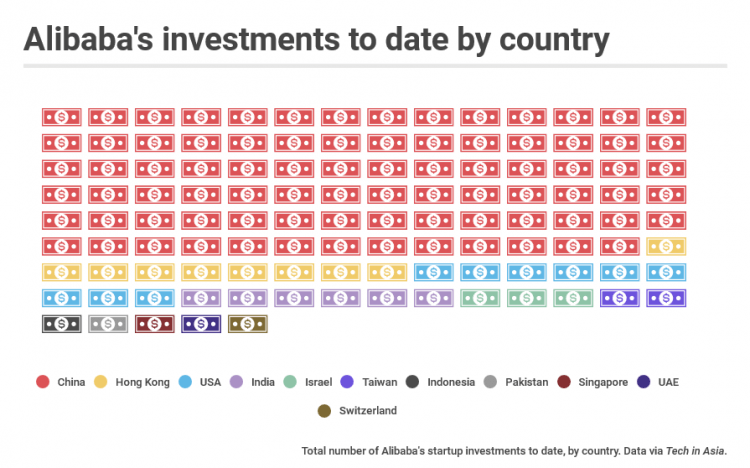
Clearly, Alibaba’s biggest priority is holding its home turf: online shopping in China. The vast majority of its investments to date have gone to China-based startups (over 70 percent, and nearly 80 percent if you include Greater China regions Hong Kong and Taiwan) – and its favorite industries to invest in, ecommerce and logistics, have direct relevance to its existing ecommerce business.
And while those charts reflect total deal numbers over Tech in Asia’s entire historical database, looking at deal size in more recent years doesn’t suggest a major change in direction. If you look at the five biggest rounds Alibaba participated in in 2016 and 2017, for example, you find a pretty similar pattern. Six out of those ten investments were in Chinese firms, and most of them were focused in industries relevant to Alibaba’s core ecommerce business.
Aside from US VR firm Magic Leap, Lazada and Tokopedia were the only foreign companies to make the list. And in China, most of Alibaba’s money went to companies with some relevance to ecommerce and delivery, including investments in Sun Art (a retail grocery chain company), Intime (another brick-and-mortar retailer), and Ele.me (food delivery app).
If you break those deals down by the total amount funded, Chinese firms were the clear winners, with US$12.8 billion raised. Indonesian firms were next, with US$3.1 billion.
And if you break the money distribution down by industry, again, ecommerce-relevant investments came out on top, with over US$10.8 billion of the US$16.5 billion total. Of course, those numbers are based on the total investments announced; we don’t know how much Alibaba specifically contributed to most of these deals.
What this year holds in store





Stay updated on the go with our mobile app.
Get latest insights with smoother, more personalized experience through TIA mobile app.











📅 Upcoming Events
22 October 2026
Payoneer x CSPN Summit 2026