This article was republished with permission from VC Cafe.
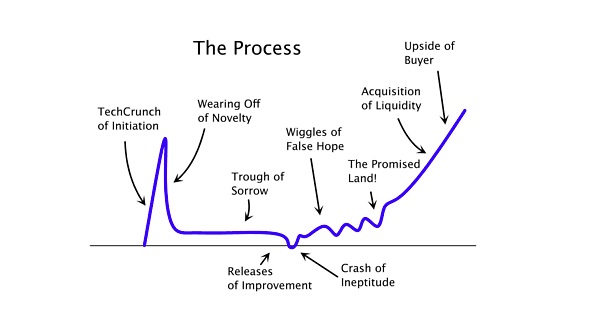
Paul Graham’s Startup Curve – avoid the “through of sorrow”!
Pinterest, Facebook, Zynga, Dropbox, AirBnb… What do they all have in common? They’ve all used growth hacking techniques to grow their user base from zero to millions (and sometimes hundreds of millions). Growth Hacking isn’t viral marketing (although viral marketing is part of it).
Growth Hacking comes to solve a very common problem in consumer startups: getting to the first x thousand/million users quickly once the product has launched and the hype has passed.
The term “Growth Hacking”, invented by Sean Ellis, and made popular by Andrew Chen, a Silicon valley marketer and entrepreneur, is a combination of two disciplines – marketing and coding:
Growth hackers are a hybrid of marketer and coder, one who looks at the traditional question of “How do I get customers for my product?” and answers with A/B tests, landing pages, viral factor, email deliverability, and Open Graph. On top of this, they layer the discipline of direct marketing, with its emphasis on quantitative measurement, scenario modeling via spreadsheets, and a lot of database queries. If a startup is pre-product/market fit, growth hackers can make sure virality is embedded at the core of a product. After product/market fit, they can help run up the score on what’s already working.
In a recent post, TechCrunch defined the three characteristics of a Growth Hacker as follows:
Growth hackers have a common attitude, internal investigation process, and mentality unique among technologists and marketers. This mindset of data, creativity, and curiosity allows a growth hacker to accomplish the feet of growing a user base into the millions.
First Steps in Growth Hacking for Startups
1) It all starts from the Growth Hacking Funnel.
In the early stages, startups should not just focus on top/bottom line metric like unique users and revenue. They should understand the different states of the user (Acquisition, Activation, Retention, Revenue) and focus on moving users from one state to the next. In a nutshell:
Acquisition: Get people to hear about your product from press, blogs and social channels. Creating searchable content that is original and interesting, increases the chances of users sharing your content and blogs picking it up as interesting stories.





Stay updated on the go with our mobile app.
Get latest insights with smoother, more personalized experience through TIA mobile app.