Bernard Leong · · 3 min read
Interesting Lessons from Stanford Entrepreneurship Podcast Series I
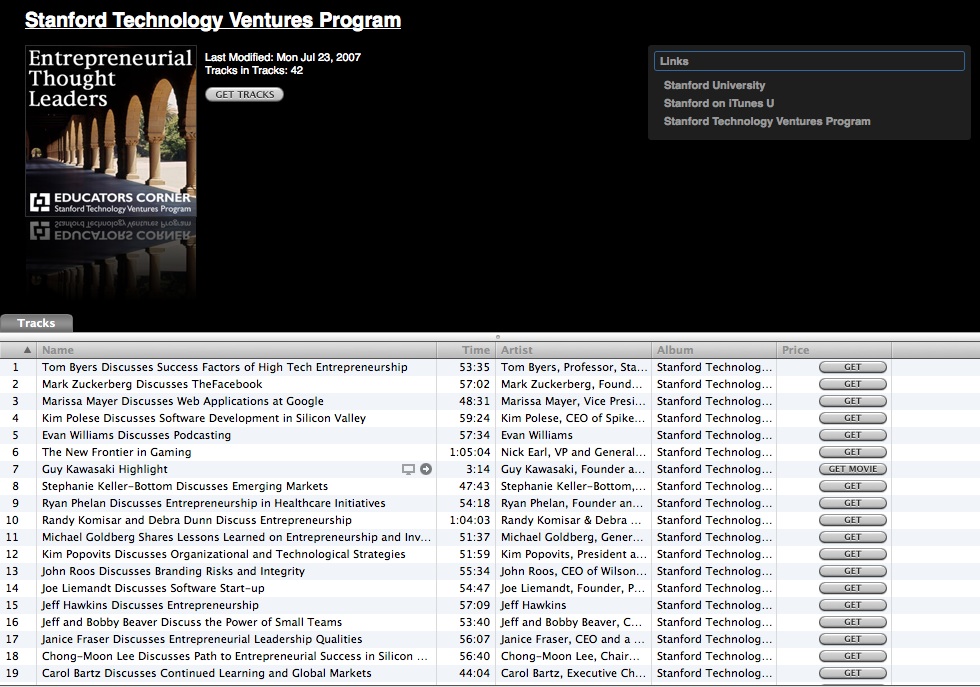
Lately I have spent some time to continue my learning by listening to podcast from the ITunes Stanford University. The series “Stanford Technology Ventures Program” and “Business Leaders and Entrepreneurs” will be of interest to those who want to know more about the trials and tribulations of both investors and entrepreneurs. I found some interesting lessons on customer service and what it means to be an entrepreneur from Tina Seelig (Executive Director for the Stanford Technology Ventures Program) and Greg Ballard (Glu Mobile).
Learning is a lifelong process. Whether you are an investor or an entrepreneur, you might find some of the lessons here interesting for your own entrepreneurial ventures:
- “Don’t save money on toilet paper, peanut butter and customer service”: Greg Ballard took the saying from his mother and added the customer service. He spoke about two interesting incidents where he tried to cut costs on customer service and ended up in disaster, particularly, the one where he outsourced an entire operation from Oregon to India, and realized that the workers are not trained and worse, it was a peak period where the workers cannot cope. So, why do I think that this lesson is interesting? In Singapore, some companies don’t really care about customer service and they suffered a backlash when they engaged themselves in acts that provoked a backlash. If you want a good example, just take a look at Odex, when the customers were unhappy about the sub-standard quality of the translation in the anime and not to mention the PR disaster unleashed from their lawsuits.
- An interesting way to teaching entrepreneurship: Tina Seelig told the story how she was teaching entrepreneurship to a group of design students. She gave the assignments in envelopes and passed it to the groups of student. In each envelope, there is a US$5 dollar note, and their assignment is to make money with that initial investment for the next few days after the start of the week. In the coming week, they have to present on just one powerpoint slide with the following information: (i) the profit and loss and (ii) how they made the money. Interestingly, the groups made money from US$200 to US$650. As for how they do it, I am seriously surprised on the kind of solutions that the groups come up with. One important lesson from this exercise is that the entrepreneur needs to identify the market opportunity. In Singapore, I still think that a lot of people who are aspiring entrepreneurs, do not catch the point. They work on the solutions rather than identifying the problem. The way she put it which I thought was elegant: only when you have a problem, you have a solution and with that solution, you create a company and it’s that simple. This is what I am thinking, if I try the same idea on a group of students in Siingapore, how will that work out? I leave that to your imagination.
I do urge that if you have iTunes on your computer, you should take some time out to listen to these podcasts and I believe that it might open up your thinking more.





Stay updated on the go with our mobile app.
Get latest insights with smoother, more personalized experience through TIA mobile app.