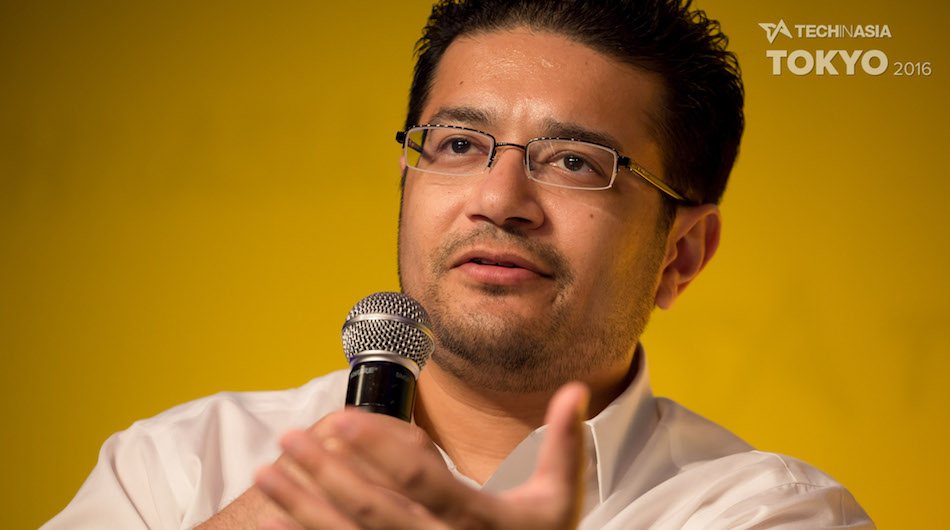
Garena president Nick Nash talks about how the company grew into one of Southeast Asia’s biggest tech firms. Photo credit: Tech in Asia / Michael Holmes.
“An army.”
That’s one secret weapon that helped Garena grow into a US$3.75 billion company – as of last count – and perhaps the most valuable in Southeast Asia, the company’s president Nick Nash told the audience at Tech in Asia Tokyo 2016.
Nick explained what he meant. “It’s a ground force of over 2,000 people – country by country – who are helping us market to real customers, real users, to villages and towns.”
Garena went from village to village, town to town.
Likening the Singapore-based company to its long-term investor Tencent of China, Nick said Garena started in 2009 with a chat platform, which later evolved into a content and game delivery business and today accounts for most of the company’s revenue. In 2014, it launched a payment service called AirPay and a year later came its ecommerce marketplace Shopee.
Garena’s annual revenue surpassed US$300 million last year – a figure equivalent to a “compound annual revenue growth of about 90 percent over the past five years.”
All of its business units have recorded stellar figures. The Garena platform has over 45 million users, who engage for 1.6 billion hours a month. Nick reported that AirPay just exceeded US$510 million in annualized transaction volume last month, while Shopee has gone from literally nothing to over US$1.3 billion in annualized gross merchandise volume (GMV), which is basically how much shoppers spent, in the past 14 months.
Nick said an army was key in building the Garena empire, starting with cyber cafes that amassed loyal customers over time.
“To organize cyber cafes required an army ‘cause you literally had to go village by village, find the owner of a cyber cafe, knock on his door, explain what we do for a living, and encourage him to sign up for our management services, which basically run almost 75-80 percent of cyber cafe screens in places like Indonesia, Thailand, and Vietnam from a central network.”
Nick was talking about the Garena Cybercafe Alliance, which lists member cafes in a directory that Garena players can access. These cafes are selected as venues for Garena events and tournaments. Garena charges the cyber cafes a nominal fee in exchange for their business being run more smoothly and getting support in IT and billing.
If his team had sat behind their desks in Singapore and advertised on Google or Facebook, they would have acquired just 5 percent of the cyber cafes currently in their network and for a higher cost, Nick opined. “With an actual face-to-face direct strategy, our cost was exponentially lower and our penetration, engagement, and satisfaction are proportionally higher.”
He said the “army” approach is a proven strategy and one that’s been used by some giant companies like Unilever. “The Unilevers of the world had done a superb job of using field forces to go to market – whether it would be to put soaps or ice creams in the storefronts. In our case, very early on in the game, having cyber cafes as distribution points was a critical competitive advantage.”
“Having an army is an enormous competitive weapon,” he stressed.
Diving deep into Southeast Asia





Stay updated on the go with our mobile app.
Get latest insights with smoother, more personalized experience through TIA mobile app.








📅 Upcoming Events
22 October 2026
Payoneer x CSPN Summit 2026