- Premium Content It takes our newsroom weeks - if not months - to investigate and produce stories for our premium content. You can’t find them anywhere else.
 Jofie Yordan · · 7 min read
Indonesia’s social commerce startups double down on rural FMCG space
A flurry of Indonesian social commerce players secured new funding in the first half of this year, just before global macroeconomic conditions deteriorated.
One player appears to be leading the pack: Super raised US$70 million in a series C round led by NEA, with participation from SoftBank Ventures Asia, DST Global Partners, B Capital, and Insignia Ventures Partners. With this fundraise, Super has amassed US$105 million in total to date – the highest among Indonesian social commerce startups.
But of course, it is far from the only one. Fellow social commerce startups RateS, Raena, and Dagangan have also secured funds.
While social commerce has distinct subtypes, investments in Super and Dagangan in particular underscore how Indonesian ecommerce is increasingly shifting to lower-tier cities and rural areas. Both companies focus on fast-moving consumer goods (FMCG), which are still undersupplied in these places because of issues like logistical difficulties.
The potential is clear. The country’s FMCG market is estimated to be around US$50 billion. As Super CEO Steven Wongsoredjo notes, more than 30% of Indonesia’s gross domestic product (GDP) comes from Kalimantan, East Java, and east Indonesia – underserved areas that are a key focus areas for the company.
Battling for rural
Compared to ecommerce heavyweights whose services are available across the country, these social commerce players operate in certain areas spread across various cities and provinces. This keeps some of them from directly battling each other on the ground – for now, at least.
For instance, Super currently operates in 30 cities across East Java and South Sulawesi. It primarily targets areas that have a GDP per capita of US$5,000 or lower. In comparison, Jakarta’s GDP per capita is around US$19,000 while Surabaya’s is about US$14,000.
Super is now eyeing an expansion to Kalimantan, Bali, West Nusa Tenggara, East Nusa Tenggara, Maluku, and Papua over the next few years.
The primary concern when operating in such areas is the inadequacy of the distribution network, which in turn increases the prices of goods. Since many rural areas are so remote, local roads aren’t even big enough for delivery trucks. Many products are shipped directly from major cities like Jakarta and others in western Indonesia, Wongsoredjo adds.
Social commerce players operate warehouses or hubs or microfulfillment centers, whether on their own or in partnership with third parties. These facilities work in combination with the social aspect through agents or resellers, many of whom are local community leaders.
By grouping orders in bulk, these companies can get cheaper prices from principals. The savings are then passed on to consumers.
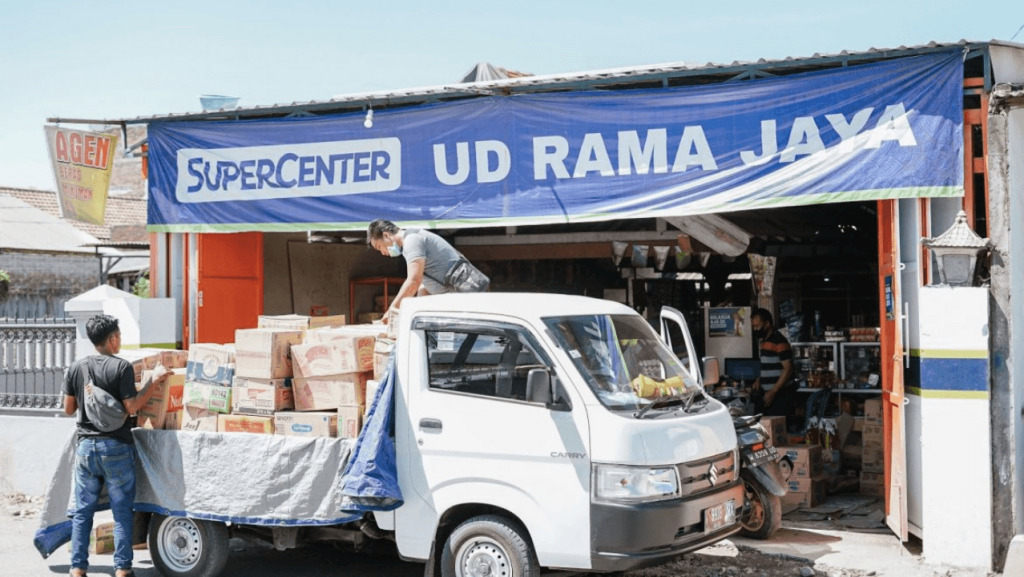
One of Super’s hubs in East Java / Photo credit: Super
Competing with conventional players
Stay ahead in Asia’s tech landscape
This is premium content. Subscribe to read the full story.
While several players including Super and Dagangan have raised fresh funds, others have fizzled out.
We know this is not ideal. ⌛ Sign up in 20 seconds. Cancel anytime.
Our subscriber community includes professionals from these companies:





Stay updated on the go with our mobile app.
Get latest insights with smoother, more personalized experience through TIA mobile app.












📅 Upcoming Events
22 October 2026
Payoneer x CSPN Summit 2026