Paul Bischoff · · 8 min read
TalkPush crushes the competition at Tech in Asia Tour Hong Kong
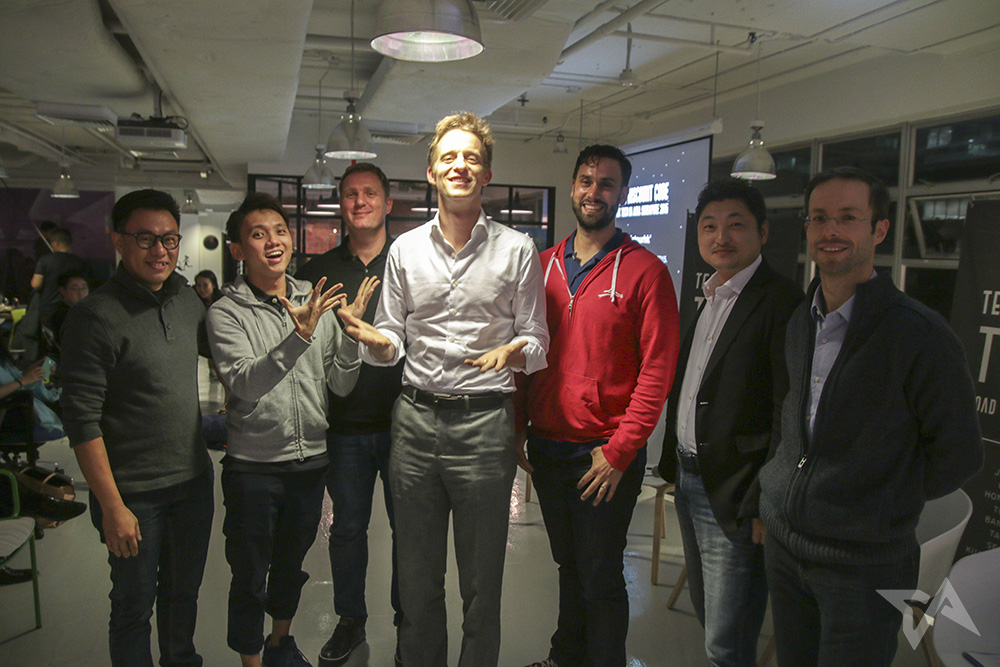
Talkpush founder Max Armbruster basks in the light of victory at TiA Tour Hong Kong.
Very few startups in Hong Kong solely target the Hong Kong market. It’s just too small. Similar in many ways to Singapore, most startups here are multinational from day one.
"Test it here, then scale it out," was the mantra echoed by Simon Squibb, CEO of Nest Investments and judge at yesterday’s Tech in Asia Tour at the recently launched Blueprint co-working space. While Hong Kong isn’t typically listed as one of the world’s great startup hubs, it does have a vibrant community of smart and innovative entrepreneurs working hard every day to go global. And when it comes to funding, Squibb explains people tend to believe the grass is always greener on the other side of the fence: "Everyone thinks their own market is hard and everywhere else is easy."
Also much like Singapore, Hong Kong exists in somewhat of a vacuum. Willson Cuaca, managing partner at East Ventures and also a judge at the event, says, "In Singapore, everything is a best case scenario," meaning the market has strong internet penetration, disposable income, good logistics infrastructure, etc. "Outside of Singapore [in other Southeast Asian countries], everything is a worst case scenario." It’s much more difficult to run startups there. (Disclosure: East Ventures also invests in Tech in Asia. See our ethics page.)
With those factors in mind, Squibb and Cuaca were joined by Tytus Michalski, managing director at Fresco Capital, Vinnie Lauria, founding partner at Golden Gate Ventures, and Takeshi Ebihara, founding general partner at Redbright Partners to listen to pitches from seven startups vying for a free trip to Tech in Asia Singapore 2015 on May 6 and 7. Talkpush ultimately took home the grand prize, which includes flight, accommodation, event passes, and an exhibition booth for two team members.
Here’s a wrap up of each startup and the judges’ thoughts on each.
Talkpush

For a single job opening in the service industry, employers receive about 250 resumes, which they then narrow down to about 12 interview candidates. Employers simply don’t have the time nor resources to interview everyone. Talkpush enables recruiters and HR departments to sift through potential candidates more quickly. A candidate receives an SMS after they apply inviting them to call in or answer questions on a mobile app. They then answer a series of pre-recorded job-specific questions. They can do this at their leisure, since no one has to be on the other end of the line. Their answers are recorded and stored in a dashboard online for the person doing the hiring to listen to the interviews.
Talkpush already has a few paying customers in the Philippines, its initial market, where it is currently targeting call centers.
It’s working on other ways to filter out candidates through speech recognition. For instance, candidates who speak faster probably have better English and are better candidates for call centers. Employers could theoretically filter by candidates who use specific words, as well. Video capability is also in the pipeline.
The startup was clearly the most well-received by the judges, who were hungry for more information about Talkpush’s capabilities. The only concern came from Squibb, who says he would be worried about his own exit if the company chooses to go it alone rather than be acquired by something bigger like LinkedIn. Talkpush aims to raise a series A round by the end of this year, after which it hopes to expand to India and other developing markets.
Notey
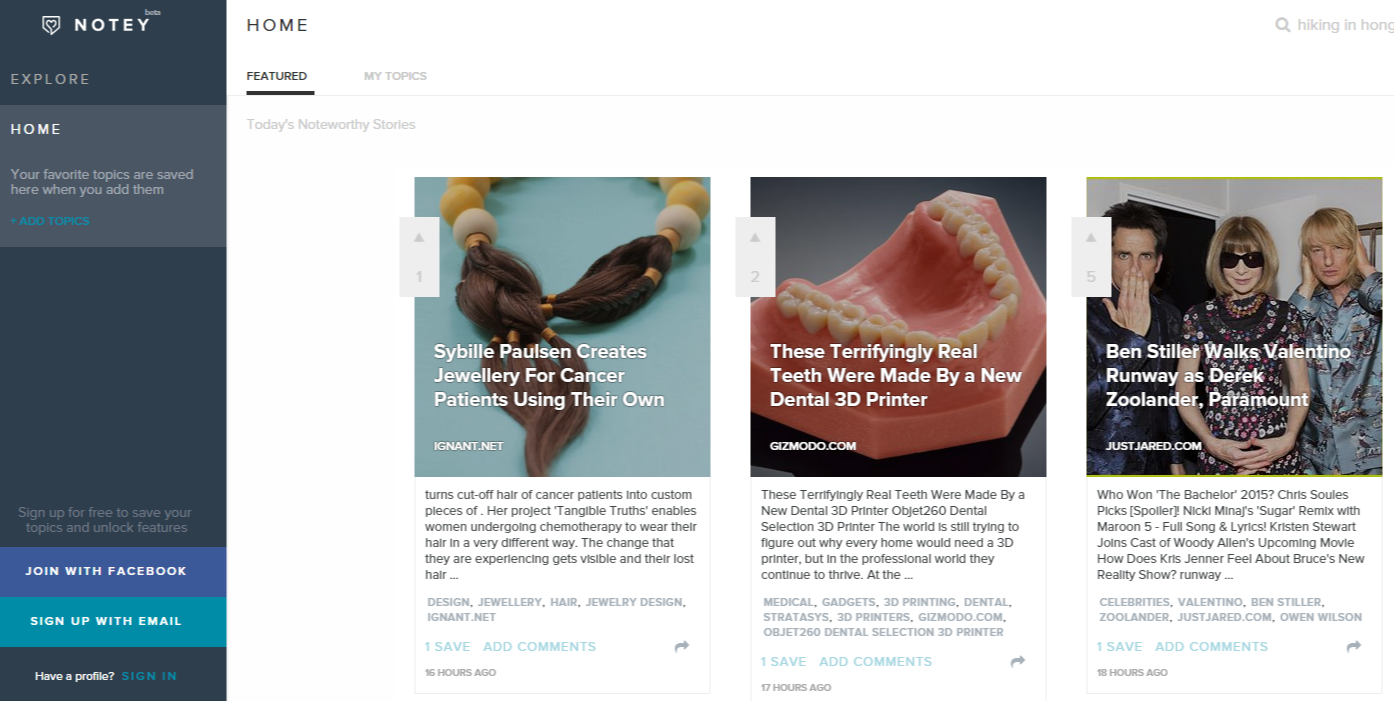
The internet is home to 150 million blogs, and 400 million people around the world read them. Notey is a slick-looking search engine tailored especially for the blogosphere, returning a tiled list of blogs based on your search with previews of each one. Notey cuts out the annoying listings pages and corporate sites that often show in Google, which often appear as a result of SEO optimization and not for their content. The founders didn’t reveal user numbers, but they point out that Notey is doing well SEO-wise, ranking high in Google search results and giving users the content they are actually searching for.
Notey demonstrates Google’s inadequacies with this example: if you Google "travel blog", not a single actual travel blog actually shows up. When I tested this out myself later on, this wasn’t exactly true; four out of the top 10 search result were indeed travel blogs. But point taken, there’s still a lot of stuff in there that I’m not actually searching for. Lauria said that example is misleading, though, because no one actually searches for "travel blog." They search for specific keywords, like "dim sum in Hong Kong."
Notey’s indirect competitors include discovery platforms like Pinterest and RSS readers like Feedly, but it has no notable direct competitors using the same model. Michalski argues that the competitive dynamics weren’t completely expanded upon, however, and Ehibara wasn’t convinced of Notey’s core value.
The startup has raised US$1.6 million in seed funding and is currently in discussion for a US$5 million series A. One of its seed investors includes former Android VP and now Xiaomi head of international Hugo Barra. On a side note, half of the Notey team is female.
Cafe X Technologies
Cafe X Technologies combines an app and a kiosk with a robot barista so that customers can order a cup of joe in advance and pick it up on the go. The kiosk, which uses a robotic arm to prepare the coffee to the customer’s specifications, can serve four people at one time and is completely automated. The team also emphasizes the quality of their coffee, focusing on efficiency, freshness, and variety. The founders are adamant that it’s not just a vending machine – it’s a robot barista.
Cafe X will launch its first kiosk at Hong Kong University in August and aims to be in 10 locations by the first quarter of 2016.
The founders began their pitch talking about the app, so when they suddenly jumped to the robotic barista, judges felt a bit thrown off. Most agreed that Cafe X should narrow their focus, either on the app or on the hardware. They used too little time to explain the kiosk, which seemed to be the main selling point of the company. Michalski says for him, it ultimately comes down to the quality of the coffee.
Librika
82 percent of people listen to music every day, and 84 percent of them don’t understand the lyrics, claims the founder of Librika. As a result, millions of people search for translations online every month. In comes Librika, a mobile app that works similar to Soundhound or Shazam. Play the music into the microphone, and it will identify the song and present you the translated lyrics in your preferred language. The lyrics are pulled from n database API owned by a partner company, with which it will share revenue. Librika aims to have 2.5 million users in one year.
To monetize the app, Librika will offer some sort of paid premium version, but the founder didn’t have much time to extrapolate on that point. Judges were concerned it wouldn’t get much traction as a native app. Lauria suggested it would be possible to make a plugin for Spotify, but this would be even harder to monetize.
Life Project
Life Project runs a series of specialty online stores, including one for pets, one for infants, and one for food and wellness. It specializes in niche products which are difficult to find or would otherwise need to be imported. It manages its own stock and warehouse, and has conducted US$900,000 worth of sales since 2012. It relies heavily on repeat customers, who make up 75 percent of those sales.
Squibb says he has actually tried the pet estore, but ultimately switched back to another one because it was cheaper. He doubts Life Project’s competitive advantage, especially when there are so many other ecommerce options out there. Other judges echoed his sentiments, saying that this business is not only difficult to scale, but it would be difficult just to survive. And because of Life Project’s procurement and warehousing scheme, customers often don’t know until after they’ve ordered something if it’s out of stock or not.
ActiMirror

ActiMirror looks like a dark mirror when it’s dormant, but once activated, it becomes an interactive video display. Body motions, face recognition, and RFiD in physical products can all initiate a targeted advertisement for the customer. And because it’s a mirror, people will be naturally drawn to it to check themselves out.
Beyond the hardware is a data analytics engine that collects customer data. ActiMirror already has a few clients who wish to advertise through its platform, including luxury brands like Cartier.
Unfortunately, a product demo failed to wow the judges, who wanted a better explanation of actiMirror’s core intellectual property. Michalski noted that the user experience didn’t make him want to buy the product, which in this case was a toy car. Others worried that this was not an original idea and there is too much competition in the market.
Brand Pit
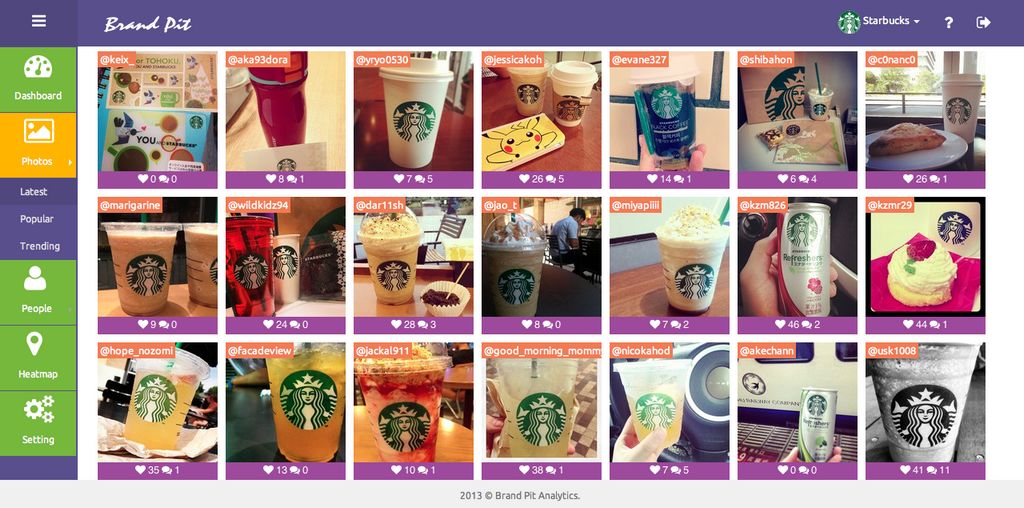
1.8 billion photos are posted on social media every day, and over 80 percent of them are not hashtagged, according to Brand Pit’s founder. As a result, text-based analytics of social media "sucks." Brand Pit uses image recognition to run analytics for brands on social media. For example, Starbucks can sift through all the Instagram photos in Japan to find where their logo is popping up most and who is posting it. Brands pay a subscription to see not only how they are performing, but also how competitors are performing. Brand Pit’s image recognition technology is specifically made for low-resolution social media photos. And because it uses images instead of text, Brand Pit is language-agnostic.
While Brand Pit crushed the pitch, the co-founder struggled through the question-and-answer session with the judges. She explained the biggest pain point for Brand Pit is processing power, which requires more servers than text-based analytics. As a result, analytics cannot currently be run in real time.
Cuaca says he’s seen Brand Pit win several awards and participate in many competitions, and yet the startup has still not received funding, so something doesn’t add up. He says a company with this model doesn’t need to be pitching at competitions and should instead be focused on acquiring customers.
Stay updated on the go with our mobile app.
Get latest insights with smoother, more personalized experience through TIA mobile app.
Recommended reads
 Indonesian AI startup goes global
 Forrest Li on scaling Sea, building smarter bots, and founder grit
 An AI assistant that joins sales calls and scores team skills
 Beyond the check: Why VCs need more than capital
 SGX’s CEO says it doesn’t need a unicorn to win
 SMEs want AI too, but not the kind Big Tech is selling
 Oatside’s alt-milk rise hits a profitable gear
 Alibaba’s financial health in 12 charts
 Asia’s telcos bundle AI into mobile plans. Will it pay off?
 M-Daq chases bigger clients as revenue falls, losses grow





Editing by Steven Millward
(And yes, we’re serious about ethics and transparency. More information here.)