Samantha Cheh · · 7 min read
MDEC is powering Malaysia’s goal to become a major digital player in SEA

Though not as well-known as its neighbors Singapore and Indonesia, Malaysia has made a name for itself as the birthplace of some of Southeast Asia’s business success stories, from tech wunderkinds Grab and Jobstreet to industry leaders like AirAsia.
“Kuala Lumpur has the ecosystem to bring out potential unicorns,” says Gopi Ganesalingam, vice president for Malaysia Digital Economy Corporation (MDEC)’s Digitally-Powered Businesses Division.

Gopi Ganesalingam, vice president for MDEC’s Digitally Powered Businesses Division / Photo credit: MDEC
This sentiment is shared by Startup Genome founder and CEO JF Gauthier in a recent interview with Tech in Asia, where he said that Malaysia’s startup ecosystem has the potential to surpass some of those in today’s leading cities. In fact, the innovation policy advisory noted in its 2020 Global Startup Ecosystem Report that the nation’s capital was ranked as the 11th emerging startup ecosystem in the world.
Google’s 2020 e-Conomy SEA report also estimates that despite the pandemic headwinds, Malaysia’s digital economy is set to achieve US$11.4 billion in sales.
Kuala Lumpur’s startup ecosystem has been rapidly growing over the last five years and was valued at US$15 billion in 2020. According to Ganesalingam, Malaysia’s digital economy is by no means small, contributing as much as 19.1% of the country’s overall GDP in 2020 – and it is still growing.
A lack of visibility
But despite the abundance of potential in Malaysia’s startup ecosystem, companies still face numerous challenges. For Ganesalingam, the main one is a “lack of visibility.”
“Malaysia, as a country, [lacks] branding,” he says. “I don’t think we tell our story very well, and when that is not [done properly], your brand is not out there. Nobody knows us; nobody knows Malaysia’s potential and our entrepreneurs.”
Ganesalingam himself shares that there has been ambiguity on the claim of whether Grab was a Malaysian or Singaporean company, though he notes that the company’s Malaysian origins helped it find a problem to solve. The lack of visibility has also resulted in the country’s struggle to retain high-quality local talent, much of which tends to flock overseas.
Malaysia has the potential to take over the region.
Startup Genome’s Gauthier had also noted that the growth of Malaysia’s startup ecosystem has been hampered as well by a local-first mindset, with founders preferring to stay at home instead of looking abroad. This is a mistake, according to the founder, as data has shown that companies that quickly go abroad tend to grow “twice as fast” as their competitors.
Should Malaysian startups start on their goal of regional expansion, the country as a whole could grasp the opportunity to dominate Southeast Asia. Gaulthier believes this opportunity is unavailable to Singapore or Indonesia due to the former being “different from the rest of Southeast Asia,” while the latter’s focus is on capturing its local market. “Malaysia has the potential to take over the region.”
Looking abroad for the future
As a central cog in the Malaysian government’s plans for building a thriving startup ecosystem, MDEC has spearheaded a number of policies and initiatives to champion and lead Malaysia’s digital economy, and position the country as the “Heart of Digital ASEAN.”
“We want talent, because talent builds and attracts more talent. That’s one of the things we are doing,” adds Ganesalingam.
In particular, he highlights MDEC’s Malaysian Digital Hubs program. It aims to spur the growth of local tech companies by partnering with co-working spaces to foster a community where entrepreneurs can network with potential partners, investors, and talent – elements that Ganesalingam says were key to Silicon Valley’s success.
“We look at Silicon Valley with a lot of envy, but we know that we can never reinvent it because it was a product of a unique culture,” he says. “It was a culture of successful people who wanted to create more successful people.”
For Ganesalingam, the digital hubs are a key part of MDEC’s “Land and Expand” strategy, designed to draw foreign entrepreneurs to Malaysia’s shores. Through the program, he explains, foreign entrepreneurs can gain the right to work through the government’s Malaysia Tech Entrepreneur Pass, identify the right talent through a Digital Hub, and engage with MDEC to build their companies.
“[Foreign entrepreneurs can] look at what our country has to offer and, at the same time, look at the ASEAN market through Malaysia’s lens,” he says.
Bolstering local successes
It’s not just foreigners that MDEC is working with. The agency has also had significant success in helping local Malaysian firms get opportunities and resources. For example, its Founders’ Grindstone initiative equips founders with the soft skills to pitch, sell, and grow their businesses.
The agency has also been engaging with Malaysia’s central bank, the state-run firm Penjana Kapital that has a 1.2 billion Malaysian ringgit (US$297.7 million) investment fund, and a High Tech Fund to support startups that have been struggling as a result of the pandemic.
Another way in which MDEC has proven to be an effective champion for local startups is by greasing the wheels of business. Ganesalingam offers the example of how it has helped Soft Space, a fintech that MDEC became interested in because of its innovative technology.
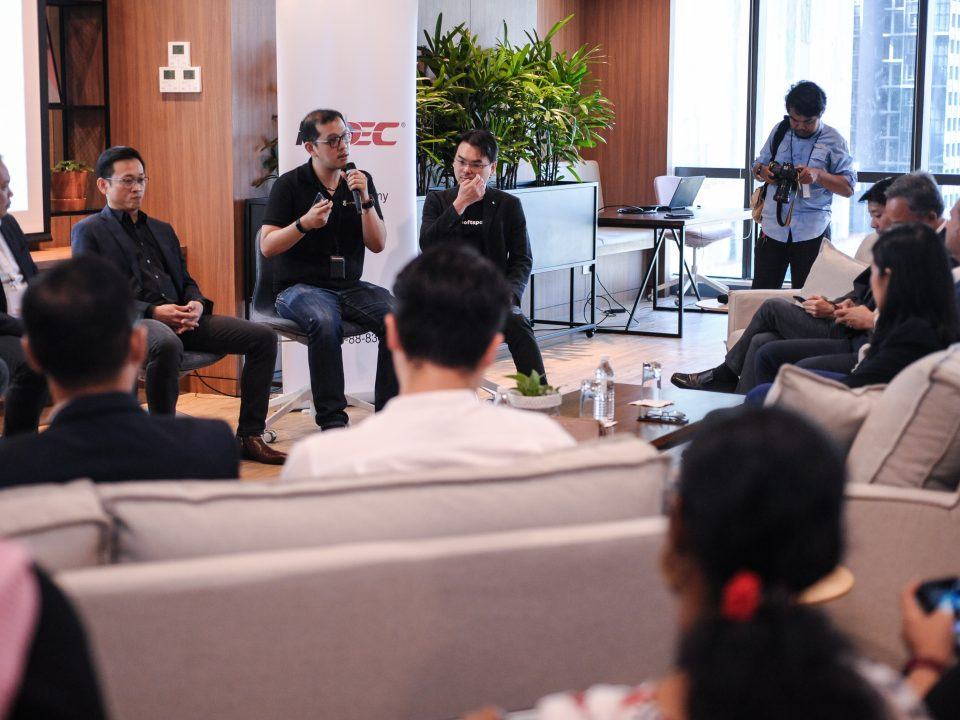
Soft Space CEO Joel Tay (center) at a MDEC GAIN Dialogue and Showcase session. / Photo credit: Soft Space
“We started talking to the company and amplifying what it does, and it got some attention from Japan. That attention turned into serious negotiation for investments,” he shares.
MDEC began strategically promoting Soft Space to the agency’s counterparts in Japan’s export authority JETRO the month prior to the fintech’s business trip to the country in order to boost its appeal to investors.
“In Japan, you need to know the people first. Japanese businessmen or VCs look at JETRO [and] MDEC [to feel] more at ease [about making investments],” he says. “We are not just tech people, we are business people, too. We understand the business language, we understand the game. When a company is supported by a government platform like MDEC or JETRO, it makes things a lot easier to move forward.”
Due in part to MDEC’s intervention and amplification, Soft Space was able to win over Japanese investors. With MDEC’s support, SoftSpace is now ranked 66th out of 1,000 companies by Financial Times and is recognized as a leading fintech player in Asia Pacific, trusted by 24 financial institutions in 10 countries that have adopted its solutions.
“We don’t run the company, but we are the wind beneath its wings,” says Ganesalingam. “If it wants to fly higher, we will provide the support [it needs].”
Creating the right environment
MDEC’s experience with Soft Space is typical of its usual intervention with startups, but the agency also offers more bespoke solutions for companies that need them.
In the case of Aerodyne, an industry-leading drone solutions firm, MDEC was especially instrumental in creating a national drone system to support the segment’s growth.
“Very few people knew what drone technology was all about, but we were able to tell the company’s story,” Ganesalingam says. “When we first identified Aerodyne, there had been no other drone players [yet]. We had to develop a drone ecosystem so as to create more drone players such as Aerodyne.”
MDEC introduced the Dronetech Testbed Initiative to fast-track the growth of the local drone industry and advocated for progressive policies that build collaborative ecosystems and connect players within the community. In January 2020, the agency partnered with the World Economic Forum to co-design and pilot policy principles and regulatory frameworks to accelerate drone technology’s societal benefits as well as mitigate its risks.
Even during the lean times caused by the Covid-19 pandemic, MDEC did not dial down its efforts to support Malaysian startups. In fact, it increased them, responding to the industry’s calls for help by running various online initiatives to connect 100 VCs to 200 startups.
“We had more than 240 companies asking for US$243 million worth of funds and as of October 2020, we were able to 26% of them,” he says. “About US$25 million was closed and dispersed among these companies.”
Ganesalingam notes, however, that even with MDEC’s efforts and support, Malaysia cannot become the star of digital Southeast Asia if there aren’t enough changes done to the country’s rules and regulations, something that Startup Genome’s Gauthier also believes.
“Our rules and regulations need to change as fast as possible because if not, if the frameworks don’t change according to how technology and people are changing, there is going to be a problem for the ecosystem and the country, be it innovation, talent, exports, or foreign direct investments” Ganesalingam explains.
“We have really good companies and we need to bring them to the fore. We have a lot of Malaysian tech mentors who have successfully built global businesses, and they are now paying it forward for the younger ones to also thrive. But we also need international mentors so that our startups can learn what it takes to become global leaders.”
MDEC, with the full support of the Ministry of Communications and Multimedia, aims to continue leading the digital economy toward realizing Malaysia 5.0.
This is focused on three strategic thrusts: empowering digitally skilled Malaysians, accelerating digitally-powered businesses, and attracting digital investments. The agency is committed to rolling out key digital initiatives to ensure the country can fully leverage and benefit from tech innovation and establish Malaysia as the heart of digital ASEAN.
Visit Malaysia Digital Economy Corporation’s website to learn more about its GAIN program.
This content was produced by Tech in Asia Studios, which connects brands with Asia’s tech community. Learn more about partnering with Tech in Asia Studios.
Stay updated on the go with our mobile app.
Get latest insights with smoother, more personalized experience through TIA mobile app.
Recommended reads
 Life’s a game, and AI agents are Animoca’s new play
 Indonesian AI startup goes global
 Forrest Li on scaling Sea, building smarter bots, and founder grit
 An AI assistant that joins sales calls and scores team skills
 Beyond the check: Why VCs need more than capital
 SGX’s CEO says it doesn’t need a unicorn to win
 SMEs want AI too, but not the kind Big Tech is selling
 Oatside’s alt-milk rise hits a profitable gear
 Alibaba’s financial health in 12 charts
 Asia’s telcos bundle AI into mobile plans. Will it pay off?





Editing by Nathaniel Fetalvero and September Grace Mahino
(And yes, we’re serious about ethics and transparency. More information here.)