Leighton Cosseboom · · 2 min read
Indonesian students in remote areas will soon receive tablets to replace textbooks

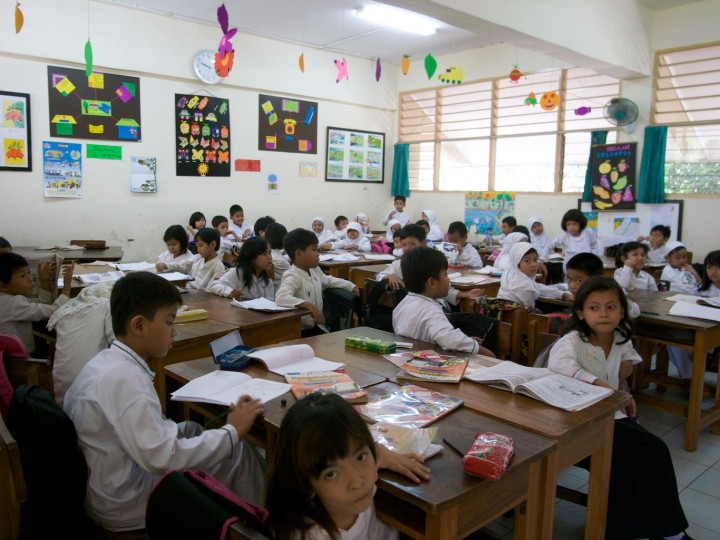
Indonesia has more than 50 million students who need to be educated by about 3 million teachers in the public school system, according to Anies Baswedan, the nation’s minister of education and culture. When a population is as large as Indonesia’s, an important and expensive item on the academic docket is providing textbooks, both used and new.
Yesterday CNN Indonesia reported on a new initiative that aims to replace physical textbooks with tablets and ebooks in Indonesian schools. The tablet they plan to distribute is called the e-Sabak (which translates in English as E-Slate).
The initiative is a three-pronged partnership between Indonesia’s Ministry of Education and Culture, the Ministry of Information and Communications Technology, and local telco giant Telkom Indonesia.
The benefit ratio of physical textbooks in schools is often limited, CNN says, as constraints like material costs, wear-and-tear, and distribution obstacles all must be factored in. These dilemmas are magnified if the school seeking books is located in one of Indonesia’s remote villages. Often, local schools are forced to get their hands on a single textbook first, then visit their local copy shop to make hundreds of photocopied versions for students each term. With tablets and ebooks, the government hopes that fewer obstacles will stand in the way of schools disseminating educational materials.
See: Mahoni launches BSE, providing 1,300 books for students
“When we start using the e-Sabak, the cost will be much cheaper and the quality will not be affected by other factors,” Baswedan told CNN Indonesia. According to him, areas in the archipelago’s disadvantaged and remote areas will be the top priority when deploying the tablets and ebooks. In the future, Baswedan hopes all schools in Indonesia will start receiving the devices.
The e-Sabaks come with preloaded ebooks and interactive learning apps for the classroom. “The e-Sabak is one package,” says M. Awaluddin, director of enterprise and business services at Telkom. “So later, when students receive them, they will already have the applications and data necessary to start learning.” Baswedan says that the e-Sabak tablet will only serve as a reference tool for students while physical items like pens and paper will still be used in the classroom. Telkom and the ministries did not give a specific timeline or indicate how many e-Sabaks will be distributed across the country.
(Source: CNN Indonesia)
Editing by Steven Millward; lead image from Rudy (New Routes); second image from Charles Wiriawan





Stay updated on the go with our mobile app.
Get latest insights with smoother, more personalized experience through TIA mobile app.