With a population of almost 250 million people and growing internet penetration, observers might expect Indonesia to provide fertile ground for the formation of new regional tech giants and startups. But entrepreneurs in the islands are facing their own set of unique challenges as they strive to develop the domestic tech ecosystem.
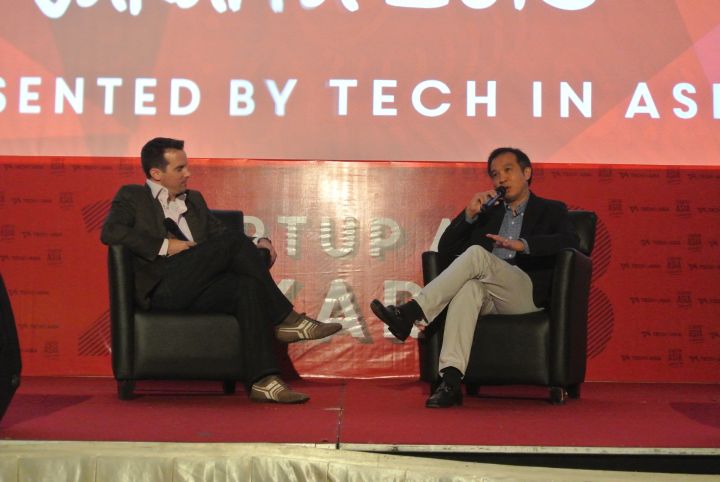
At Startup Asia Jakarta 2013, Tom Clayton of Bubbly, the Singapore based voice-driven social app with over 30 million registered users, sat down to chat with Jixun Foo of GGV Capital to talk about lessons from the Chinese market vis-a-vis Indonesia. Foo’s investment portfolio includes big Chinese names likeYouku-Tudou, UCWeb, and Qunar, the latter of which made its debut on NASDAQ earlier this month.
#10:10: Foo and Clayton Take the stage.
#10:12: A bit about Foo’s background: he grew up in Singapore, started his career at HP, and joined his first VC firm in March 2000. As the only team member there who spoke Mandarin, he often took trips to China, which helped him start his career there.
#10:12: After investing in Baidu, in 2005 Foo packed his bags and brought his family to China. “I could no longer fly in and out of China from Singapore.”
#10:16: We shift gears to Foo’s interest in Indonesia and Southeast Asia. “Indonesia is a sizeable base from which to start off in Southeast Asia, and then you can expand to Thailand and elsewhere.”
#10:17: Foo explains that he’s particularly interested in entertainment in Indonesia, and in China as well. Since China is a primarily rural market, the internet will allow content such as leisure media and gaming to reach areas that would otherwise not have access to such things. Foo thinks this could extend to Indonesia as well.
#10:20: Baidu, YY.com, Qunar, Meilishuo, UCWeb, YoukuTudou, Xiaomi – which of these companies feature business models that could be applied to Indonesia? Foo singles out Qunar, a comparison engine for the travel space. Foo invested in Qunar in 2008 because consumer leisure travel, at the time, only took up about 15 percent of the travel space revenue. Foo believed that this indicated that Qunar’s demographic made up growing market.
#10:23: In order to succeed, you need the right culture, Foo says. When Qunar linked up with Baidu, the culture fit perfectly. Qunar just announced an IPO. Foo sees this as a $5 billion to 10 billion dollar company, with the potential to be the Priceline of China.
#10:26: Qunar goes beyond just price comparison for hotels and flights. There are a lot of mom-and-pop boutique hotels that are poorly IT-enabled. Qunar has helped given these hotels tools to manage their inventory, which helps give the hotels traffic and also builds a long term relationship with an element of dependency. It’s more like a “travel Taobao.”
#10:29: We pivot to YY.com. Foo recalls that YY originated as a platform for hardcore gamers back in 2007. But then they created a voice-based social network that helped gamers communicate. This voice-based social network took off and evolved into a media-sharing and content creation platform. People can exchange virtual gifts when they like content they see, and this eventually becomes the primary monetization model. Now they’re moving into education, and they’re a $3 billion dollar company listed on NASDAQ.
#10:29: Clayton says that his friends often complain that in order for domestic Chinese companies to receive funding, they have to be “The xxx of China.”
#10:32: Foo addreses Clayton by bringing up Tencent, which he believes has the potential to be bigger than Facebook. The social phenomenon it created with QQ, the messaging service which monetized through virtual goods sales, has now extended to a wide range of apps.
#10:35: Foo holds up his Xiaomi phone. “Lei Jun wants to own what’s on your screen. That way he can earn way more than the 15 percent gross margin he earns from the hardware sales.”
#10:37: Is GGV coming to Southeast Asia any time soon, Clayton asks? Foo notes that the company will remain selective, but they’re excited about this part of the world. As a result, they’re in the early stages, and need to first understand the market before they can bring anyone here. “The most important thing is talent flow,” Foo says.
#10:40: Foo says that he can see Qunar or YY coming to this part of the world. He says that both are considering activity in Southeast Asia. A lot of Chinese companies are trying to scale, and Southeast Asia will likely be a part of that strategy.
#10:42: “Why are there so many Singaporean VCs in China?” Clayton asks, half-jokingly. Foo says it shall remain a mystery. The interview ends.
This is a part of our coverage of Startup Asia Jakarta 2013, our event running on November 21 and 22. For the rest of our Startup Arena pitches, see here. You can follow along on Twitter at @TechinAsia, and on our Facebook page.
Stay updated on the go with our mobile app.
Get latest insights with smoother, more personalized experience through TIA mobile app.
Recommended reads
 Indonesian AI startup goes global
 Forrest Li on scaling Sea, building smarter bots, and founder grit
 An AI assistant that joins sales calls and scores team skills
 SGX’s CEO says it doesn’t need a unicorn to win
 SMEs want AI too, but not the kind Big Tech is selling
 Oatside’s alt-milk rise hits a profitable gear
 Alibaba’s financial health in 12 charts
 Asia’s telcos bundle AI into mobile plans. Will it pay off?
 M-Daq chases bigger clients as revenue falls, losses grow
 VC tracker: Accel raises US$3.5b, including US$550m for India