 Jonathan Chew · · 6 min read
The road industry 4.0 is paving for Singapore’s manufacturing industry

The future of manufacturing isn’t just about high-tech robots and machines. It’s also about achieving a sustainable future for businesses and society.
That was the key theme at Industrial Transformation Asia-Pacific 2022 (ITAP 2022), an annual advanced manufacturing convention that brought together key stakeholders – such as the Agency for Science, Technology and Research (ASTAR) and other industry partners – to discuss industry 4.0 technologies.
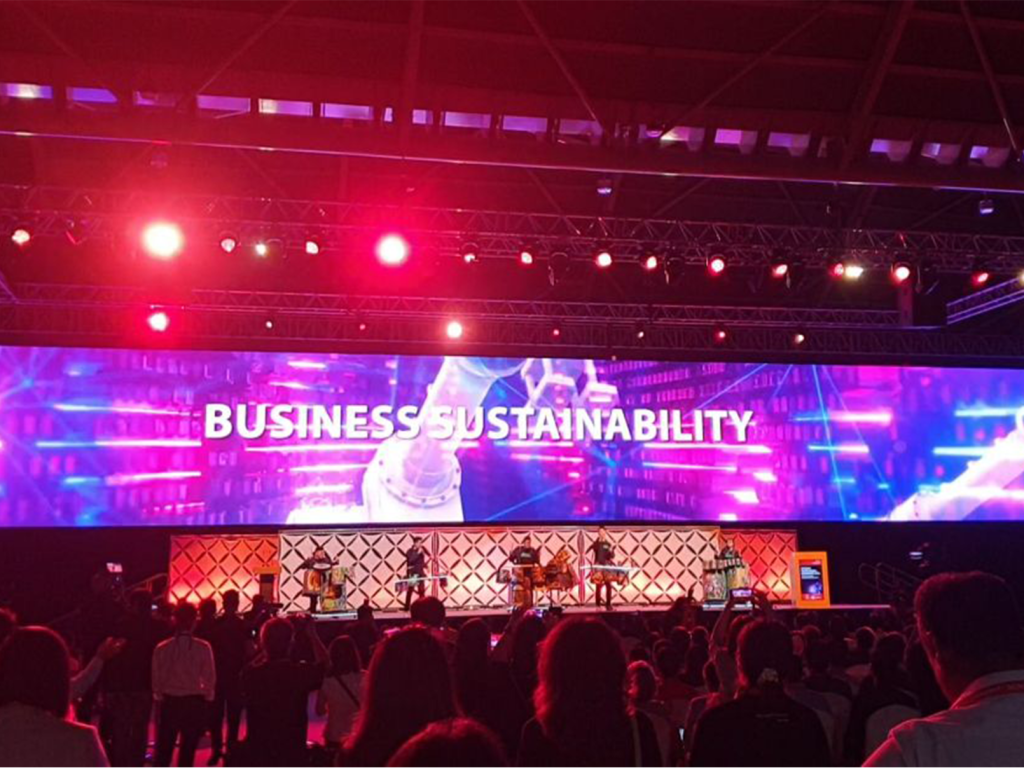
ITAP 2022’s opening ceremony / Photo credit: Tech in Asia
ASTAR and its partners led the way by showcasing a variety of advanced manufacturing solutions, including those meant to help companies stave off the worsening effects of climate change.
Peeking into the future
In line with the strong focus on sustainability, solutions for tracking energy efficiency were one of the key technologies being showcased.
One example was the energy efficiency monitoring and analytics system (E2MAS), developed by ASTAR’s Singapore Institute of Manufacturing Technology (SIMTech). The solution allows companies to tap into SIMTech’s monitoring and analytics capabilities to assess the real-time energy efficiency of their equipment and quickly identify consumption hotspots. Following that, it suggests actionable steps to improve energy efficiency for potential cost savings.
Industry 4.0-focused cutting-edge solutions were also on display. One such technology was an electric-vehicle (EV) module that can be integrated into existing street lights, co-created by the Innovation Factory@SIMTech and Fonda Global Engineering.

The EV module by Innovation Factory@SIMTech and Fonda Global Engineering / Photo credit: ASTAR
The Innovation Factory is a one-stop design and solution center led by ASTAR’s SIMTech and supported by Enterprise Singapore as well as more than 500 researchers from ASTAR’s Advanced Remanufacturing and Technology Centre (ARTC) and SIMTech. It provides important resources that help companies transform their ideas into commercially viable products – especially useful for SMEs with limited resources and capabilities.
EV drivers can use these specialized lamp posts to charge their vehicles instead of having to find EV charging stations. Additionally, the scalable solution can be mounted on other infrastructure such as bollards and walls, allowing quicker implementation of EV charging infrastructure to help meet increasing demand for electric-vehicle charging in Singapore.
Digital twin solutions were another popular form of technology on the exhibition floor. It has several use cases, such as creating virtual simulations of companies’ factory floors.
ARTC showcased its own 3D Digital Twin system, which uses AI and industrial IoT tech to provide real-time energy-monitoring and prediction capabilities for manufacturing processes.
Firms can use the system’s monitoring dashboard – paired with live 3D simulations – to track the energy efficiency of different segments within their manufacturing lines and get actionable insights. The system can also be integrated with existing physical assets without having to install power meters for tracking at every station, saving time and costs.
Digital twin technology also helps manufacturers test new hardware more efficiently, as it can accurately render how a machine would perform based on existing parameters in a factory environment. This helps companies fix potential errors before manufacturing and integrating a new machine in their production lines.
“By the time your machine is ready for production, your testing of the software code has already been done. All you need to do is test your machine for one or two weeks,” said Kim Cheong Tay, a commercial engineer from Rockwell Automation, a member of ASTAR’s ARTC. He added that without digital twin technology, the same process could take several months to complete.
Helping SMEs innovate
ITAP 2022 also featured companies that have benefited from the Innovation Factory@SIMTech – one example is Flexmech Engineering, which provides manufacturing machine solutions.
The partnership was an opportunity for the firm to expand beyond just being a service provider, according to Tan Ru-Ding, managing director of Flexmech Engineering. “Innovation Factory allowed us to have our first foray into making our own products, such as customized metal golf putters, silicone cake molds, and customized machine sensors,” he said.
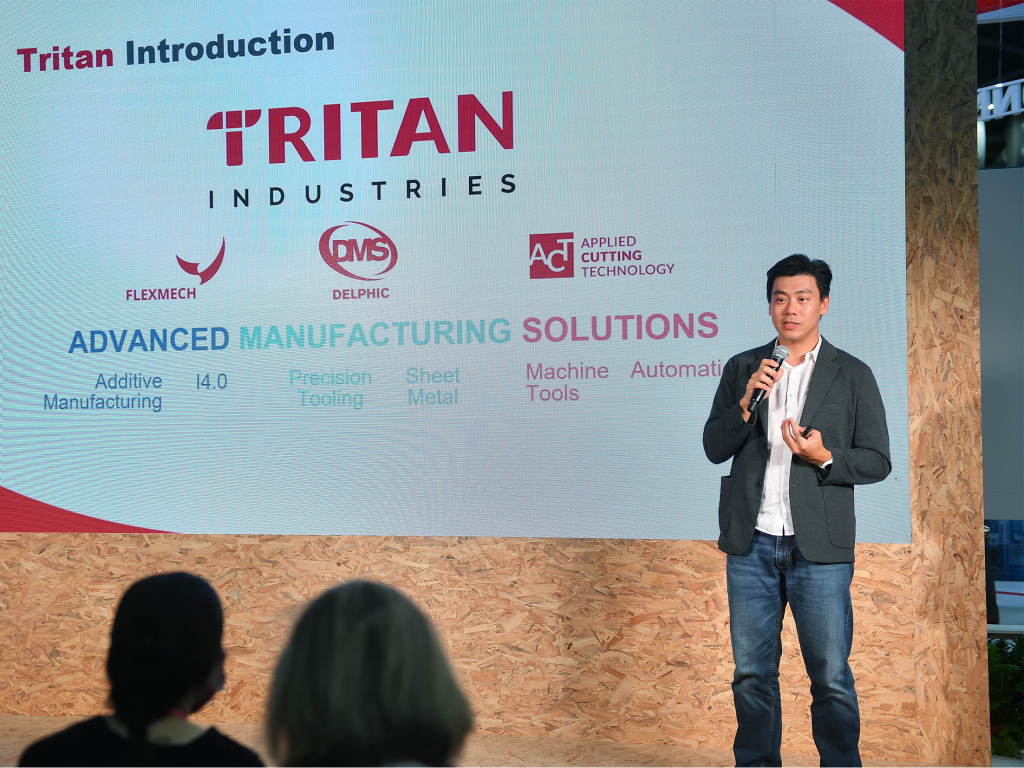
Tan Ru Ding, managing director of Flexmech Engineering, giving a presentation during the event / Photo credit: ASTAR
With Innovation Factory @ SIMTech’s product innovation expertise and knowledge, the entire design process took around three months to complete. Being able to design and produce customized sensors was a great boon to Flexmech Engineering and “changed the image of the company,” according to Tan.
“We are no longer just selling other people’s products,” he continued. “It speaks volumes about our capabilities.”
Paving the road ahead
A key highlight of ITAP 2022 was the Future of Manufacturing CXO Summit and Roundtable co-organized by ASTAR and Constellar. It featured a panel discussion about how companies can become more sustainable in a meaningful way. Thought leaders from the industry such as Jamie Neo, director of ink supplies operations at HP Inc, and Allan Lim, CEO of Alpha Biofuels, among others, took part in the discussion.
Industry 4.0 technologies play an important role in driving those changes, said Neo. In HP’s case, data analytics, real-time detection, and diagnostics helped improve the yield and uptime of the firm’s machines, resulting in less energy consumption and waste.
“We also replaced our stainless steel pallets with 3D-printed ones. They’re much lighter and require less energy to transport,” she explained.
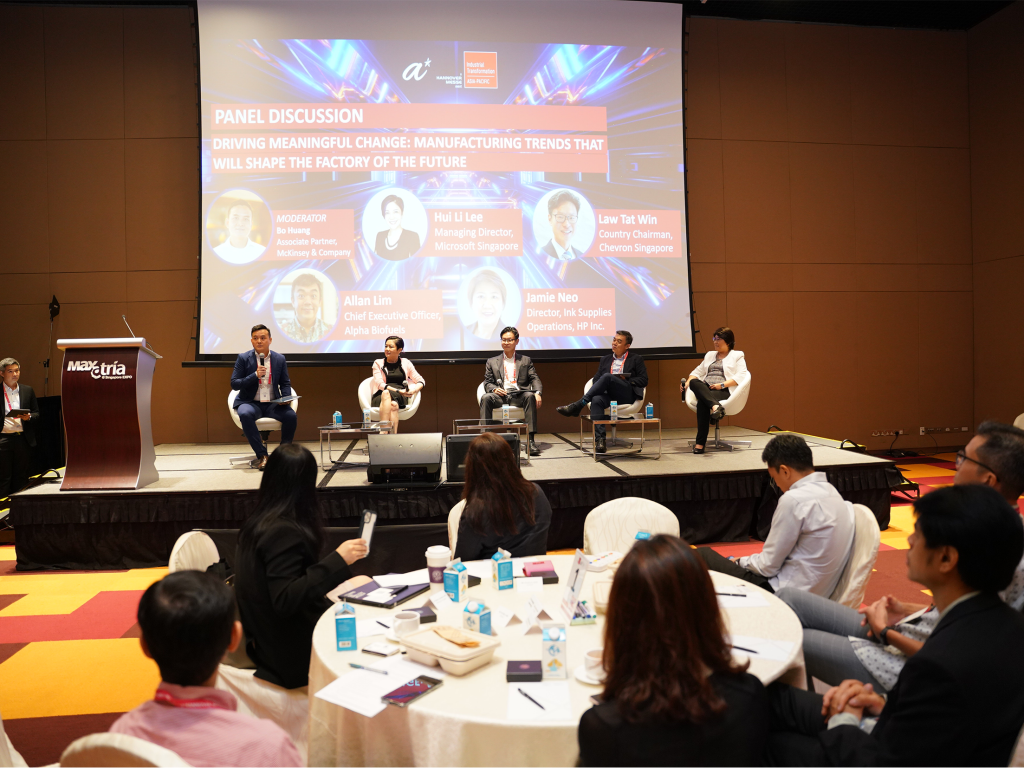
Speakers at the Future of Manufacturing CXO Summit and Roundtable’s panel discussion / Photo credit: ASTAR
Partnerships are also essential to drive meaningful changes. To develop a circular economy, every part of the supply chain has to work together, said Lim, who added that a lot of these decisions are made at the SME level in the supply chain. This is why major manufacturers should incorporate them as partners in their sustainability efforts.
Another highlight from ITAP 2022 was the signing of a memorandum of understanding (MOU) between ASTAR and six other partners from the public and private sectors to help local businesses improve their environmental sustainability with the Green Compass tool.
The tool, which helps companies better manage their environmental impact and chart roadmaps for improvement, was developed last year by ASTAR, JTC, and Tuv Sud, a sustainability solutions provider. Following the signing of the MOU at ITAP 2022, four other organizations – Enterprise Singapore, the Singapore Manufacturing Federation, Singapore Precision Engineering and Technology Association, and Singapore Polytechnic – have come on board to bring Green Compass to more companies in the country.
Return to form
For many attendees and exhibitors, ITAP 2022 was a welcome return to face-to-face meetings and opportunities, bolstering connections within the manufacturing industry.
For some, it was a chance to learn more about the latest tech, while others found potential new business partners or customers.
“ITAP is always the place to show new ideas,” said Flexmech Engineering’s Tan. “It really plays an important role in Singapore’s manufacturing industry.”
The Agency for Science, Technology and Research (ASTAR) is Singapore’s lead public sector R&D agency. Through open innovation, it collaborates with its partners in both the public and private sectors to benefit the economy and society.
To learn more about ITAP 2022, visit ASTAR’s website.
This content was produced by Tech in Asia Studios, which connects brands with Asia’s tech community. Learn more about partnering with Tech in Asia Studios.
Stay updated on the go with our mobile app.
Get latest insights with smoother, more personalized experience through TIA mobile app.
Recommended reads
 The truth about AI language models: No one wants to pay for them
 Tracking AI hiring in Singapore: OpenAI, Anthropic, and more
 Korea’s physical AI ambitions meet the factory’s bottom line
 SEA financials tracker: Moladin’s revenue rises 6% in 2025
 On‑demand services lift Line Man Wongnai’s 2025 revenue to $544m
 Flipkart’s costly late push into quick commerce and food delivery
 Inside Singapore’s government team that kills its own products
 Once an IPO hopeful, SCI Ecommerce nears collapse
 Who’s betting big on ChatGPT ads? Not Asian brands
 VC tracker: Granite Asia launches US$50 million fund





Editing by Winston Zhang and Arpit Nayak
(And yes, we’re serious about ethics and transparency. More information here.)





📅 Upcoming Events
22 October 2026
Payoneer x CSPN Summit 2026