 Winston Zhang · · 6 min read
I was interviewed for a job by a robot. Here’s how it went

The current job market is a nightmare to get through. Thanks to the pandemic, competition for the few available openings is through the roof, and candidates have to deal with more rejections than ever – or worse, no response at all.
It’s not much better for recruiters and human resources (HR) personnel. The lack of roles means that the number of applicants for each available one is much higher – some of whom might not even be qualified in the first place.
“On average, a corporate role receives 250 applications,” says Sudhanshu Ahuja, CEO and co-founder of HR tech firm Impress.ai. “Recruiters spend a lot of time reading resumes and making repetitive phone calls to candidates. When candidates don’t hear back – because the HR staff have too many applications to handle – then employer branding issues arise as well.”
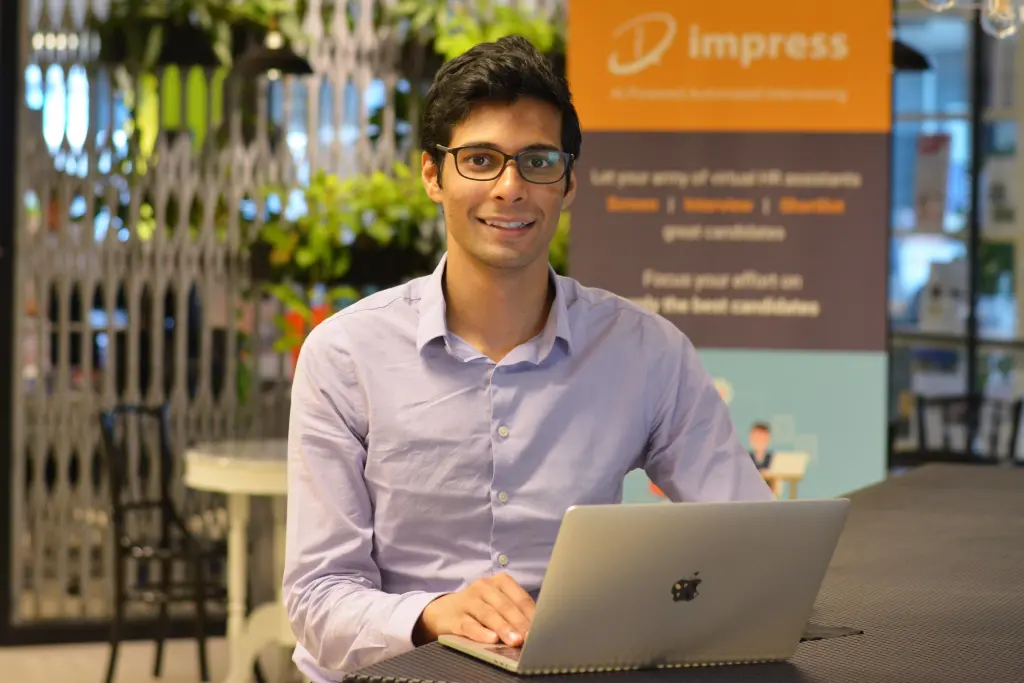
Sudhanshu Ahuja, CEO and co-founder of Impress.ai / Photo credit: Impress.ai
Impress.ai aims to alleviate these issues, among others, with its recruitment chatbot solution. But can a robot really effectively screen applicants without coming off as impersonal and cold?
I had to find out for myself.
“Good morning, Dave”
Posing as an Australian permanent resident applying for a graduate associate position at Australia-based venture capital firm ABC Corporation, I took a mock interview with Impress.ai’s chatbot.
After the initial greetings, the chatbot introduced the company, providing some background information on its focus areas of investment. I was also offered the opportunity to ask some questions, such as ABC’s featured portfolio companies and what its work culture is like.
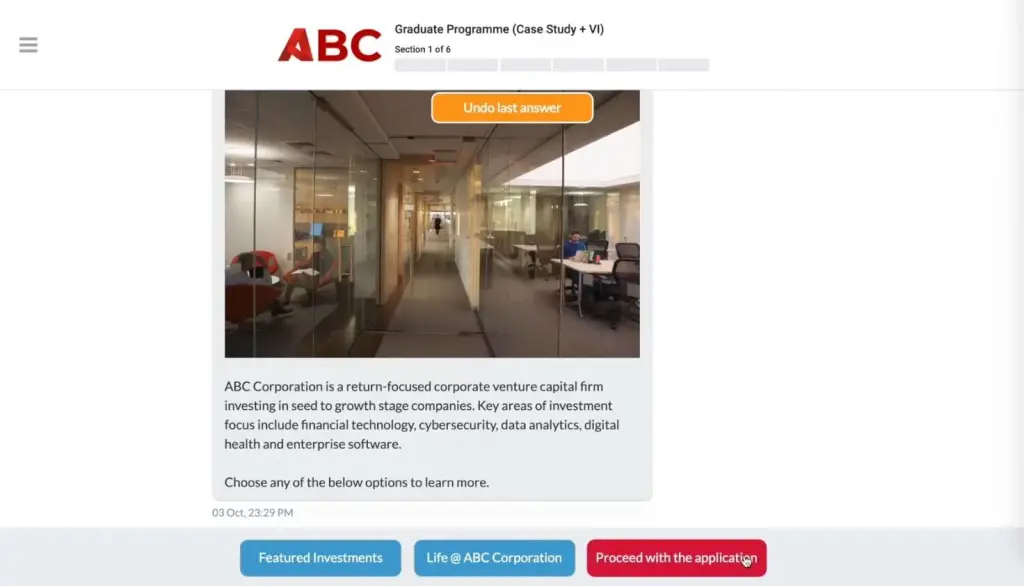
A warm open / Photo credit: Impress.ai
I was then invited to upload my resume – I used a mock one provided by Ahuja – from which the bot pulled details that it then invited me to check and edit. The bot was also able to identify an eight-month gap between a couple of roles, and asked if I’d like to provide an explanation for it.
A short behavioral questionnaire was up next, in which I was presented with simple scenarios and quizzed on how I would act in a given situation. Impress.ai’s platform is built on industrial and organizational (I/O) psychology principles, which helps recruiters evaluate candidates based on core competencies such as skills, knowledge, and traits. This allows for objective assessments across a variety of jobs.
“For each competency, there can be seven or eight different ways of assessing them: scenario-based questions, knowledge-based questions, maybe even behavioral questions,” Ahuja explains. “Candidates’ answers are then converted into mathematical vectors and compared to reference answers on the database, which is where AI helps, scaling operations to address the deluge of applications.”
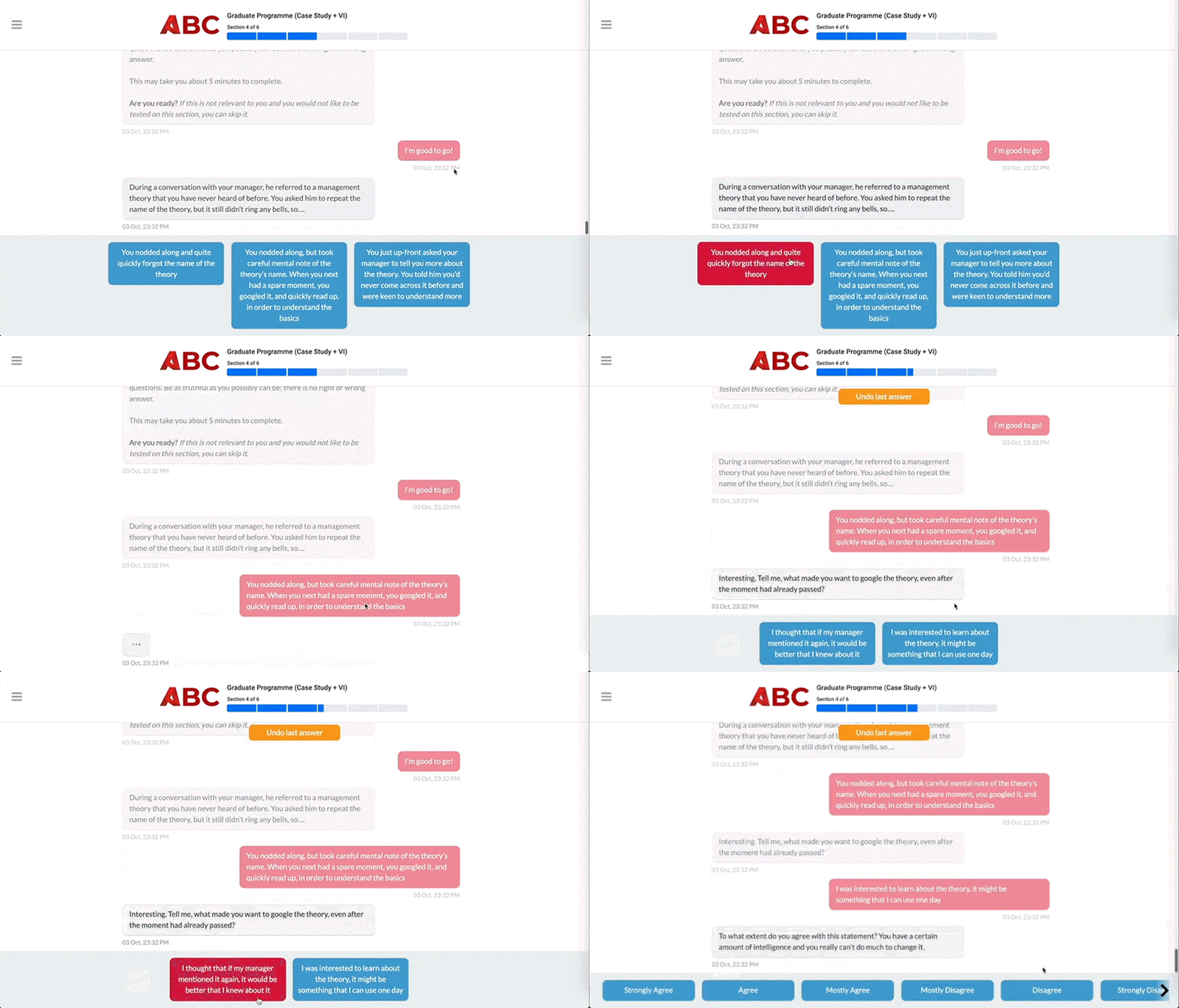
Yes, of course I’d follow up… / Photo credit: Impress.ai
What followed was a test of more concrete skills: I was given a case study to address, complete with questions on strategy and profit margin and market share projections. Math is not my strongest suit, but my wrong answers prompted the bot to give me some hints to nudge me in the right direction. That said, it stopped short of actually telling me the right answer to every question.
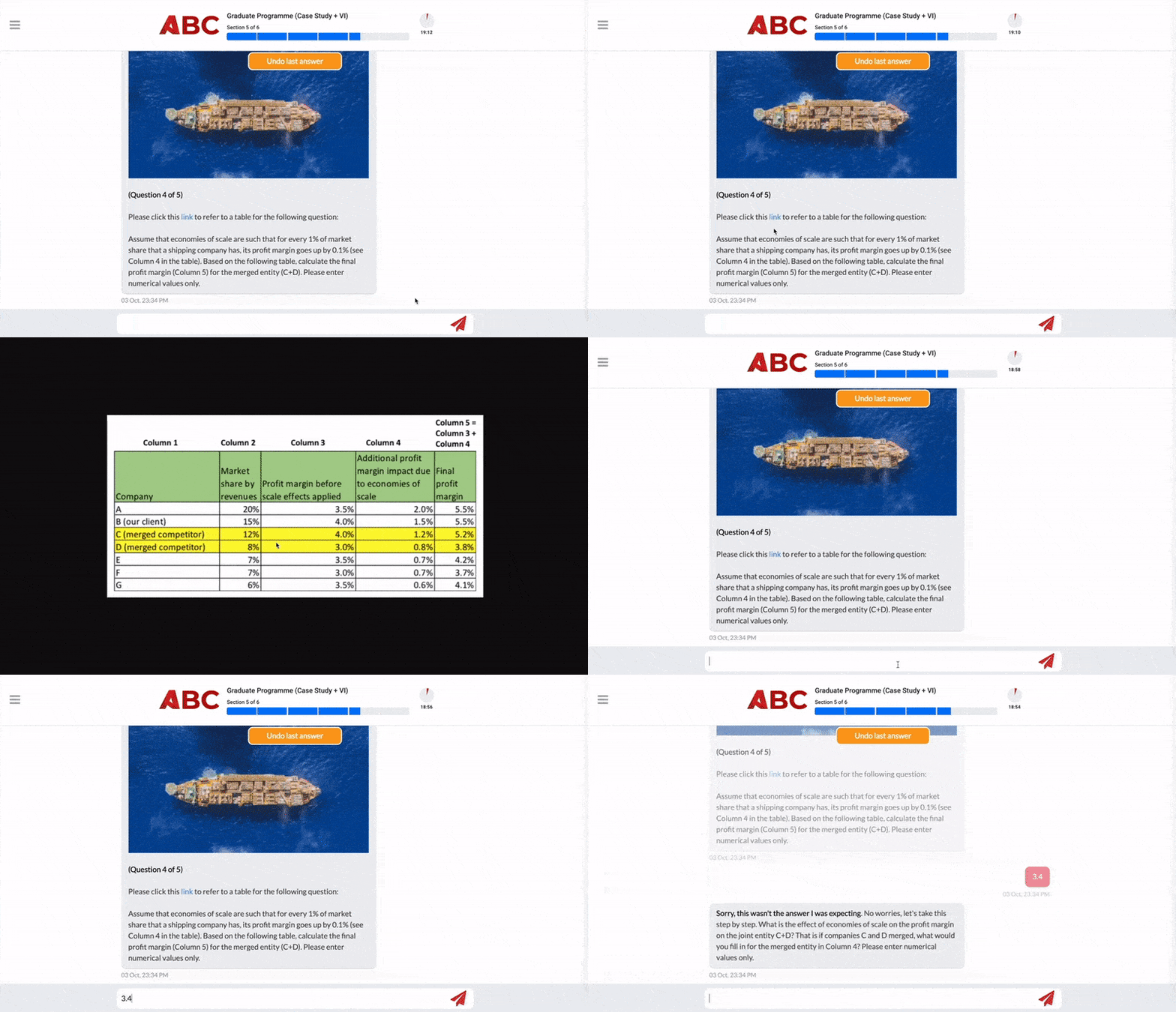
Math, my arch nemesis / Photo credit: Impress.ai
After the case study test, I was brought to the final step: A recorded video interview. As this was a mock interview, I didn’t actually do a recording, but this was another example of a third-party collaboration. Impress.ai works with Sonru, a video interview solution provider, to make this feature possible.
The interview finished with the bot asking me if I had any questions. Common questions, such as the company’s address, have programmed answers, but if the candidate asks something unexpected, that turns into a query for recruiters to answer.
“Typically, we see the platform reach up to 98% accuracy in answering candidates’ questions,” Ahuja claims.
My question about whether long hours were to be expected was met with the promising (and automated) response of “No, you do not have to work overtime.” Happy with that, I ended the interview.
Unbiased smooth talker
I’d obviously “applied” for a role that I was in over my head for, given my complete lack of math skills. That said, while I was always aware that I was conversing with a robot, I found the conversation flow smooth and personable. According to the CEO, natural language processing drives this, and it’s a core focus of the company to make the conversations interesting.
“A lot of conversation structures are logical – so whatever you would expect in a face-to-face conversation, many of these elements can be replicated,” he says. “Once you have the intelligent design of using these conversation components instead of binary questions, then you can have a more complex structure and more natural conversations.”
These “conversation components,” which Ahuja likens to Lego blocks that can be plugged in and out according to recruiters’ needs, make the interview-building process a simple one. Through an intuitive graphical user interface, HR personnel can start by picking from question templates that are put together based on standard requirements for a given role or industry. After that, they can customize the rest of the conversation from a library of thousands of questions that is being added to consistently. They can also indicate how they’d like the answers to each question to be evaluated.
“For example, for a sales role, recruiters go to the database and select sales competencies, which give them a lot of sample questions,” Ahuja explains. “We also offer certain kinds of questions that we come up with alongside partners with expertise in these processes, then license these questions to clients, advising them about the kind of experience that they should be looking to deliver to candidates.”
The platform is also set up to help recruiters avoid the pitfalls of unconscious biases when evaluating applicants. Its default settings hide irrelevant and potentially biasing information such as the candidate’s name or photo. Additionally, it doesn’t display the same candidate’s answers to questions in sequence, so recruiters won’t be able to subconsciously build a candidate persona in their mind as they go through the responses.
“The algorithms themselves, by design, don’t take into account any information about the candidates,” Ahuja says. “A lot of decisions were made to make sure that as much bias as possible is taken out of the shortlisting process.”
Looking ahead
Impress.ai has seen success with its solutions. For example, it has helped Singapore-headquartered DBS Bank cut its average time spent on shortlisting candidates by about 75%, from 37 minutes to eight minutes.
The banking industry is one of the company’s specializations, along with the education, telecommunications, and consulting sectors. However, it has plans to expand both its capabilities and its geographical reach: Australia is next on the list, as are the retail and healthcare sectors.
“The feedback we’ve received from users tells us that candidates really want to hear back. They really like it when the company engages with them and makes an effort to give the candidate a good experience,” Ahuja says.
“Ultimately, we’re trying to help make the job search process easier for both candidates and recruiters.”
Impress.ai is an AI chatbot platform for enterprise recruiters to autonomously conduct structured competency-based interviews using techniques from I/O psychology.
Request for a demo and find out more about how it can help with your hiring processes on its website.
This content was produced by Tech in Asia Studios, which connects brands with Asia’s tech community. Learn more about partnering with Tech in Asia Studios.
Stay updated on the go with our mobile app.
Get latest insights with smoother, more personalized experience through TIA mobile app.
Recommended reads
 What it takes to stand out as a product manager in the AI era
 Why AGI won’t move the GDP needle, by an OpenAI founder
 Sam Altman: AI needs attention span, not higher IQ
 A $650M AI founder: Your ‘demo-level’ AI is a ‘real danger’
 How to break into robotics without an engineering degree
 When skills beat degrees in an AI economy
 Firing fast is the secret to building top sales teams
 Asia’s AI divide: Creators vs. experimenters
 An AI interviewer being built on interview data, not CVs
 Mark Cuban on AI scale: why Apple wins while data centers bleed





Editing by Nathaniel Fetalvero and September Grace Mahino
(And yes, we’re serious about ethics and transparency. More information here.)






📅 Upcoming Events
22 October 2026
Payoneer x CSPN Summit 2026