J.T. Quigley · · 5 min read
Don’t laugh – this wearable device alerts you before you have to poop
Try to remember back to elementary school for a moment. You’re in the middle of math class, two periods after lunch, and you feel it coming. Way down, deep in your bowels, there’s a faint rumble. Moments earlier, another student already left with the hall pass, and the seconds start to feel like minutes as you stare anxiously at the door.
What if they don’t come back soon? What if I have… an accident?
Now fast forward to the present day and imagine that fear as an adult. Imagine if an injury or illness made it impossible for your body to even preemptively signal that you were ready for a trip to the toilet. Try to think about what your life would be like if you had to wear adult diapers just to be able to leave the house.
Fecal incontinence – the loss of bowel control – affects an estimated 2.2 percent of the general population around the globe. The actual number is likely much higher, as cases are underreported due to embarrassment. Treatment often requires surgery, drugs, or a combination of both – or diapers. A Japanese startup may have devised a technological alternative to all of those.
D Free is a wearable device, created by Tokyo- and California-based venture Triple W, that tells users when they will have to go to the bathroom. The “D” stands for diaper – an important moniker in Japan, especially, where the adult diaper market is expected to surpass the baby diaper market by 2020.
As important as a thermometer
Imagine D Free as a miniature ultrasound. Weighing just 20 grams and measuring 1.4 x 2.0 x 0.4 inches, the tiny white module can be worn inside a user’s belt or in special underwear. It sends ultrasonic pulses into the abdomen – users can choose the frequency, from every second to every 10 seconds – that detect waste buildup in the bladder and intestines. D Free shares this data with a user’s (or caregiver’s) smartphone, up to 20 meters away, via Bluetooth LE.
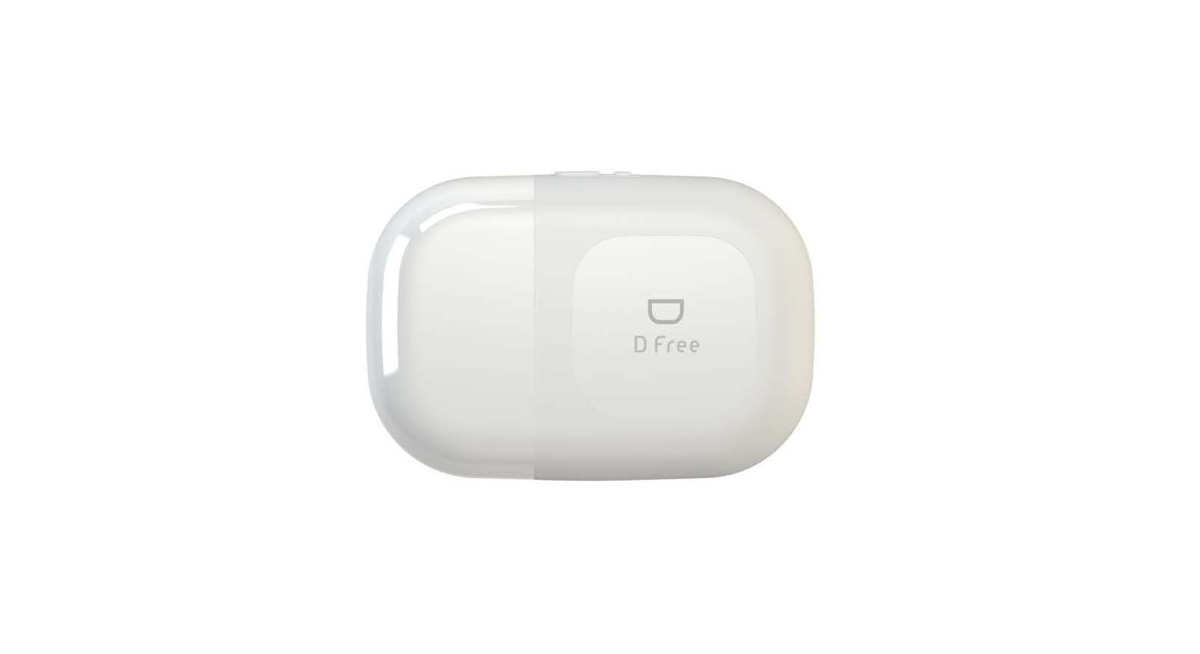
Alerts can also be tailored to a user’s specific condition. Someone with full mobility, for example, can set the app to alert them 10 minutes before they should use the toilet. Someone bound to a wheelchair, on the other hand, can receive the alert 30 minutes prior, to give them more time to find an accessible bathroom or to call for assistance.
Battery life, depending on how often the device sends out an ultrasound, is generally about a week. It uses inductive charging to avoid external ports.
The device was designed for two user segments: elderly people who have lost their bowel control (and are living with family or in assisted living homes – as seniors living alone probably don’t use a smartphone); and those suffering from physical trauma or illnesses that can lead to fecal incontinence, such as spinal cord injuries, Parkinson’s disease, and dementia.
Yuki Aoyama, Triple W’s managing director, envisions the product becoming as integral to nursing homes as thermometers are to hospitals. Like a household thermometer, the startup also hopes to avoid the high hurdles associated with being certified as a medical device.





Stay updated on the go with our mobile app.
Get latest insights with smoother, more personalized experience through TIA mobile app.