 Samantha Cheh · · 5 min read
Energy guzzlers: Data centers and the question of sustainability

Data centers are the ubiquitous “backbone” of the internet, responsible for processing, storing, and communicating all the data that we generate and use when we’re online. One could argue that without data centers, there would be no internet.
The advent of the Covid-19 pandemic saw the already high demand for data center capabilities skyrocket as global internet traffic surged by 40%.
With the arrival of 5G networks and growing adoption of cutting-edge tech like cryptocurrencies, AI, and cloud computing, the demand for data centers is set to double by 2025.
However, the potential of data centers is only half of a more complicated story – the outsized growth of the industry has come at the expense of the environment.
“Data centers contribute significantly to carbon emissions due to their high power consumption and often inefficient cooling systems,” says Wen Yonggang, chief scientist at Red Dot Analytics (RDA), a deep-tech company providing industrial AI software.
The world’s greatest energy guzzlers
Data centers are considered “the world’s greatest energy guzzlers” and are estimated to consume a tenth of global energy production.
Rapid technological innovation has led to greater energy consumption and, consequently, higher greenhouse gas emissions that are having visible and devastating impacts on the environment. As countries all around the world increasingly witness the realities of climate change, there has been a “burgeoning interest in developing green data centers,” says Wen, who holds a doctorate in electrical engineering and computer science from the Massachusetts Institute of Technology.
Most recently, the Singapore government “temporarily paused” developing new data centers, though the moratorium has since been lifted. This is an illustrative case of the tension between economic growth and sustainability that many governments and companies are struggling to resolve.
Technology solves the sustainability question
It’s difficult to accurately determine the environmental cost of digital technologies due to the rapid speed of innovation. Other factors like energy source, server distance, and equipment deterioration all play a part.
Governments are looking into how they can improve the energy efficiency of data centers – some in the US and Europe are reportedly considering “green data center laws”, while China has mandated that all new data centers be “more energy efficient”.
Closer to home, Singapore is set to introduce higher efficiency standards to better align with the Singapore Green Plan 2030.
Wen suggests that the end of Singapore’s moratorium on new facilities could spur data centers to meet these higher standards, especially in light of the two “mega trends” that are shaping the next decade: energy transition and digitalization.

Wen Yonggang, chief scientist at Red Dot Analytics / Photo credit: Red Dot Analytics
“Data centers could optimize the energy efficiency of mission-critical operations and enable more accurate greenhouse gas emissions tracking, aligned with Singapore’s efforts in addressing climate change,” he says.
This is where firms like RDA come in. The company takes the pioneering AI and “cognitive digital twin” research by Singapore’s Nanyang Technological University (NTU) and translates it into enterprise solutions that are aimed at improving the sustainability of critical infrastructure.
Cognitive digital twinning refers to creating a virtual replica of a real-world system, which can then be used to quickly process massive amounts of data and “visualize the effect of any change before it is implemented,” explains Wen.
The difference that digitalization makes
Currently, traditional data center operations are a largely manual process, which naturally leads to a lot of inefficiencies and inaccuracies.
RDA worked with Wen and his NTU team’s research to develop DCWiz, a cognitive twinning solution that digitalizes center operations and introduces AI to create predictive models that can forecast energy consumption and enhance decision-making.
With the solution, “data center managers can remotely manage and automate for more sustainable energy solutions,” Wen explains.
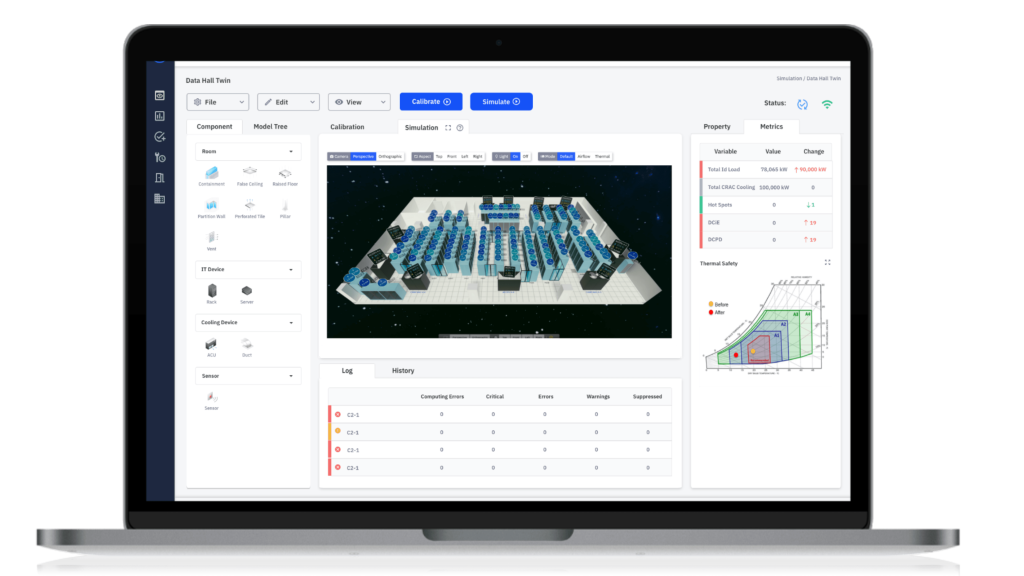
Photo credit: Red Dot Analytics
Between 2017 and 2018, Singapore’s National Supercomputing Center (NSCC), a government initiative supporting public and private research with high-performance computing capabilities, deployed DCWiz. At the time, the NSCC was struggling with performance gaps and huge power bills due to the energy-intensive nature of supercomputing technology.
“Due to the intricacies of the interactions between different components involved in data center cooling, developing an optimal control policy is a challenging task,” Wen says.
By digitally modeling the NSCC’s entire operation, DCWiz identified inefficiencies in its hot and cold air-mixing framework that led to a poor power usage effectiveness rating. The discovery – and the efforts to correct it – resulted in the NSCC achieving energy cost savings of US$4,400 a month, as well as a 15% to 30% improvement in its cooling systems efficiencies.
“Better predictive technologies can help companies gather the deep insights needed to improve their workflow across operations. They can anticipate future changes and mitigate risks, while also significantly reducing operational complexity and carbon emissions” Wen says.
“Two hands to clap”
With digitalization showing no signs of slowing down, demand for data center services is unlikely to taper off. This is why many governments continue to seriously consider policies that can ease the environmental impact of these facilities.
Wen says that while these efforts are important, “it takes two hands to clap, and companies must do their part to help achieve sustainability goals.”
Google’s initiative to match its power consumption to weather patterns and Microsoft’s pledge to go “carbon negative” by 2030 are just some examples of this.
“Committing to green supply chain practices, promoting sustainable practices, and providing green investment and financing – these are some of the ways that [companies] can contribute,” he notes.
Accreditation@SG Digital was launched in July 2014 to accelerate the growth of promising Singapore-based enterprise tech-product companies. It helps these firms establish credentials, build business traction, grow, and compete in the global market, opening up more opportunities for their solutions to be showcased and adopted.
Red Dot Analytics (RDA) is an AI-powered technology solutions provider that aims to bring research-backed AI and digital twin solutions to help organizations digitalize and optimize their data center solutions. Founded in 2016 by scientists from Nanyang Technological University and industry experts, its award-winning cognitive digital twinning solution, DCWiz, has helped make mission-critical environments more environmentally sustainable, agile, and resilient.
To find out more about how advanced digital technologies can enhance sustainability in your data center, check out its website.
This content was produced by Tech in Asia Studios, which connects brands with Asia’s tech community. Learn more about partnering with Tech in Asia Studios.
Stay updated on the go with our mobile app.
Get latest insights with smoother, more personalized experience through TIA mobile app.
Recommended reads
 Why ‘vibe PMing’ is the future of product management
 ‘Not how humans act’: how agentic AI is changing cyberattacks
 Southeast Asia pulls ahead of global average on AI adoption
 TiDB is engineering the infrastructure for AI’s agentic future
 ‘Good morning, Dave’: The new world of physical AI in daily life
 How OpenAI is betting on one powerful “brain” over many tools
 How AI agents will be the new software buyers
 This startup helps chipmakers stop repeating the same mistakes
 You can’t spell India without AI
 The hardware secret that gave OpenAI the edge on Anthropic





Editing by Winston Zhang, Nathaniel Fetalvero, and Jaclyn Tiu
(And yes, we’re serious about ethics and transparency. More information here.)



📅 Upcoming Events
22 October 2026
Payoneer x CSPN Summit 2026