Colin Moreshead · · 4 min read
Maritime shipping startup Shippabo beats the competition at Skyland Ventures pitch battle
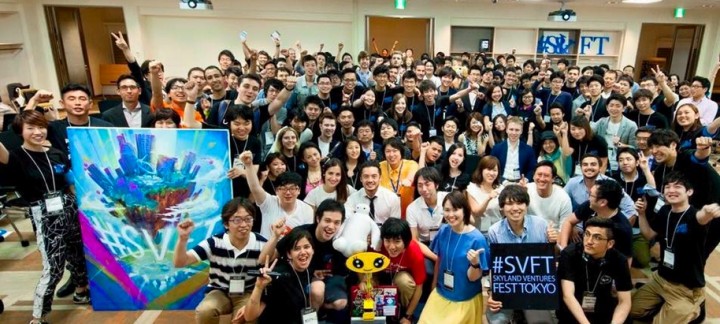
Photo credit: Daiki Hirozawa, East Ventures.
Skyland Ventures, a local, independent venture capital firm yesterday held its inaugural Skyland Ventures Fest Tokyo (SVFT) at Microsoft’s Tokyo offices, with Tech in Asia as a media partner. SVFT was a rousing success for founder Max Kinoshita, who welcomed more than 600 guests from around the world throughout the day.
Shippabo deemed seaworthy
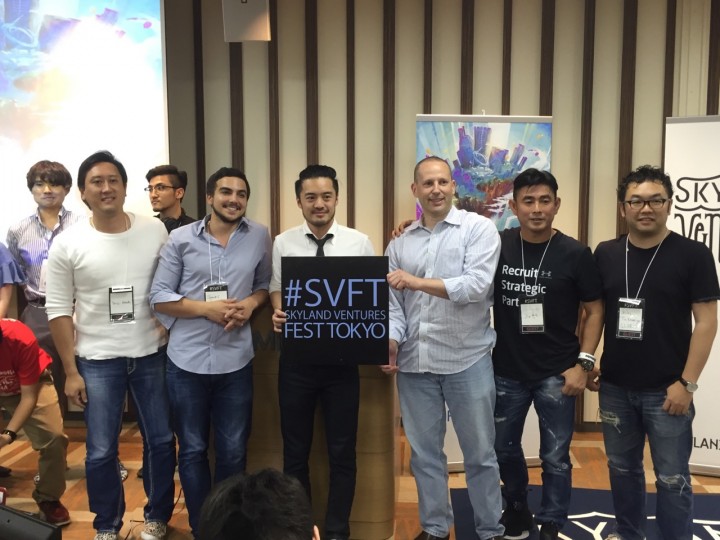
Shippabo’s product manager and co-founder, John Lien (holding the sign), with judges (L-R) Shinji Asada, James Riney, David Milstein, Akihiko Okamoto, and Shinichi Takamiya.
Los Angeles-based firm Shippabo took home the top prize in SVFT’s inaugural pitch battle. Shippabo is a web-based platform aimed at small and medium-sized businesses who import and export goods. Traditionally, smaller operations have had to spend outsize amounts of time and money filing forms, searching for price quotes, and attempting to track their goods.
Shippabo’s service is designed like a sort of Expedia for container ships – it collects pricing data for comparison, automates documents for filing and allows users to track their shipments to arrival. Shippabo also helps users manage customs clearance, making it easier to ship a 40 foot container of t-shirts across the Pacific than it is to get through security at some airports.
Co-founded by John Lien, Nina Luu, Sam Luu, and Wes Chien, Shippabo started in Los Angeles, but is fixated on Asia. They have every reason to be optimistic about their current location, too; ships that make berth at the Port of Los Angeles handle more than US$200 billion in trade with Asia each year. With carriers like Maersk and American President Lines, Shippabo could see rapid expansion in its user base. For winning the pitch battle, Shippabo received US$1,500 in prizes, from Ginzametrics, RareJob, +822 Summit, and Tech in Asia.
Their win will also send Shippabo to Bootstrap Alley at Tech in Asia Tokyo 2015.
The challengers
The other startups shortlisted for the event can be seen below:
Ikkai is an application developed by Thomas Pouplin and Yasmine Claire Djoudi. Ikkai addresses the issue of overworked corporate employees and underemployed university students in Japan. Workers looking for a little help on a job like cleaning their room or cooking dinner, just “one time” – ikkai in Japanese – can post ads on the app to find some help from a student in need of money and experience.
Yuta Nishigaki’s DAWGS Inc. presented its service SnShot, which provides on-site image printing from social networks like Twitter, Facebook, LINE, or Instagram. With SnShot, any wedding, party, or event can be documented, as guests’ smartphones are effectively turned into Polaroid instant-shot cameras.
Raymond Hong, CEO of JOKERPACK Inc., showed off his company’s BeeCanvas filesharing platform. Hong believes that filesharing is still too fragmented, spread across services like Evernote, Google Drive, and Dropbox. BeeCanvas puts everything on a blank page so that collaborators can view every aspect of a project in storyboard format.
Famarry CEO Yuka Fujii was on hand to pitch her company’s service, which helps users navigate Japan’s confusing wedding photography business. Many venues in Japan don’t allow personal photographers, and some Japanese couples are deciding instead to have “photo weddings” in lieu of a ceremony. Famarry helps users find photographers, and should they choose to skip the wedding itself, the service helps them to produce their photo wedding for friends and family to view.
Scatter Lab CEO Jongyoun Kim presented Ginger, an AI application that syncs with messaging apps to develop an understanding of you and your relationships. By evaluating data from Between, Ginger is able to recognize when your partner is stressed, or what sort of tender, loving care your relationship might need.
DKT Robotics CEO Kensei Demura introduced the Kenseiko Mini, a small robot designed to be a cute household companion. Though the demonstration was shaky, and the robot seemed far from market ready, it should be noted that Demura is a high school student. With several Japanese behemoths like Softbank looking into robotics, Demura may have a bright future in store.
Bunguu Inc. CEO Kazuya Hirobe demonstrated his company’s new software, Replia. Replia helps to give front-end designers an edge – it takes design work from Photoshop and generates Objective-C/Swift/Storyboard source code. Hirobe hopes that the time saved will lead to speedier improvements in UX design.
AnchorUp co-founder Alba Zurriaga Carda presented her company’s app, which seeks to revolutionize travel for Millennials. AnchorUp uses a user’s location to identify nearby spots to check out, which can be further winnowed down based on time and budget. Their gamification model also garners invitations to exclusive parties and “special missions.”
Junya Yamaguchi, CEO of POLYGLOTS, Inc., showed off his company’s app, POLYGLOTS. The app targets Japanese who are trying to study English through reading, customizing the experience to fit each user’s news, music, video, and other media tastes. Yamaguchi is confident that the app’s 70 percent continuity rate is attributable to the fun users have studying with it.
The pitch battle was presided over by five judges with backgrounds in VC:
Shinji Asada, Japan head at Salesforce Ventures
David Milstein, partner at Fidelity Growth Partners Japan
Akihiko Okamoto, president of Recruit Strategic Partners
James Riney, principal at DeNA
Shinichi Takamiya, chief strategy officer at Globis Capital Partners
Stay updated on the go with our mobile app.
Get latest insights with smoother, more personalized experience through TIA mobile app.
Recommended reads
 Indonesian AI startup goes global
 Forrest Li on scaling Sea, building smarter bots, and founder grit
 An AI assistant that joins sales calls and scores team skills
 Beyond the check: Why VCs need more than capital
 SGX’s CEO says it doesn’t need a unicorn to win
 SMEs want AI too, but not the kind Big Tech is selling
 Oatside’s alt-milk rise hits a profitable gear
 Alibaba’s financial health in 12 charts
 Asia’s telcos bundle AI into mobile plans. Will it pay off?
 M-Daq chases bigger clients as revenue falls, losses grow





Editing by David Corbin and Terence Lee
(And yes, we’re serious about ethics and transparency. More information here.)