- Insights This article was written by a TIA community member. Insights pieces undergo the same rigorous editorial process that newsroom-produced articles have.
 Daniel Song · · 5 min read
Openspace’s VP is bullish on Indonesia’s alternative lending and digital content
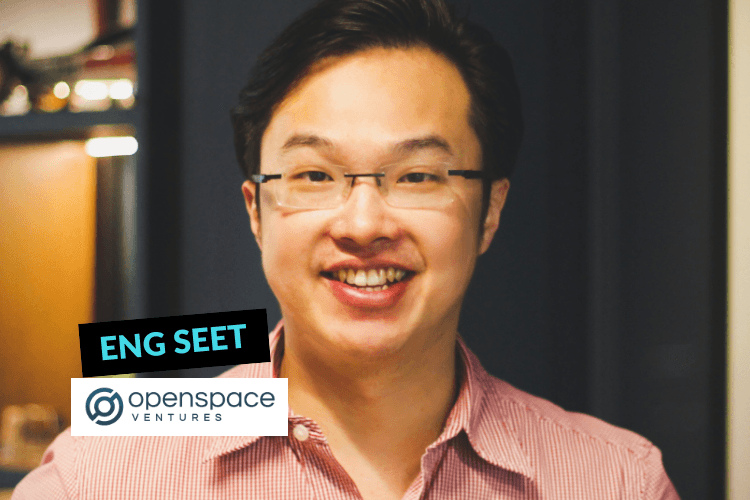
Eng Seet, vice president at Openspace Ventures
This article is part of Tech in Asia’s partnership with Asia VC Cast hosted by Daniel Song where we publish the revised transcripts from the podcast’s interviews with inspiring entrepreneurs and experienced VCs. This is heavily revised from the show’s original transcript. For the full interview, go here.
Eng Seet is the vice president of Openspace Ventures, a Southeast Asia-based early-stage VC firm that has invested in tech startups like Go-Jek, FinAccel, Sale Stock, and Halodoc in Indonesia.
Prior to joining Openspace, Seet was part of Bank Central Asia Indonesia’s corporate venture arm, investing in early-stage fintech startups. He also co-founded Kredivest, one of the first P2P invoice lending platforms in Indonesia. He was previously with Macquarie, JPMorgan in Londo,n and Daiwa SB Investments Singapore.
Seet and I talk about his journey, the P2P lending landscape in Indonesia, and some verticals.
Tell us a little bit about yourself and how you came to be a VC at Openspace.
I’m based out of Jakarta and I’m responsible for the Indonesia coverage at Openspace.
I grew up in Malaysia and studied in the UK. I started my career in the private equity space for a few years, did a couple of deals in fintech, and then decided to move to Singapore.
After 10 years of investing, I decided to try something on my own. I then packed my bags and moved my family to Indonesia to do a startup. I built a P2P lending company, bootstrapping for a year and a half, but things unfortunately didn’t work out for us. I ended up joining the BCA Indonesia corporate venture arm before joining Openspace Ventures.
We have just rebranded from NSI Ventures and recently closed our second fund of US$135 million. We’re focused on series A investments across Southeast Asia. We are also sector-agnostic and have made about 19 investments to date, five of which are in Indonesia.
How do you see the fintech lending landscape playing out in Indonesia?
Just a quick recap, P2P lending first came to Indonesia in early 2016 when there were less than 20 players in the market. Today, you have hundreds of alternative lenders, not to mention other startups like ecommerce or payments companies that are exploring the financing angle as well. So, there’s now an influx of alternative lenders.
There are three things fintech companies should pay attention to. One is regulations. It’s still very uncertain what the regulatory landscape will look like in the future, but it will affect your compliance costs and unit economics.
The second thing is funding. There are a lot of startups leveraging retail funding for their initial growth. While that’s OK, it will hit a bottleneck at some point because you’ll need institutional money for the next growth phase. Otherwise, there will be supply constraint, and this is what we saw in the US market with Lending Club. For the first few years, the company was growing fine, but the inflection point came in when institutional money started flooding into the market and the system.
The third point is risk pricing. I think startups should focus on pricing their credit products correctly. It’s not a homogeneous market. Every single credit product has very specific credit risk, and incorrect pricing can contaminate the system to some level because everyone is addressing the same credit segment.
Having said all of that, I’m still very bullish on this space. Alternative lenders are still at a very early stage at the moment. I think lenders who can scale without sacrificing on asset quality will eventually be successful.
What needs to take place in Indonesia to regulate the space and push out the frauds?
What other key growth sectors do you see in Indonesia?
What can we expect from you and Openspace this year?





Stay updated on the go with our mobile app.
Get latest insights with smoother, more personalized experience through TIA mobile app.