Apoorva Dutt · · 6 min read
How Amazon’s ‘one-click purchase’ feature changed the game
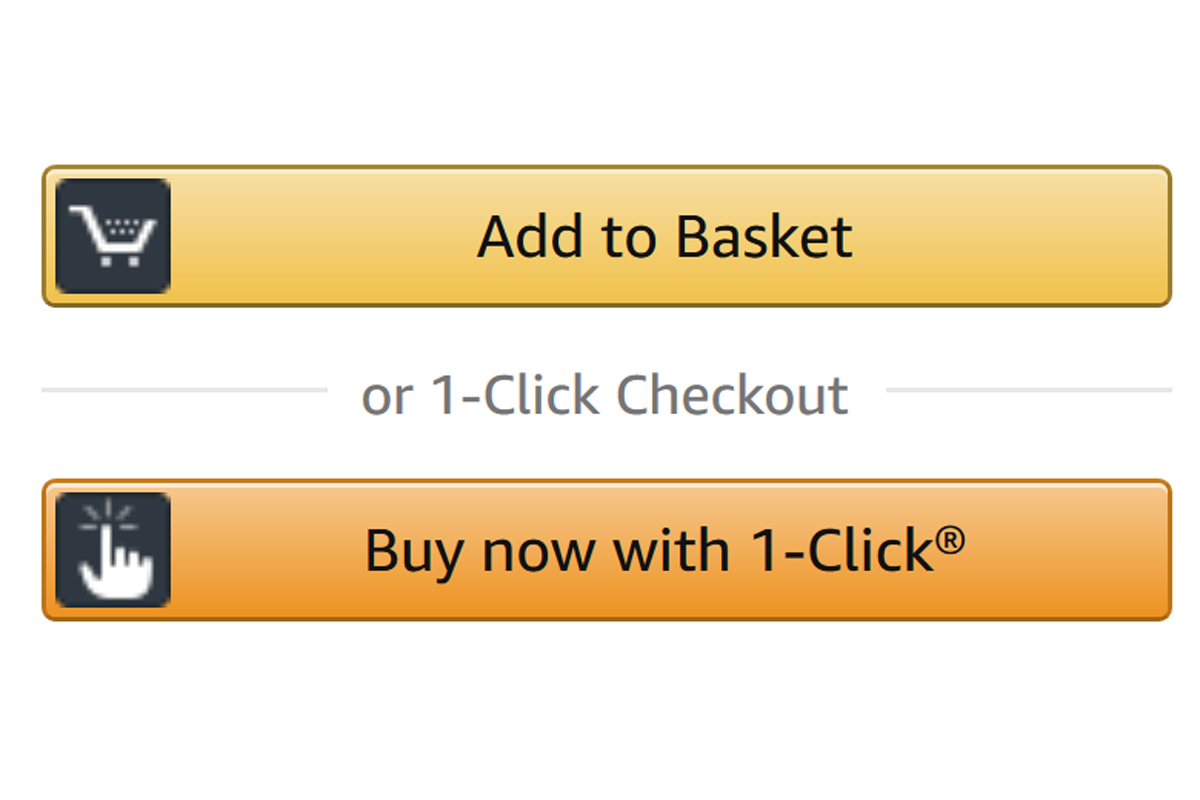
Amazon’s one-click feature was a game changer. / Image courtesy of Amazon
The following is an edited excerpt taken from Richard M. Brandt’s One Click: Jeff Bezos and the Rise of Amazon.com. The excerpt was provided by Portfolio Publishing. You can buy a copy of the book here.
(Note: Amazon’s one-click patent expired in September 2017, and is now being replicated by many other ecommerce platforms.)
Bezos wants to use technology to provide great service to customers. That philosophy resulted in what is perhaps Amazon’s most famous -and infamous – patented software program, known as “1-Click ordering.”
The 1-Click software was written mostly by a programmer named Peri Hartman, who joined Amazon in 1997. Hartman was given the task of working on the software that would be the interface to the customers, including the ordering system they would use to buy books.
Hartman recalls that, one day over lunch with Bezos and Shel Kaphan, the head of software development, Bezos told them, “We need something to make the ordering system frictionless. We need to make it so the customer can order products with the least amount of effort. They should be able to click on one thing, and it’s done.”
A simple idea on simplicity, and Hartman took it literally. He set to work creating a program that would require just one click to order a product. (His name appeared first on the patent application, which became patent number US5960411.) The patent filing was titled, innocuously enough, “Method and system for placing a purchase order via a communications network.” More telling was the label in an illustrated flow chart in the patent: “Enable SingleAction Ordering.”
In fact, it is a simple idea. The 19-page patent filing is made up mostly of flow chart diagrams that show the sequence of events that enable buyers to place an order with a single click: Retrieve the buyers’ identification and payment methods when they first place an order, enter it into the system, and the next time they look up a book, they’ll see a 1-Click ordering button on the buyers’ pages.
Sound like a no-brainer? That’s what Amazon’s competitors thought. Many people in technology hate this type of broad patent, known as a “process patent” since it mainly describes the process of doing something that is, well, patently obvious – in this case, reducing to one the number of clicks needed to make a purchase. That is, however, the kind of attention to detail that has helped make Amazon.com a success.
Jeff Bezos will do anything he can think of to make the process of using Amazon.com easier. The genius is that Bezos thought of it first. He knew that doing anything online had to be simple in an age when people were becoming overwhelmed by complicated computers, software, and internet technology. This, in fact, was a principle that Larry Page and Sergey Brin adopted a couple years later when creating Google.
But few competitors have had the sense to follow this rule. Even today, most Web sites seem to be confusing morasses of text, graphics, videos, flashing ads, and a tangled string of links. Amazon.com doesn’t match the simplicity of Google’s famously spare site, but it is well designed and easy to navigate. “His general philosophy was to be friendly to customers,” recalls Hartman. “The focus should be on the customer, not on the website. It’s pretty obvious that a simple website is easier to use than one with of a bunch of fancy gadgets. He was adamant about that.”
His goal was not just to make browsing for books easy, but an enjoyable experience. “People don’t just buy books because they need books,” he has said. “There are products like that. Pharmaceuticals are that way. Nobody enjoys browsing the Preparation H counter. But people will gladly spend hours in a bookstore, so you have to make the shopping experience fun and engaging.” It didn’t require a free online latte to make customers appreciate Amazon.com. In the late 1990s, there was so much room for improvement in website design that any incremental advancement was like getting an extra bottle of oxygen on a trek to the top of Mount Everest.
“To be nine times bigger than your nearest competitor,” Jeff explained to The Washington Post in 1998, “you actually only have to be 10 percent better.” Three years after the site was launched, he said that the majority of his customers came to the site, not because of advertising, but because of positive word-of-mouth.
From the beginning of his company to the present day, Bezos has been fanatical about squeezing out every incremental percentage point of usefulness in Amazon.com. They’re often simple things like the 1-Click feature and, later, a one-click button to designate a gift and have it wrapped. He won’t wash a customer’s car (there are too many customers for Amazon to provide individual attention), but he’s happy to implement new policies if they will help all customers. When one elderly woman sent an email to the company saying she loved ordering books from the site but had to wait for her nephew to come over and tear into the difficult-to-open packaging, Bezos had the packaging redesigned to make it easier to open.





Stay updated on the go with our mobile app.
Get latest insights with smoother, more personalized experience through TIA mobile app.