- Premium Content It takes our newsroom weeks - if not months - to investigate and produce stories for our premium content. You can’t find them anywhere else.
 Katrina Balmaceda Uy · · 7 min read
Smart walkie-talkie startup by 2359 Media founder is profitable without funding
A quick Google Play search for a walkie-talkie app yields more than a hundred results. While some like Zello receive stellar ratings based on thousands of reviews, many face common complaints.
Push-to-talk (PTT) functionality, for example, is a core function of walkie-talkie apps. With it, a smartphone user doesn’t need to make a call or go through several swipes and clicks to send a voice message. The idea is to simply push a single button and speak into your phone, much like the way a regular walkie-talkie operates.
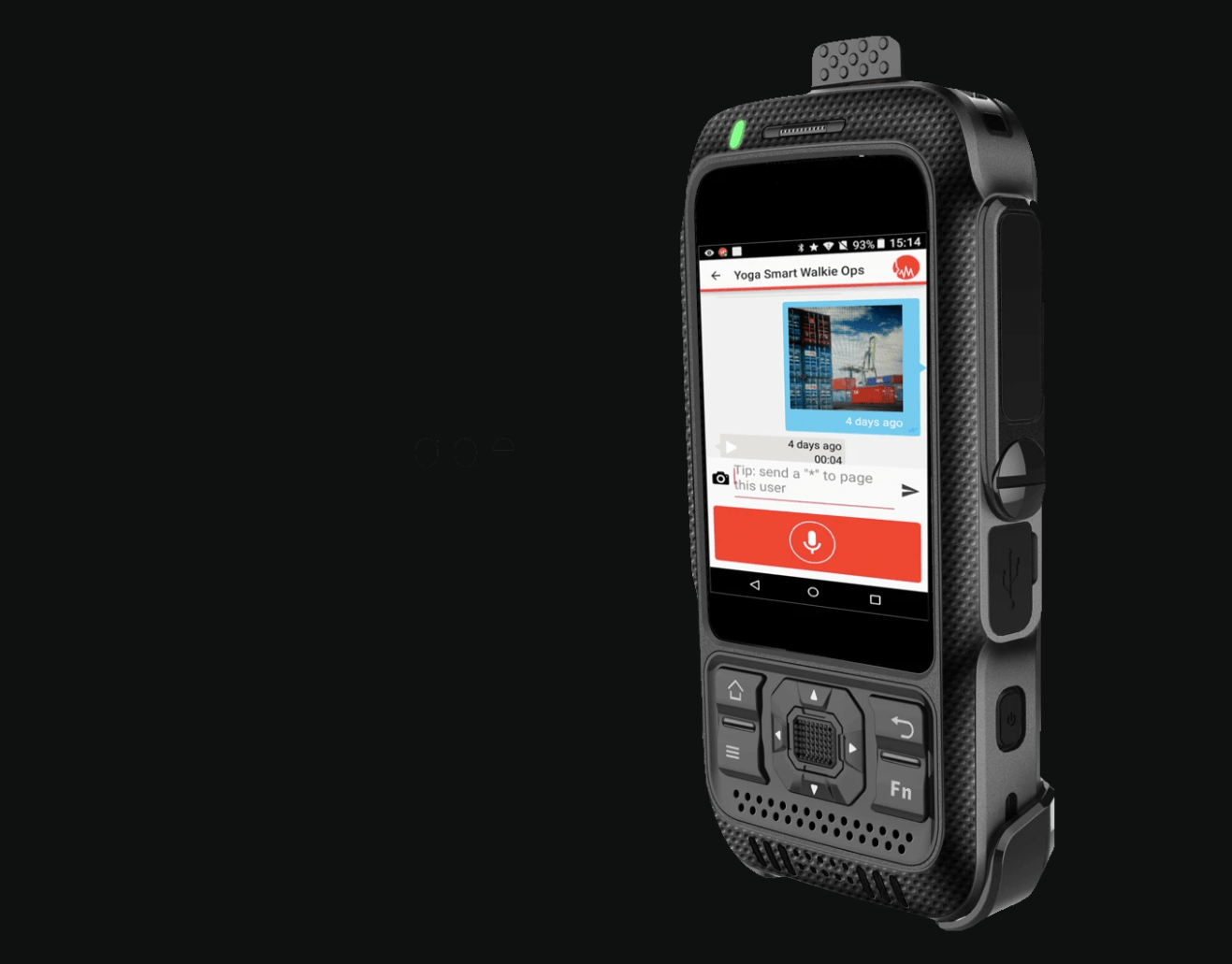
Smart Walkie Talkie’s rugged smartphone / Photo credit: Smart Walkie Talkie
One of the most frequent problems for walkie-talkie apps, however, is that the PTT button doesn’t always work. Other complaints include high battery usage, plenty of ads, low volume, or poor overall user experience.
Still, the number of apps and complaints does show a clear demand for integrating a walkie-talkie function into mobile phones.
Wenhan Zhou realized that when leading Singaporean telco SingTel asked 2359 Media, an app development company he had co-founded in 2009, to create a communications app for the telco’s hotel clients. So, in 2015, 2359 Media launched VoicePing, which Zhou claims to be one of Singapore’s first walkie-talkie apps that can be installed on smartphones.
However, a smartphone’s volume typically ranges from 60 to 80 decibels (dB), making it difficult to hear voice messages outdoors and in loud environments. (Case in point: the Galaxy S10, hailed this year as one of the smartphones with the loudest speakers, only reaches a voice volume of 82.2 dB.)
Mobile phones also don’t typically come with dedicated PTT buttons, which means most smartphones with walkie-talkie apps don’t offer true PTT functionality. The lack of a physical button makes it hard to instantaneously send messages while one is on the move or in situations that require a high degree of focus, such as driving, operating heavy machinery, or responding to emergencies. And it can be inconvenient to wield both a bulky walkie-talkie and a smartphone while on the field.
To solve these problems, Zhou created the Smart Walkie Talkie and left 2359 Media in 2015 to launch its eponymous company. Smart Walkie Talkie is a smartphone and walkie-talkie hybrid with a rugged exterior, a dedicated PTT button, and a volume range of up to 110 dB depending on the hardware model. The phone can be paired with VoicePing and offers GPS tracking and in-app document submission protocols. Workers can use the phone’s camera to snap and send work proof pictures.
The customized phone also comes with a clip that can be attached to work clothes so that it does not need to be in hand all the time. For most users, precise location tracking at every moment is not required, which allows the phone to reduce battery usage as it does not collect GPS data at very frequent intervals. The company does offer adjustable intervals depending on the level of location accuracy required by the client, though.
VoicePing’s enterprise version lets companies manage devices and send information to field workers from a desktop computer. It also comes with application programming interfaces for enterprise resource planning software. For example, by integrating the app with manpower scheduling software, a company could automatically create VoicePing groups based on the assigned crew and specific jobs for that day.
To date, around 250 companies have used Smart Walkie Talkie, ranging from small businesses with five staff to major enterprises like Cisco, Cappella, and Shangri-la Singapore. Clients from the hospitality sector make up 20% of their customer base, while the logistics sector contributes another 20%.
The rest comprise a variety of companies, such as security and manufacturing firms. Car workshops, as well as waste management and water filtration companies, also use Smart Walkie Talkie – people Zhou never imagined would be using the product when he launched the company.
These types of companies tend to have large, mobile, or dispersed teams that need to communicate with one another frequently. Smart Walkie Talkie’s research shows that such field-based workers make up 60% of Asia’s workforce. The company’s total addressable market in Southeast Asia and Australia is estimated to be US$1.5 billion a year with 18 million work subscribers, according to a post by Zhou on LinkedIn.
Finding a market for apps
The rule of three
Competing apps and hardware
Stay ahead in Asia’s tech landscape
This is premium content. Subscribe to read the full story.
Around 250 companies have used Smart Walkie Talkie, ranging from small businesses to major enterprises like Cisco, Cappella, and Shangri-la Singapore.
We know this is not ideal. ⌛ Sign up in 20 seconds. Cancel anytime.
Our subscriber community includes professionals from these companies:





Stay updated on the go with our mobile app.
Get latest insights with smoother, more personalized experience through TIA mobile app.