In recent years, there has been a wave of Chinese electric-vehicle makers – from Byton to Nio to Xpeng – looking to take on Elon Musk’s Tesla, encouraged by government support for a move away from the internal combustion engine.
Now that the Palo Alto-based giant has slashed prices ahead of commencing local production later this year in China, people are asking if the burgeoning crowd of domestic challengers are going to run out of road.
It has become such a hot topic that even Miao Wei, China’s industry and information technology minister, has joined the debate.
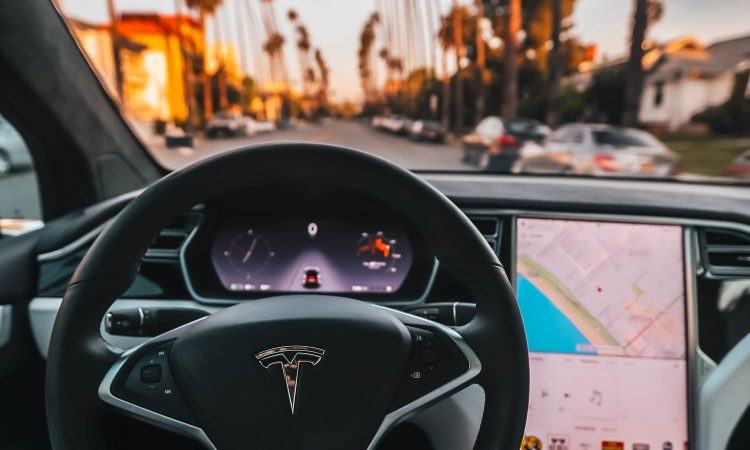
Photo credit: Roberto Nickson / Unsplash
“Not all [independent Chinese carmakers] will die, but neither can they all survive,” the minister told the China Securities Journal when asked about the impact of Tesla’s price cuts on the sidelines of the National People’s Congress on Tuesday.
Competition from Tesla is a “good thing” for domestic companies as the two sides can learn from each other, said Miao, adding that the market can decide which ones survive.
Intense debate has emerged since Tesla announced its biggest price cuts in China earlier this month, involving reductions as big as 28 percent for Model X, Model S, and Model 3 cars. The Model 3, Tesla’s cheapest car, now has a floor price of 407,000 yuan (US$60,600), according to the company’s Chinese website. The cuts come ahead of the expected start of local production in Shanghai later this year, which could also help to lower average selling prices.
“Rounds of price reductions would damage brand image as well as customer loyalty,” said William Li Bin, Nio’s founder and chairman on an earnings call last week, where competition with Tesla was the most asked-about subject. “We are committed to adopting a reasonable pricing strategy instead of lowering price to gain market share.”
There is a lot at stake for those wanting to crack China’s EV market. Sales of new energy vehicles (NEVs) bucked the trend with a year-on-year increase of 61.7 percent in 2018 to 1.26 million units, according to data from the China Association of Automobile Manufacturers. This rapid growth has largely been driven by government incentives to encourage consumers to shift away from gas guzzlers.
Nio and Xpeng are among the dozens of Chinese startups attempting to upend established carmakers and Tesla, betting that the future of mobility lies in connected smart cars. At the same time, EVs have lowered the barriers to entry for car-making because they do away with internal combustion engines that require hundreds of precisely engineered parts.
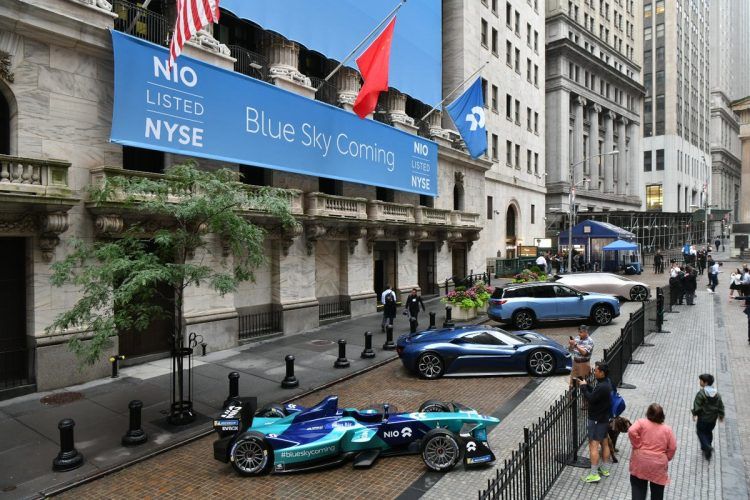
Nio cars at New York Stock Exchange IPO / Photo credit: Nio
China sees connected EVs as an opportunity to reduce foreign oil imports and finally gain parity in car production with established powerhouses such as Germany, the US, and Japan.
That is what inspired China to issue new car manufacturing permits to companies outside the traditional carmakers – many of whom were content to continue producing cars for overseas joint venture partners – hoping to inject innovation and create a homegrown Tesla.





Stay updated on the go with our mobile app.
Get latest insights with smoother, more personalized experience through TIA mobile app.