 Terence Lee · · 4 min read
3D printing pioneer Stratasys opens Singapore office in search of ideal ratio
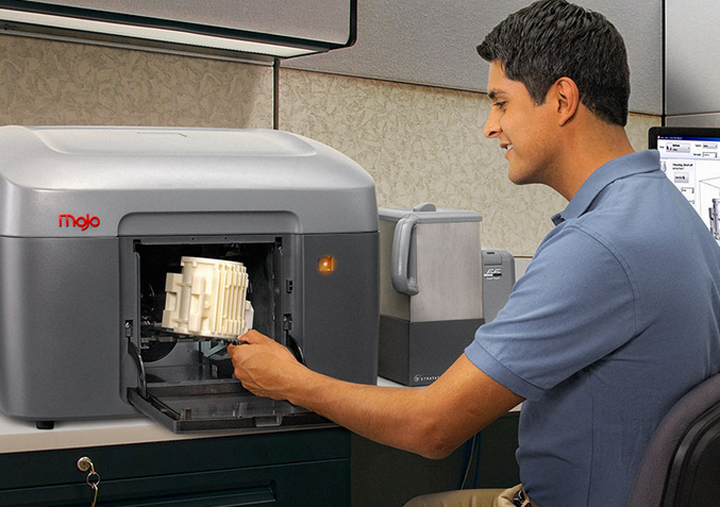
Photo credit: Stratasys
Asia has awakened to the possibilities of 3D printing, with early adopters around the region tinkering with hardware hacking, partially for fun, and also to tease out the commercial potential of a technology that could eventually disrupt entire supply chains.
However, Stratasys (NASDAQ: SSYS), a US-based pioneering maker of professional-grade 3D printers, has notably been working at it for decades. In a bid to bring the technology to widespread adoption, it has developed an interesting way to gauge success: Studying ratios.
Jonathan Jaglom, general manager of Stratasys in Asia-Pacific and Japan, explained this to me when he was here in Singapore this week at a 3D printing conference to talk about his prognosis for the technology’s prospects in the region.
One indicator to watch, he said, is the ratio between the number of 3D CAD software programs and 3D printers in the world. The ratio in Asia-Pacific lies between 1:80 and 1:120, according to studies by Stratasys, nowhere near an ideal situation. But that is good news to the company, since it hints that 3D printing could experience a boom in the coming years.
It is this potential boom that explains Jonathan’s presence in Singapore. It also explains why Stratasys, a company with over $400 million in annual revenue, decided to launch a new office here last week, its seventh location in Asia. Japan may be the largest Asia-Pacific market for the company, but China followed by Southeast Asia are the fastest growing. Asia-Pacific as a whole is Stratasys’ fastest rising region in sales.
Asia muscles in on 3D printing
While the small Singapore office with a “handful of staff” will deal mainly with customer retention, support, and marketing activities, Jonathan says that Stratasys is open to doing more, perhaps even setting up an R&D center on the island. While talks with the government are still in the early stages, the state has recently announced a decision to pump S$500 million ($400 million) over the next five years into a “future of manufacturing” program, which includes 3D printing.
Singapore’s move echoes what is being done in China, which has invested in several 3D printing research centers and set up an alliance involving businesses and universities to work out new industrial standards and policies.
For sure, Asia has been slow to realize the possibilities of 3D printing, even in the enterprise sector alone. At a panel discussion where Jonathan was involved, held at the Inside 3D Printing conference, he faced questions that dealt with basic knowledge like how 3D printing can be utilized for manufacturing and the medical field — when in fact medicine was a pioneer use case for 3D printing when the technology emerged in 1988.
But Asia could catch up soon. Jonathan’s eyes brightened when he talked about the universities and colleges in Singapore, which are buying high-end 3D printing platforms. That is generally not the case among universities in Europe and the United States, which tend to for lower-end ones. He adds:
Asia is all about growth. Education is a means to mitigate the gap between Asia and the West, since manpower is the way to catch up. It also helps that the Singapore government has the ability to think long-term, and is not subject to budget cuts.
Of course, ramping up a nascent industry in Asia won’t be easy, and Jonathan, whose shoulders sagged a little after seemingly visualizing the road ahead, acknowledged market education as his “biggest challenge”.
3D printing may now be a familiar word around town, but it will take a lot of awareness-building before the masses can explain in detail what the phrase actually means. The process of converting the masses is complicated, and involves getting potential customers to buy-in and switch from their old habits. Gesturing to the conference hall, Jonathan asks:
Waiting for boomtime





Stay updated on the go with our mobile app.
Get latest insights with smoother, more personalized experience through TIA mobile app.








📅 Upcoming Events
22 October 2026
Payoneer x CSPN Summit 2026