- Insights This article was written by a TIA community member. Insights pieces undergo the same rigorous editorial process that newsroom-produced articles have.
 Ada Kong · · 5 min read
Hormuz closure exposes Taiwan and Korea’s AI energy trap
The ripple effect of the ongoing Strait of Hormuz crisis is spreading far and wide, with Taiwan and South Korea – the two indispensable hardware anchors of the global AI era – bearing some of the biggest impact.
Both economic powers have doubled down on gas imports for their power generation needs in the past few years, a structural flaw that the current energy crisis has exposed. As the main manufacturers of the high-end semiconductors and memory chips powering the world’s tech revolution, their competitiveness and local companies have come under serious risk.
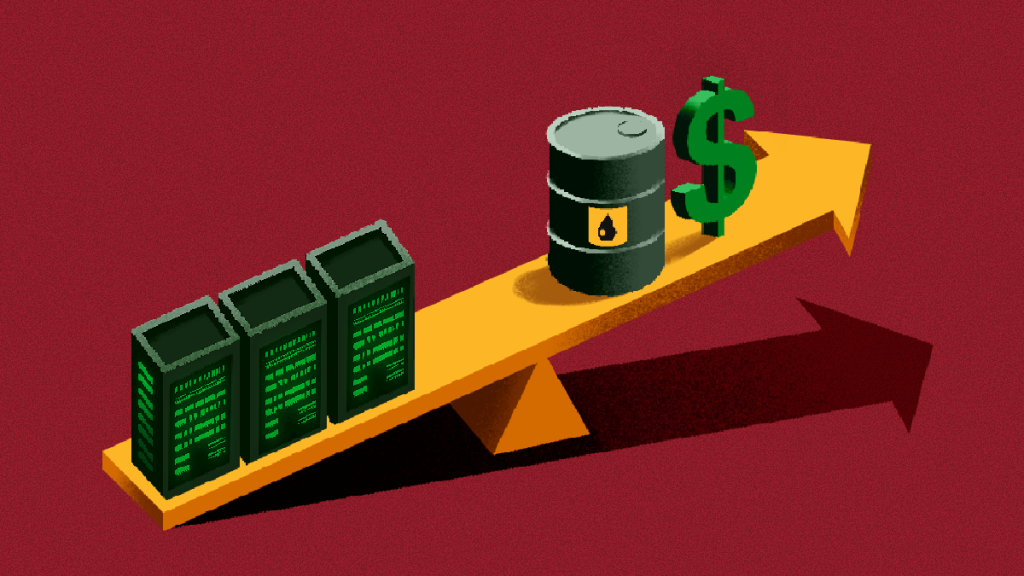
Image credit: Ulla
The concern isn’t just around energy spending. The world’s biggest tech buyers, including Apple, Google, and Microsoft, have all committed to ambitious clean energy targets.
For Samsung, SK Hynix, and TSMC, whose fabrication plants – also known as fabs – run on whatever the grid provides, meeting those supply chain requirements is becoming structurally difficult when that grid is largely powered by gas.
Wired to the grid, exposed to the world
Taiwan and South Korea are reliant on fossil fuel imports to power their factories. With chip fabrication among the most energy-intensive industrial processes on earth, grid composition matters a lot.
Taiwan accounts for 60% of global chip manufacturing revenue and 90% of the most advanced chips, which are crucial for the AI sector. Yet the country relied on imports for 95% of its energy needs last year, including more than 38% of its natural gas and 70% of its crude oil from the Middle East.
See also: The power problem behind India’s AI ambitions
Meanwhile, in South Korea, SK Hynix and Samsung collectively control around 70% of the global market for DRAM (dynamic random-access memory) – the memory chips that power everything from servers to smartphones. Similarly, the country imports 94% of its energy and 72% of its crude oil from the Middle East.
The dangers of having so much energy imported has become apparent starting February this year, as the US-Iran war disrupted shipping through the Strait of Hormuz.
While Taiwan’s government says it has enough liquefied natural gas (LNG) supplies to last throughout May, the cost of replacement shipments is surging. Should supply interruptions persist, the country would need to turn to the spot market – where the JKM, the Asian benchmark price for LNG, has spiked around 80% since the war began on February 28, according to National Central University professor Chi-yuan Liang.
In South Korea, volatility in oil and gas prices has already shaken economic confidence. The South Korean won has plunged to a 17-year low, and mounting pressure on production costs from rising oil prices is intensifying stagflation fears. Manufacturing costs are projected to rise by 0.71% for every 10% increase in international oil prices.
Doubling down on gas
This dependence on imported fossil fuels looks set to only increase.
Instead of shielding its economic engine with price-stable, cleaner energy, South Korea is deepening fossil fuel dependency – and binding its highest-growth industries to it. Under the government’s 11th Basic Plan for Electricity Supply and Demand, which is due for revision this year, LNG generation capacity is expected to surge from 43.2 gigawatts to 69.2 GW by 2038, largely driven by coal-to-gas conversions and new infrastructure such as the Dangjin LNG Terminal.
Customers are already watching
Stay ahead in Asia’s tech landscape
This is premium content. Subscribe to read the full story.
These countries make the chips powering the AI era, but the two import most of their energy from a region now in crisis.
We know this is not ideal. ⌛ Sign up in 20 seconds. Cancel anytime.
Our subscriber community includes professionals from these companies:





Stay updated on the go with our mobile app.
Get latest insights with smoother, more personalized experience through TIA mobile app.