- Premium Content It takes our newsroom weeks - if not months - to investigate and produce stories for our premium content. You can’t find them anywhere else.
 Melissa Goh · · 6 min read
A history of Singtel’s successes and failures in reinventing itself
Digital disruption is hard to do, and it’s even tougher for large companies that lack the agility of startups. But this hasn’t deterred telecom giant Singtel from trying.
The Singapore-headquartered company has over 700 million mobile customers worldwide. Beyond the city-state, Singtel counts telecom companies Bharti Airtel in India, Globe Telecom in the Philippines, AIS in Thailand, and Telkomsel in Indonesia as regional associates, and wholly owns Optus in Australia.
While the telecom giant has tried its hand in over a dozen digital offerings over the years, not all of them have been met with equal success. Take mobile wallet Dash for instance: Part of the firm’s International Group, Dash launched two years ahead of GrabPay and the same year as DBS PayLah but trails behind both competitors in usage and downloads in Singapore.
That said, other Singtel products like Gomo, a no-contract, all-digital mobile plan launched in March 2019, is gaining traction. It rounded up over 80,000 customers in its first year, according to the telecom giant. Gomo was Singtel’s response to the rising popularity of the generous – yet affordable – data plans first launched by digital telco Circles Life in Singapore, where it claims a 5% market share.
Over the years, Singtel has also pumped significant money into its digital advertising and cybersecurity businesses, neither of which have yet to make a profit.
Among Singtel’s three main business lines, Consumer, Group Enterprise, and Group Digital Life, the first two make up the lion’s share of operating income, as measured in EBIT (earnings before interest and taxes). Group Digital Life, Singtel’s digital services arm, is currently still loss-making.
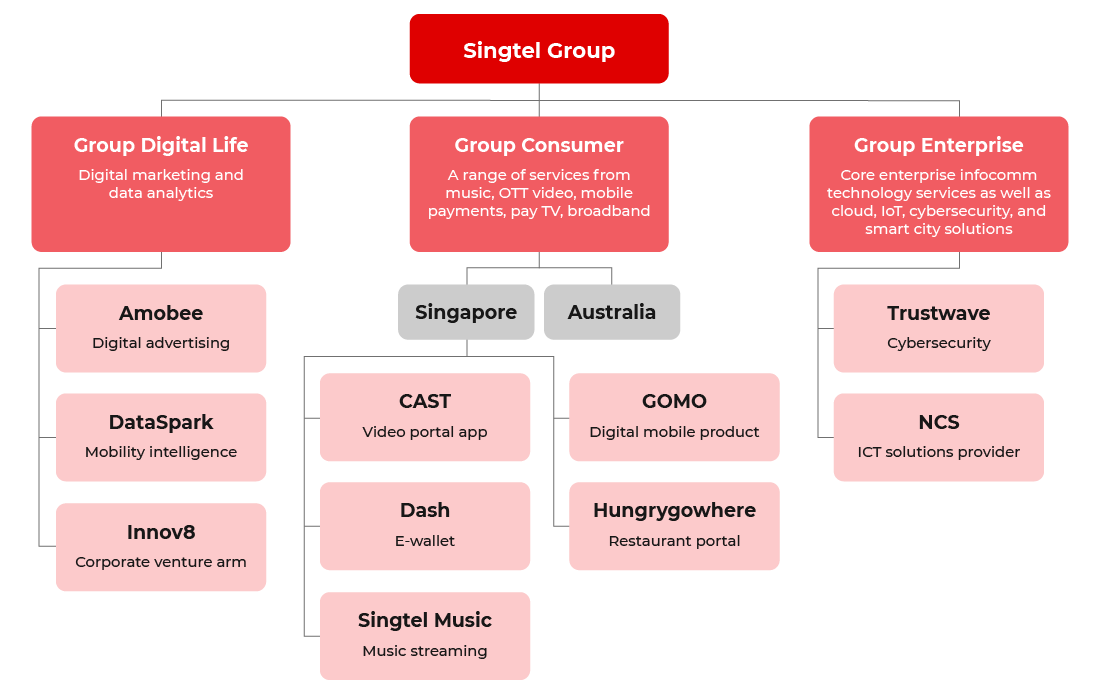
Some of Singtel’s digital offerings / Table: Tech in Asia
In recent years, the telecom firm has set its sights on gaming and esports in order to reach out to Gen Z and millennials. In March, the firm beefed up its gaming offering with a joint venture in Storms, a gaming news and discovery app, which it invested in together with AIS and South Korea’s SK Telecom. The financial terms of the series A investment were not disclosed.
“We see great potential in Southeast Asia where over 200 million are gamers,” said Arthur Lang, CEO of Singtel International Group.
Consumer offerings
Singtel’s digital bets began as early as 2009, with the launch of music download service AMPed and lifestyle site inSing.com, which offered restaurant and entertainment deals.
Between 2010 and 2011, it launched several e-publishing initiatives, including e-magazine and e-book readers Delite and Skoob, the latter of which rivaled Amazon’s Kindle.
In 2012, Singtel launched Newsloop, a free news aggregator app, which offered local and international news as well as magazines – similar to US-based Flipboard. Newsloop appears to have shut down around August 2019.
A surprising exit
Enterprise offerings
Stay ahead in Asia’s tech landscape
This is premium content. Subscribe to read the full story.
From ecommerce, an e-magazine, a messaging service, a lifestyle site, to investing in a gaming startup – Singtel has done it all.
We know this is not ideal. ⌛ Sign up in 20 seconds. Cancel anytime.
Our subscriber community includes professionals from these companies:





Stay updated on the go with our mobile app.
Get latest insights with smoother, more personalized experience through TIA mobile app.








📅 Upcoming Events
22 October 2026
Payoneer x CSPN Summit 2026