Ali Nawab is a founding partner of One Ten Ventures, a venture capital firm focused on digitization and global business along the Pakistan-Middle East-Canada corridor. He has led value creation for large companies globally, taught at Tsinghua University in Beijing, writes code, and has led successful and unsuccessful startups for over ten years. He is currently working on a wearable technology startup between Dubai and Toronto. He can be reached on Twitter at @alinawab.

Pakistan is undoubtedly the next frontier for entrepreneurship, which is still seeing massive investor interest and rampant growth despite the many challenges facing the country. While investment in Pakistan traditionally focused on real-estate, manufacturing, and imports, a large portion of local and foreign investors are looking at the booming internet industry as an avenue for diversification and also to gain first mover advantage in an untapped market.
The growth in Pakistan’s internet industry is being led from the front by a cadre of young entrepreneurs, all of whom have a strong desire to contribute to their local economy and give back to the community. Many of them have a mix of local education and foreign exposure, and use their understanding of markets to drive innovation in Pakistan.
Many entrepreneurs, however, are still on the fence about leaving their comfortable careers and returning to Pakistan, despite a drive to be the change they want to see in Pakistan. Many were eagerly awaiting results of the election last May 11, waiting for a glimmer of hope to drive their decision, which was quite clearly visible in the election results.
For anyone contemplating a move to entrepreneurship, the good news is that there are tremendous value creation opportunities across multiple industry sectors in Pakistan – as seen in this chart:

Note that the above landscape focuses solely on consumer-facing technology startups; I’m planning a follow-up article on B2B companies. Pakistan also has several large technology companies running with limited publicity; some are mentioned in this article by Farrukh Zafar, while others are listed on the startup directory from DYL Ventures which lists about 65 startups at the time of writing this.
So, if you have identified your target market, the next step is to rapidly build up the capabilities and gain first mover advantage. There are three key drivers for setting up a business in Pakistan today which can be grouped into priorities, process, and resources. Entrepreneurship is a priority area for everyone given the demographics, as they can see the immense demographic growth, internet penetration, and many verticals ripe for digitization. On the process side, there is an acute shortage of mentors, incubators, advisors and guides for aspiring entrepreneurs that can help turn an idea into commercial success; however some self-organized groups are leading the way.
Resources are Pakistan’s key strength and challenge at this point. Salaries for a fresh graduate from a technical college for a startup can start under Rs 25,000 ($250), however its top technical universities only produce about 1,000 graduates annually. Given the rapid development of entrepreneurship in Pakistan, there is likely to be an acute shortage of high quality resources – so hopefully a reverse brain drain occurs as more foreign-educated nationals return home.
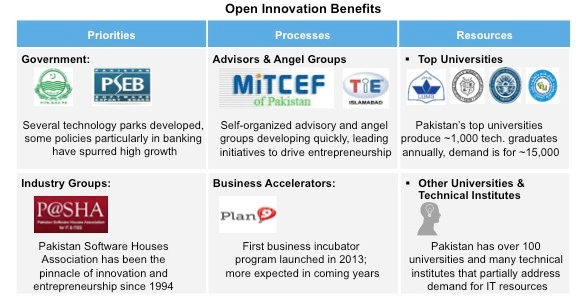
Overall, Pakistan’s entrepreneurial landscape is poised to be the engine that leads Pakistan’s economic recovery. Given that it’s driven by a young and educated workforce, developing business accelerators and increasing priorities on entrepreneurship are vital to the success of these emerging internet startups.





Stay updated on the go with our mobile app.
Get latest insights with smoother, more personalized experience through TIA mobile app.