Erik Crouch · · 6 min read
Myanmar was off the grid for decades – now it’s catching up fast

SIM cards for sale in Yangon. Image by Remko Tanis
But starting in 2011, the country’s tech went into hyperdrive. Between 2011 and 2012, the percentage of people with cellular subscriptions nearly tripled. Between 2012 and today, it has gone up almost nine-fold.
Percentage of Myanmar population with cellular subscriptions
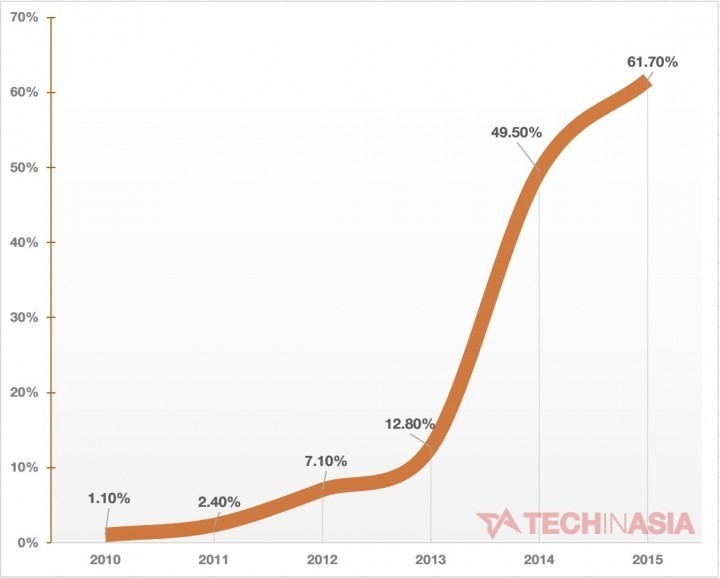
2010 – 2014 data by World Bank – 2015 estimated based on telecom data
The country’s transition from military rule to democracy has been paralleled by another revolution – the one that took people from complete disconnection to smartphones, Facebook, and startups.
Facebook is the internet: both good and bad
Two people I spoke with about tech in Myanmar were David Madden, founder of the Phandeeyar Innovation Lab, and Poppy McPherson, an editor at the Coconuts Yangon website.
Both Poppy and David said, verbatim, the same thing: in Myanmar, Facebook is the internet.
“Publishers will often post news updates and picture stories straight to Facebook, with no link to the homepage,” says Poppy. “Even writers and poets post their work direct to the site.”
Facebook has become a vibrant portal for news and politics in Myanmar, and it’s one that the government has embraced as well.
“The Minister of Information – famously known as the ‘Facebook Minister’ for his extensive use of the social network – has more than 300,000 followers,” says David. “For millions of people, Facebook has become the go-to site for news, discussion, and debate.”
In Myanmar, Facebook is the internet.
All this in a country that, just a few years ago, had internet penetration rates lower than North Korea’s, and a censorship regime that rivaled mainland China. Pre-publication censorship officially ended in 2012, and a vibrant network of hard news, tabloids, and lifestyle publications have erupted in the years since – and many rely exclusively on Facebook for distribution.
This abrupt opening-up has brought some of the best and the worst impulses of an online citizenry out into the public.
Mobile or bust
“The only operator used to be the state-owned telco MPT (Myanma Posts and Telecommunications). It charged US$250 for a SIM card and the network wasn’t great,” says David. In the brief time since foreign telecos started operating in the country, however, prices have plummeted while coverage has soared – David says there are now “thousands of towers, covering well in excess of 50 percent of the population.”“20 years of consumer internet is all being built at the same time,” David says. “There are startups building ride-sharing apps and anonymous social messaging apps. Then there’s everything in between: education apps, online bookstores, ticketing, and more.”
Making sense of a tech explosion
During the country’s recent elections, not only was the online debate lively, but it had real consequences. There was a boom in apps that explained each candidate and their positions. The country’s voting lists were digitized, and authorities used apps to monitor against fraud.Things are more optimistic in the world of startups. David’s Phandeeyar program runs a co-working space and classrooms in downtown Yangon. In 2015, Phandeeyar (which means “creation place” in Burmese) held dozens of workshops and seminars, as well as three hackathons.





Stay updated on the go with our mobile app.
Get latest insights with smoother, more personalized experience through TIA mobile app.