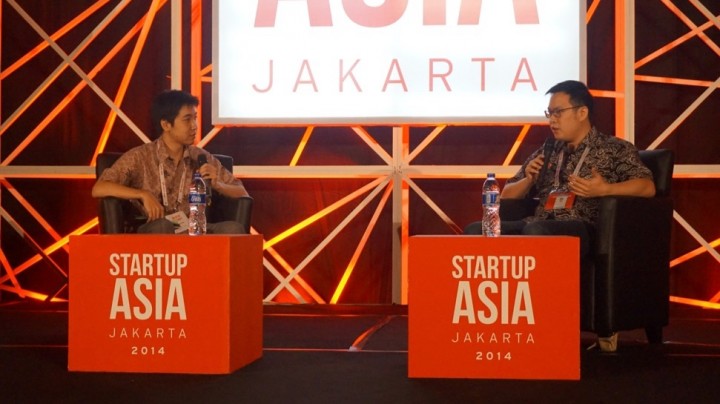
His name may not be familiar, but if you’ve booked a flight from Indonesia in the past couple of years, chances are you’ve heard of his startup, Traveloka. As of late, Traveloka has managed not only to become one of the go-to websites for flight bookings but also one of the most well-known Indonesian startups overall. At Startup Asia Jakarta 2014, CEO Ferry Unardi talked about his startup journey thus far.
Where most startup founders share a similar backstory of how their entrepreneurial drive pushed them to start a company, Traveloka’s story is a little different. As Unardi puts it, “I don’t see myself as an entrepreneur, I’m more of an engineer.” As someone who got the “engineering bug” as a teenager and moved on to studying math at university and a career at Microsoft, starting a company was the furthest thing from his mind. That was at least until three years after he started working for Microsoft when it struck him that he “might not be the best engineer”. It was after that Unardi decided to look into other opportunities. On a whim, he decided to take a flight to China just to see what the market had to offer. He noted that the travel industry seemed interesting but it wasn’t until a little later that the idea began to formulate.
Here’s where the story takes a twist toward the familiar, with the idea that “if there isn’t a service that’s doing what you need, build it yourself”. As a student in Boston, an employee in Seattle, and a frequent traveller to his hometown of Padang, Unardi found it increasingly annoying that he was not able to easily book a flight home as he always had complications when figuring his route out. It was then that the math-loving 23-year-old decided to step out of his comfort zone and into “the most stressful time” of his life.
Dropping out, starting up
However, where most founders start off by hitting the ground running, Unardi took a step back first. He had no business experience at all and had no idea how to run a company. So he took the logical next step and began an MBA at Harvard University. His plan was to complete his MBA at Harvard so that he would gain the experience needed to be able to manage his company well. However, after only a semester, in a situation familiar to many startups, their plans had to be changed yet again.
“I remember everyone questioning my decision to drop out, but it was what had to be done. It was a very hard decision, for both me and my partner as he was working for LinkedIn at the time and had shares that were not fully vested as yet, but I remember saying, “we’re 23, we’re young enough to make mistakes” and that there was no better time.” This was back when the e-ticketing industry was just gaining traction in Indonesia and companies like Tiket had just received funding. Unardi recalls to the audience at Startup Asia that he believed if they hadn’t jumped into the market at that exact time, they would have missed the train.
That is when Traveloka was born. Not as what we know it as today, but at its earliest form, a vastly different service as a whole. At its inception, Traveloka was merely a flight search and aggregating platform. There’s a very simple explanation as to why: it’s because Unardi and his partners were engineers and that’s what they enjoyed doing. They found solace in working with the technology and the math that went into flight searches. The market however, wanted more.
“Quickly enough we learned that the problem was not only about finding flights but about transacting as well” he explains. Customers were dissatisfied with having to use different services to finish their purchasing process, and that is when Traveloka took it upon themselves to rectify this issue. He then ran into the many issues that most companies face, not only in the technology industry but in general.
Airlines swoop in
Unardi tells us that the biggest change they had to deal with in the pivot from the company’s style came in the form of managing their team. They had to go from a group of eight to ten developers to an actual team with divisions such as customer service, as they were now dealing with people’s money, thus having a higher responsibility than they initially thought they would. Traveloka learned that it’s not possible to be a company that lives solely on the internet. Instead what startups have to do is be a grounded company with an online presence.
For someone with a limited management background, it was a challenge for Unardi to manage his team in an effective way. When asked where he took his inspiration from and what helped him manage his team successfully, Unardi cites startup veteran and venture capitalist legend Ben Horowitz’s book, The Hard Thing About Hard Things. “The book taught me that people pay attention only to growth and users but you really should focus on what’s behind that – like building the right team. People don’t talk about this because it’s not directly related to the internet. But at the end of the day we are a company and we need to first and foremost build a company,“ he says.
However, that wasn’t their only issue. As a small startup, big companies, especially the airlines were not really willing to work with Traveloka, barely even taking notice of them. In order to tackle this, Unardi went back to his earlier point of building a company with a physical focus and an online presence, rather than the other way round. Traveloka had one strategy they used to address this issue, it was the same strategy they used to gain a foothold in the market: “If you build a good service, the people will come.”
Unardi believed that you shouldn’t want to build a service where people can pinpoint the one feature that they like – instead it’s the entire service as a whole that people should like using. This is what Traveloka did; they built a service that people wanted to use. This allowed the team to build a large user base and in turn, get noticed by the airlines.





Stay updated on the go with our mobile app.
Get latest insights with smoother, more personalized experience through TIA mobile app.













📅 Upcoming Events
22 October 2026
Payoneer x CSPN Summit 2026