- Premium Content It takes our newsroom weeks - if not months - to investigate and produce stories for our premium content. You can’t find them anywhere else.
 Vincent Fernando, CFA · · 7 min read
Commentary: A Grab-Gojek merger makes sense but isn’t the smartest play
Many would agree that merging ride-hailing giants Grab and Gojek would make business sense. But that’s easier said than done and probably not the smartest move for both.
Speculation about a potential merger mounted after The Information recently reported that the Southeast Asian rivals are in discussions about a potential merger. In January, Tech in Asia published an opinion piece on why the combination makes sense. The ride-hailing giants, however, didn’t confirm the merger talks, with Gojek saying that the report wasn’t accurate.
The merger could definitely create synergies, deriving cost savings and helping the combined entity become profitable. Nevertheless, the companies have no option but to deny such reports right now, given that any public admission would invite scrutiny from the regulators and business partners as well as the media and the public.
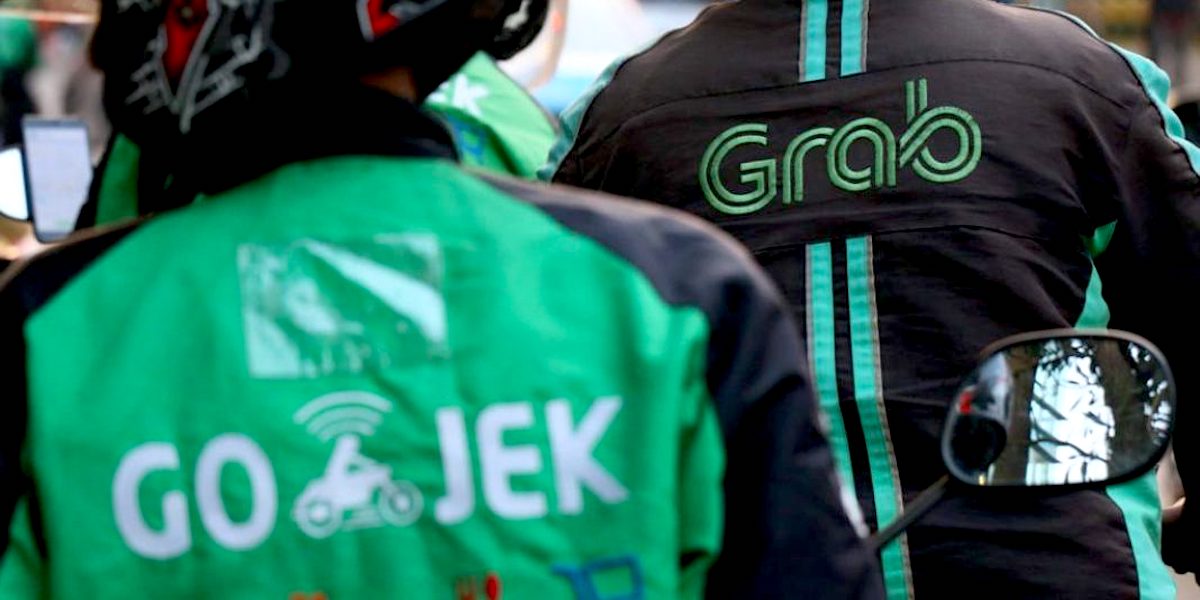
Photo credit: The Low Down
Duopoly stronger than a monopoly
Sometimes, it’s good to have large visible competitors because monopolies are usually kept in check by regulators that have mandates to protect consumers from companies that overprice their products and services. People tend to hate monopolies, but they generally tolerate duopolies or markets dominated by just a few companies. Duopolies are actually great business positions to be in, perhaps even better than monopolies because they attract less regulatory scrutiny or public outrage.
Microsoft, for example, should probably be grateful to Apple for bringing competition in the PC market all these years. Google can thank Apple as well for having iOS as an alternative to Android. Without competition, these companies would be under much harsher government scrutiny and would be much more restricted in their businesses. While surely Apple takes some customers away from Microsoft and Google, competition hasn’t prevented these companies from enjoying phenomenal growth and becoming trillion-dollar businesses.
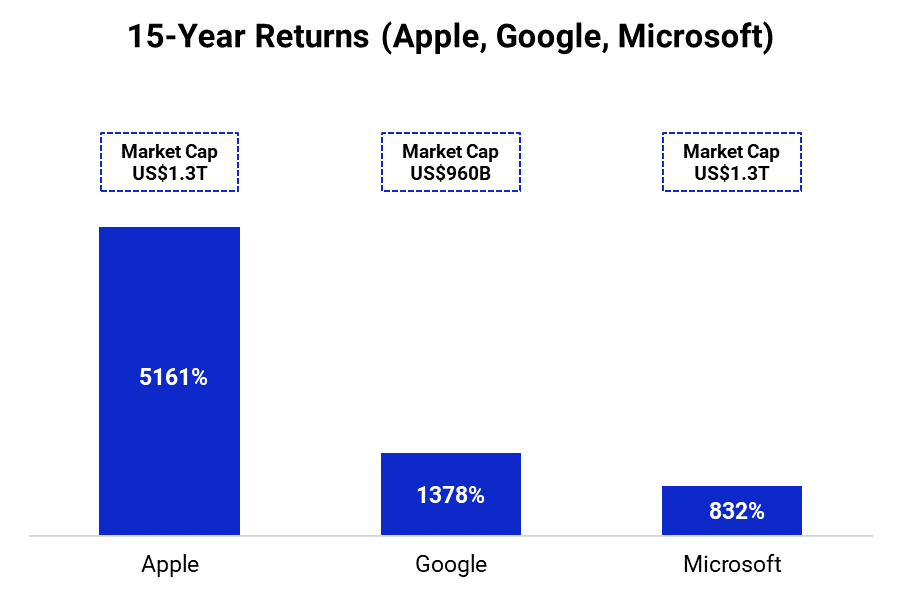
Source: Zero One
Tech vs. traditional companies
How can a tech duopoly be so successful? Because the real competition for tech companies is the traditional economy. For instance, ride-hailing is up against car ownership and taxi services, while e-commerce goes head-to-head with offline commerce.
As such, tech firms enjoy most of their long-term growth by migrating users of old technologies to their new technologies. Innovation replaces low-tech industries as the digital economy takes its share from the traditional businesses.
Expanding tech penetration versus traditional products is by far the largest growth opportunity for tech businesses, and there remains massive upside for digital economy penetration in Southeast Asia.
For example, while the number of ride-hailing users in Southeast Asia soared from 8 million active users in 2015 to 40 million in 2019, these consumers represented just 6% of the region’s population, according to a recent report from Google, Bain & Company, and Temasek.
An opportunity not to be missed
Phenomenal growth
Cement duopoly status
Stay ahead in Asia’s tech landscape
This is premium content. Subscribe to read the full story.
Sometimes, it’s good to have large visible competitors because monopolies are usually kept in check by regulators that are mandated to protect consumers.
We know this is not ideal. ⌛ Sign up in 20 seconds. Cancel anytime.
Our subscriber community includes professionals from these companies:





Stay updated on the go with our mobile app.
Get latest insights with smoother, more personalized experience through TIA mobile app.







📅 Upcoming Events
22 October 2026
Payoneer x CSPN Summit 2026