- Premium Content It takes our newsroom weeks - if not months - to investigate and produce stories for our premium content. You can’t find them anywhere else.
 Simon Huang · · 8 min read
How Grab built its lead in the food delivery war
As Grab prepares to go public, Tech in Asia is taking a closer look at each of its business segments, which one must understand to appreciate how the whole enterprise works.
We start with deliveries, which accounted for half of the super app’s adjusted net revenue in 2020 and is the largest of the company’s four segments.
Supercharged by an acquisition and a pandemic
Grab’s delivery vertical offers four main products: GrabExpress, GrabFood, GrabKitchen, and GrabMart, with food delivery being the linchpin.
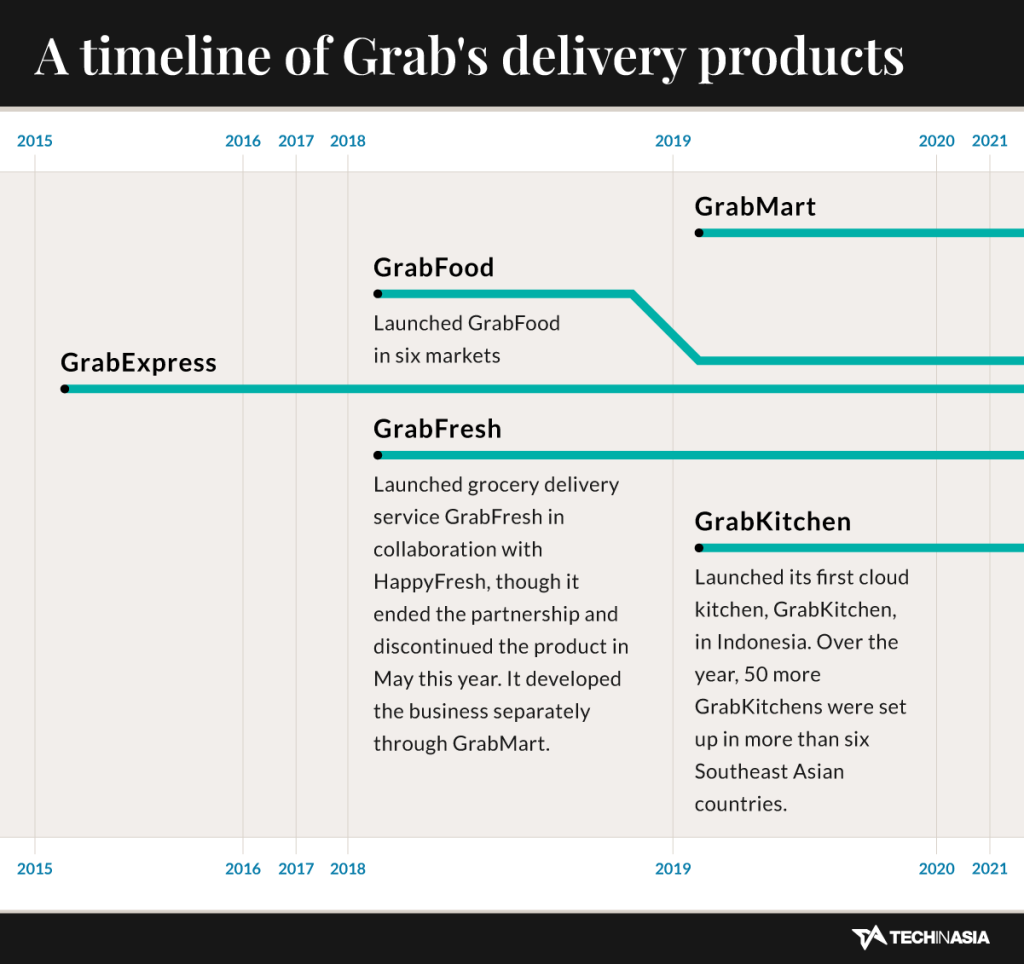
Image credit: Timmy Loen
The Covid-19 pandemic was a major growth driver for the firm’s delivery products, with adjusted net revenue in 2020 quadrupling from 2019.
However, Grab recognized the importance of food delivery even before the health crisis struck. Back in 2019, Lim Kell Jay, then regional head of GrabFood, told CNBC that “the food industry has better margins than ride-hailing. We believe that the food business is going to really fuel our growth and get us to profitability in the long run.”
That said, GrabFood’s watershed moment was really Grab’s acquisition of Uber’s Southeast Asia operations in 2018. While media and regulatory attention at the time focused on the implications for the two players’ ride-hailing businesses, what the merger did was supercharge GrabFood.
While the food delivery arm had existing businesses in Indonesia and Thailand, Uber Eats was more established and had operations in other markets, such as Singapore and Malaysia, that GrabFood was not present in.
Acquiring Uber allowed Grab to access Uber Eat’s merchant partners and talent, while also removing a formidable competitor from the playing field.
EBITDA-positive in 2022
Grab’s deliveries business is growing strongly. Adjusted net revenue rose from a negligible amount in 2018 to US$844 million in 2020, making up almost half of Grab’s total adjusted net revenue. That figure is expected to swell even further at a compound annual growth rate of 40% from 2020 to 2023.
Bear in mind that adjusted net revenue is not equal to revenue as recognized under relevant accounting rules like the International Financial Reporting Standards (IFRS).
Rather, it is a financial measure that subtracts the base incentives of driver and merchant partners from gross billings (the total dollar value of transactions conducted on the Grab platform). Base incentives are the amounts Grab pays out to its driver and merchant partners up to the amount of commissions and fees that Grab earns from these partners.
Grab has included these non-IFRS metrics in its historic numbers and projections, as it believes they are useful to understand and evaluate the performance of the business.
They also paint the business’s performance in a more positive light – the IFRS revenue for Grab’s delivery business is significantly lower at US$5 million in 2020.
A multibillion-dollar market
Food delivery turf war
Stay ahead in Asia’s tech landscape
This is premium content. Subscribe to read the full story.
Being a super app is more than having a sexy label. It brings real advantages.
We know this is not ideal. ⌛ Sign up in 20 seconds. Cancel anytime.
Our subscriber community includes professionals from these companies:





Stay updated on the go with our mobile app.
Get latest insights with smoother, more personalized experience through TIA mobile app.