- Premium Content It takes our newsroom weeks - if not months - to investigate and produce stories for our premium content. You can’t find them anywhere else.
 Thu Huong Le · · 6 min read
Vietnam’s QR code revolution puts pressure on digital wallets
Tap-to-pay methods have become popular in Vietnam, a surprising turn in a country where cash made up 70% of transactions just a few years ago.
What’s the driving force behind this shift? The unassuming quick response or QR code, which can now be found at eateries, pet food stores, hair salons, and street vendors across Vietnam, among others.
Fintech companies are not the sole drivers of this transformation.
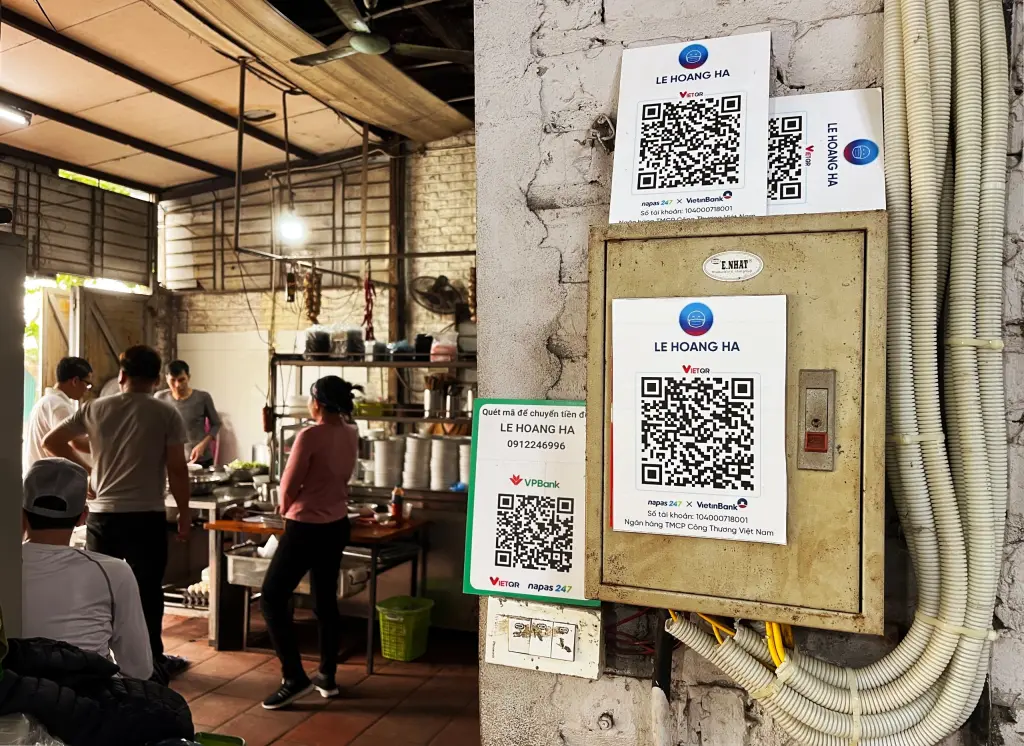
Customers can make direct bank transfers via QR codes to pay for their pho (noodle soup) in Hanoi. / Photo credit: Mai Nguyen Anh for Tech in Asia
In 2021, the National Payment Corporation of Vietnam (NAPAS) introduced VietQR, a standardized QR code system that enables customers to scan and pay across banks’ mobile applications.
Payments via VietQR doubled in volume in the third quarter of 2023, reaching 100 million transactions per month, according to NAPAS. That’s one transaction for every person in the country, which means people in urban areas use the system multiple times a month on average.
VietQR’s growing ubiquity raises several questions. For one, do consumers still need digital wallets if they can pay instantly through their banks’ mobile apps? If e-wallets are not a necessity, can they become sustainable businesses?
However, others argue that e-wallets and domestic real-time QR payments like VietQR can coexist. While the former builds services on top of the QR code network, the latter focuses solely on enabling fund transfers.
Regardless, Vietnam’s digital payment market, which will be worth an estimated US$160 billion in gross transaction value (GTV) by 2025, has entered a new era of competition.
The “unsexy” QR code
In 2020, Tech in Asia reported that about 30 digital wallets were competing to get consumers in Vietnam to go cashless. At that time, none had become as commonplace as Alipay or WeChat Pay was in China.
Since then, a select few have emerged as dominant players in the market.

With a user base of 31 million, MoMo is one of Vietnam’s most popular e-wallets. / Photo credit: MoMo
A recent report by research firm FiinGroup identified MoMo, ShopeePay, and VNPay as the leading fintech service providers in Vietnam. Another survey conducted in Q2 2023 by Decision Lab, a market research firm based in Ho Chi Minh City, found that MoMo, ZaloPay, and ShopeePay are the most popular digital wallets.
Intense competition
Competing or complementing?
Stay ahead in Asia’s tech landscape
This is premium content. Subscribe to read the full story.
Fueled by the simplicity of a QR code, Vietnamese consumers are embracing cashless payments at an unexpectedly rapid pace.
We know this is not ideal. ⌛ Sign up in 20 seconds. Cancel anytime.
Our subscriber community includes professionals from these companies:





Stay updated on the go with our mobile app.
Get latest insights with smoother, more personalized experience through TIA mobile app.