Jonathan Chew · · 6 min read
How this startup taught its AI voice bot to speak just like a local

One of the biggest milestones a child experiences is speaking their first words. For most people, talking to each other is their primary method of communication, as it is also vital for interactions.
“As humans, we love to listen, tell stories, and take joy in simply chatting with others,” says Jennifer Zhang, CEO and co-founder of Wiz.ai, a provider of AI engagement solutions that use human-like conversational voice bots.
Having co-founded startups before, Zhang instinctively understood that it was important for companies to interact and communicate effectively with their customers. This led her to take a look at one of the most important forms of interactions for businesses: customer engagement.
She discovered that the quest to maximize profits has pushed companies toward mass automation, resulting in impersonal, text-based, and self-serving solutions that skimp on customer satisfaction.
Difficulties with scaling
Traditionally, companies would set up a dedicated call center to cater to their customers. But these require a huge initial investment to establish as well as a constant inflow of both time and money to keep them running.
Scaling up voice engagement capabilities while maintaining a high standard of service is usually also a difficult affair, Zhang says.
Usually, having more call agents would mean less waiting time for customers and better service, but that also means it can be more expensive.
She adds: “Call centers have to walk a thin line between making customers happy and keeping costs low.”

Jennifer Zhang, CEO and co-founder of Wiz / Photo credit: Wiz
The human element of the call center is another pain point for most companies. Training people from scratch involves costs, and the performance of these agents can be unpredictable, Zhang explains.
Seasonal requirements – such as sales periods – also exacerbate the problem. “You can’t just hire 10x more people and then fire them the next month,” she points out.
Wanting to help businesses scale up customer engagement in a cost-efficient manner, Zhang and two other partners came together in 2019 to found Wiz. They wanted to offer an AI solution that was scalable and cost-effective while being warm and human-like.
The answer was clear: To reinvent the customer journey, the company would have to offer AI-powered voice bots. Zhang believed these were better than text-based chatbots, as talking was the “most natural way [for people] to communicate.” Voice bots would also allow companies to automate both inbound and outbound customer engagement touchpoints through a simple phone call.
All these customer calls can also be categorized with intent data. With this, companies would have access to greater business insights, allowing them to build more in-depth customer profiles as well as react proactively to rising customer trends.
Can an AI code-switch too?
Solution in hand, Zhang and her co-founders set their sights on Southeast Asia to begin their journey, starting with Singapore as a home base.
For Zhang, the region was a great place to start due to its rapid growth and the rising opportunities in its digital space. Southeast Asia has also shown a strong reception of automated customer engagement, with prominent companies like Malaysia-based airline AirAsia already having adopted AI chatbots.
The languages spoken in Southeast Asia posed a unique challenge, which Wiz was also eager to take up.
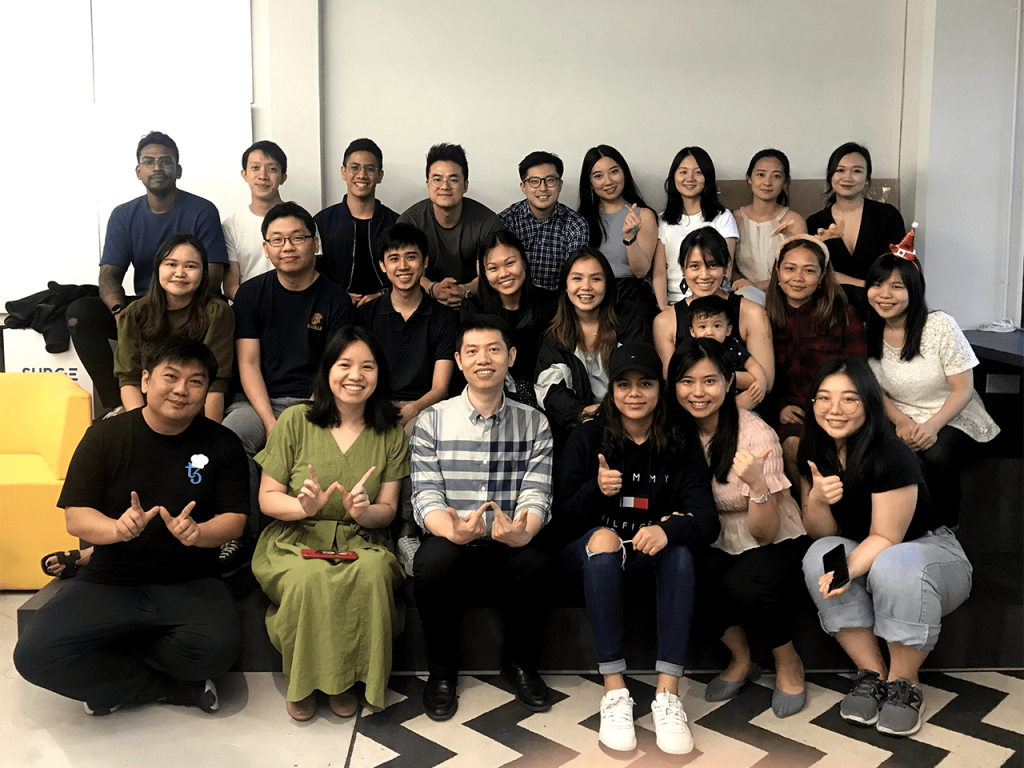
Wiz’s Singapore team / Photo credit: Wiz
“When we first entered the Singapore market, we had a steep learning curve because Singlish (a colloquial language spoken widely in the country) is very challenging,” Zhang says.
Singlish is a mix of English, Malay, Chinese, and various other languages and dialects, which makes it difficult for AI natural language processing (NLP) models to accurately analyze, especially with a local accent thrown in.
This conundrum extends throughout the rest of the region, with some 680 million people speaking more than 1,000 languages and dialects, each with their own accent.
As existing NLP models have little experience with these languages, Wiz took a step-by-step approach to introduce its AI to the different meanings and expressions in Southeast Asia’s diverse linguistic landscape.
Teaching colloquialisms to a computer
Wiz used varying examples of conversational scenarios to help its AI identify words accurately. It also trained the system to determine the meaning of special words – such as lah – used in colloquial languages like Singlish that could alter the overall meaning of the sentence.
“It’s totally different with Singlish,” Zhang says. “When we were testing the ground, the accuracy [in language processing] was below 60% sometimes.”
The company set the goal of meeting an accuracy rate of 95% to determine whether its AI could correctly process regional languages like Singlish. The development process took roughly a year before Wiz hit its target.
But it wasn’t just enough to recognize and understand the language, as Zhang also wanted the startup’s voice bots to sound authentic and sincere. To this end, Wiz fed its AI even more verbal scenarios to develop its text-to-speech capabilities, allowing the voice bot to mimic the local accent used for each language.
According to Zhang, its voice bots have become so indistinguishable from real voices that 90% of customers can’t even tell the difference.
Once the bot had solid language understanding and text-to-speech capabilities, Wiz moved on to building dialogue and conversation models for the AI that would let it map out possible responses based on what a customer says.
Putting it to use
Having implemented all of these features, Wiz can begin applying the conversation capabilities and models it had developed to varying industry-specific scenarios that might come up.
Zhang boiled down these scenarios to two main categories – inbound customer service calls, such as general inquiries or help desk calls, and outbound calls such as appointment or deadline reminders and product upselling.
“In the traditional call center, there are usually long wait times [in these scenarios]. In some instances, they may not actually employ a person because it’s too costly,” she explains. “With Wiz’s AI voice bots, you are able to spin up new bots during peak periods, and pack them away when you don’t need them.”
Still, the company isn’t looking to replace human agents entirely, but create an environment where they work together in a “human-AI” collaboration, says Zhang. The voice bots can target certain call scenarios that make more economic sense to automate – such as guiding customer onboarding – so that it lets human agents concentrate on higher-value interactions.
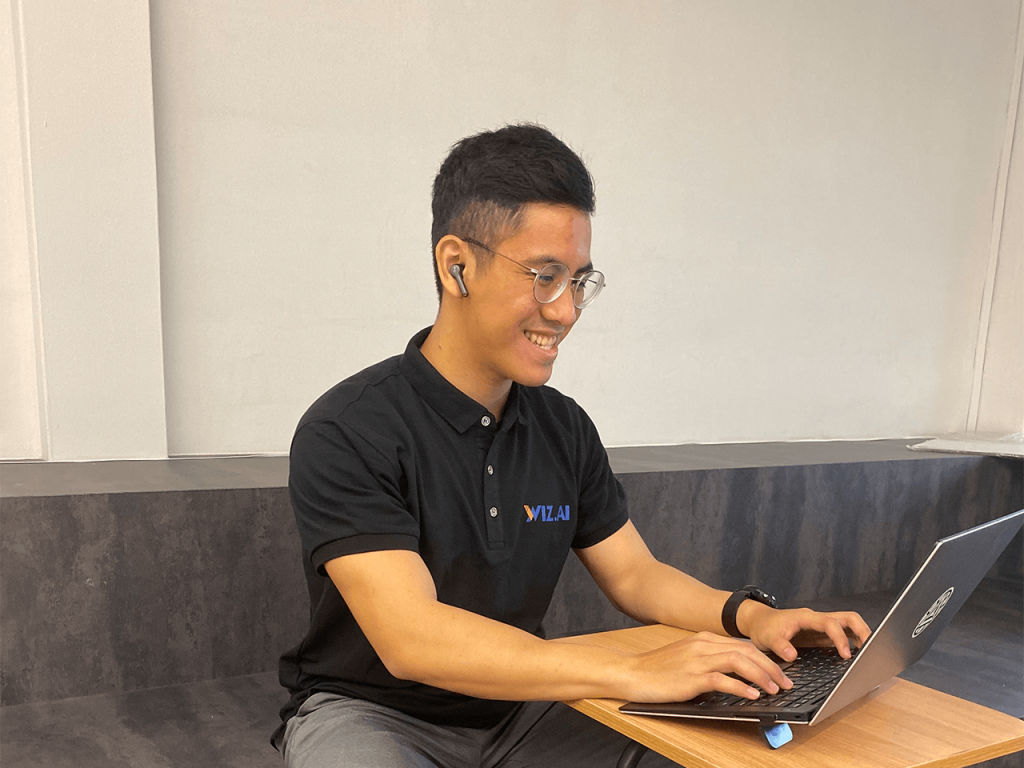
Danish Eddie, customer experience designer at Wiz, works on a dialogue interaction module for the voice bot / Photo credit: Wiz
When applied, the startup’s voice bots have helped companies automate and scale their customer engagement process in a cost-efficient manner. According to Zhang, Wiz’s voice bots have enabled businesses to lower their costs by 40% to 60%, with user acquisition going up by roughly 5x and outreach efficiency almost quadrupling on average.
With its voice bot fully developed, Wiz hopes to take it beyond its existing presence in Singapore, Indonesia, the Philippines, Thailand, and China, and expand globally by adding even more languages to the platform.
Apart from the industries it’s currently in – which have mostly been within financial services, telecommunications, and healthcare – the startup also wants to move into other promising areas like fintech, ecommerce, and government services.
“I think there’s a lot of growth for us in the future with more scenarios and [by building] more engines,” Zhang says. “We want to offer the most intelligent customer interaction solutions at an enterprise level that can cover not only Southeast Asia but also other markets.”
Wiz.ai provides voice engagement solutions for businesses through its AI-powered voice bot. Its voice AI engagement solutions are intuitive, interactive, and easily accessible by customers, while being highly scalable for companies through process automation.
Interested in trying it out? Schedule a demo with Wiz.ai on its website.
This content was produced by Tech in Asia Studios, which connects brands with Asia’s tech community. Learn more about partnering with Tech in Asia Studios.
Stay updated on the go with our mobile app.
Get latest insights with smoother, more personalized experience through TIA mobile app.
Recommended reads
 Indonesian AI startup goes global
 Forrest Li on scaling Sea, building smarter bots, and founder grit
 An AI assistant that joins sales calls and scores team skills
 Beyond the check: Why VCs need more than capital
 SGX’s CEO says it doesn’t need a unicorn to win
 SMEs want AI too, but not the kind Big Tech is selling
 Oatside’s alt-milk rise hits a profitable gear
 Alibaba’s financial health in 12 charts
 Asia’s telcos bundle AI into mobile plans. Will it pay off?
 M-Daq chases bigger clients as revenue falls, losses grow





Editing by Nathaniel Fetalvero, Lorenzo Kyle Subido, and Jaclyn Tiu
(And yes, we’re serious about ethics and transparency. More information here.)