- Premium Content It takes our newsroom weeks - if not months - to investigate and produce stories for our premium content. You can’t find them anywhere else.
 Jack Ellis · · 5 min read
Grab may have cause to sue Go-Jek over map copying, say lawyers

Photo credit: Grab
Go-Jek launched its Singapore ride-hailing app in beta last month, satisfying the city-state’s craving for a ride-hailing service to take Uber’s spot and compete on the level with the latter’s acquirer Grab.
The Indonesian company’s Singapore entry was quite some time in the making, having first been announced back in May. But a report earlier this week suggested that Go-Jek may have cut a few corners in order to get its service up and running.
Based on a tip-off, Mothership pointed out several uncanny similarities between the maps of Singapore that appear in Grab’s and Go-Jek’s apps – similar enough for the news site to state that “either Go-Jek’s team manually copied all of Grab’s pick-up points onto their own map or they wrote a code to pull out the map data from Grab’s app.”
No accusation, no denial
When asked by Tech in Asia to comment on the copying allegation, Go-Jek didn’t deny that it may have used information from Grab.
It said in a statement that its app “uses raw data on pick-up [and] drop-off points from multiple sources, including our riders and drivers. We then use an algorithm to analyze and refine map data in order to enhance user experience.”
Grab didn’t explicitly accuse Go-Jek of copying, but it was keen to emphasize the value of in-house research and development.
“Grab cares about our customers and believes that it is important to invest in technology to create a good experience for them. Pick-up and drop-off points may seem to be small details, but they are very important in completing that good experience,” the company told Tech in Asia in a statement.
“In fact, we have a dedicated mapping team who is focused on improving the user experience by adding very precise pick-up points in the app,” the statement continued. “We do that by using huge amounts of historical ride data [and] machine learning, collecting direct passengers and drivers feedback, physical[ly] vetting some high-frequency locations to find the right spots, and hosting mapathons. This has resulted in more than 5,000 specific pick-up points in Singapore, of which many are unique to Grab’s app alone.”
Possible legal options
That could sound like Grab is trying to present itself as an innovator whose hard work has been appropriated by a copycat competitor. Without evidence that any laws have been broken or that it is being subjected to unfair competition, the Singapore-based company can do little more than engage in a war of words over Go-Jek’s alleged copying. Data scraping is, after all, a fairly commonplace practice among tech companies.
Wayne Ong, a commercial and private lawyer in Singapore, tells Tech in Asia that Go-Jek’s alleged actions “are likely not criminal in nature.”
However, “Grab may have a claim against Go-Jek for infringement” if any intellectual property-protected material has been copied, he adds.
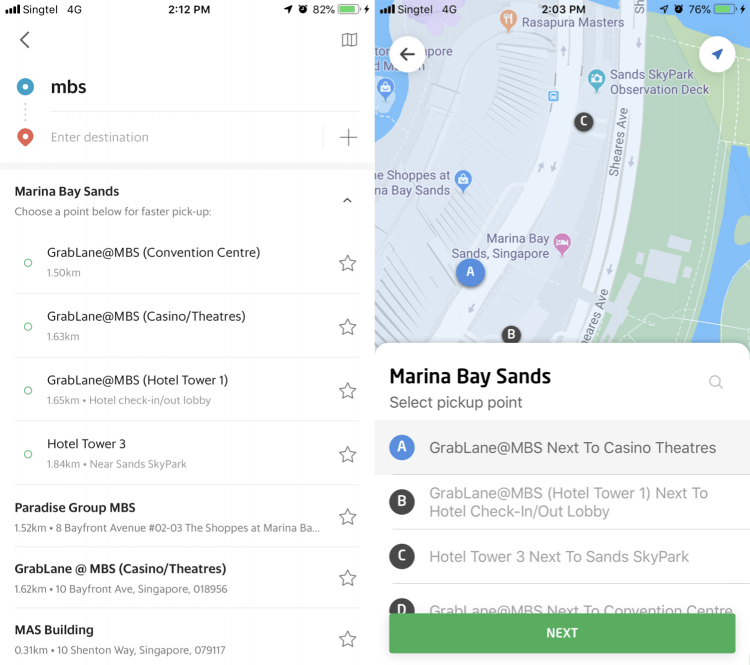
Grab on the left, Go-Jek on the right / Photo credit: Mothership
Fingerprints
Not for the first time
Stay ahead in Asia’s tech landscape
This is premium content. Subscribe to read the full story.
“Data scraping,” in one form or another, is a fairly commonplace practice. But the way in which it is done determines whether or not it’s legal.
We know this is not ideal. ⌛ Sign up in 20 seconds. Cancel anytime.
Our subscriber community includes professionals from these companies:





Stay updated on the go with our mobile app.
Get latest insights with smoother, more personalized experience through TIA mobile app.








📅 Upcoming Events
22 October 2026
Payoneer x CSPN Summit 2026