- Premium Content It takes our newsroom weeks - if not months - to investigate and produce stories for our premium content. You can’t find them anywhere else.
 Jaclyn Tiu · · 5 min read
Why the Philippines may be Grab and Go-Jek’s most challenging market
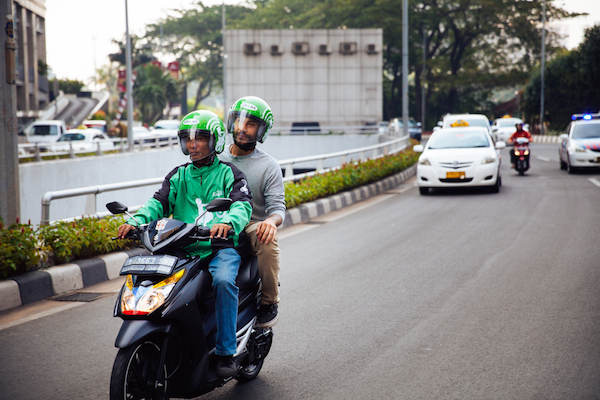
Photo credit: Go-Jek.
In May, Go-Jek announced that it would enter four Southeast Asian markets within 2018, giving Grab’s monopoly some serious competition. The countries on the Indonesian company’s list included Vietnam, Thailand, Singapore, and the Philippines.
So far, it has expanded to all except the Philippines, where ride-hailing revenue is expected to increase by 30 percent annually. One in five people in the capital Manila rely on ride-hailing services, nearly double what’s seen in other cities in the region.
So what’s stopping Go-Jek from rolling out in the archipelago?
Thwarted application
The biggest hurdle for the Indonesian firm is a regulatory one.
In August, the Philippines’ Land Transportation Franchising and Regulatory Board (LTFRB) issued a circular suspending new license applications for transport network companies (TNCs).
The suspension meant that new players like Go-Jek wouldn’t be able to apply to operate legally in the country. The ruling came after the LTFRB saw an influx of TNC applications when it lifted a previous ban on applications for transport network vehicle services (TNVS).
While Go-Jek did submit its application on August 13, the circular was signed and ordered by the board on August 9. “The moratorium came out before [Go-Jek] filed their application for accreditation,” said LTFRB chairman Martin Delgra III in a media statement last September.
“[The company’s application] is still pending. We’re still reviewing it,” Delgra told Tech in Asia in an interview.
The LTFRB also implemented a cap on the number of TNVS – ride-hailing vehicles that are allowed to ply the streets – at 65,000 units.
According to Delgra, they’re not looking to lift the ban on new TNC license applications yet because of this cap.
“Right now, there is no basis to increase the 65,000 to 80,000 or 100,000. Once we are able to hit the 65,000, we’ll see whether there is stiff competition – if it’s no longer healthy or that there’s still room for a few more TNCs,” Delgra says.
However, ride-hailing firms like Grab have aggressively lobbied to increase the 65,000 cap.
“More passengers are waiting for longer hours and, worse, getting stranded on the road because they could not get a ride,” a Grab spokesperson says, noting that Grab and Uber had 125,000 units operating in the country before the cap.
Grab’s struggles
Restrictions on private motorcycles
Go-Jek’s options
Stay ahead in Asia’s tech landscape
This is premium content. Subscribe to read the full story.
Regulations and a ban on new ride-hailing licenses are big hurdles. Grab is also struggling in the country.
We know this is not ideal. ⌛ Sign up in 20 seconds. Cancel anytime.
Our subscriber community includes professionals from these companies:





Stay updated on the go with our mobile app.
Get latest insights with smoother, more personalized experience through TIA mobile app.










📅 Upcoming Events
22 October 2026
Payoneer x CSPN Summit 2026