Policies can be a double-edged sword for business owners – offering benefits like tax cuts while also making operations a bit more challenging through various restrictions.
Whatever the case is, one thing’s for certain: Policies are abundant, particularly in Southeast Asia.
Photo credit: Shutterstock
There are 10 countries in the region, each with its own sets of rules and initiatives. Multiply that across different verticals, various stages of supply chains, operational considerations, and more – now you quickly see how overwhelming it can get.
To give you a clearer picture of the landscape, we’ve summarized some of the key policies that may affect you if you’re running a business in Southeast Asia.
Pay up
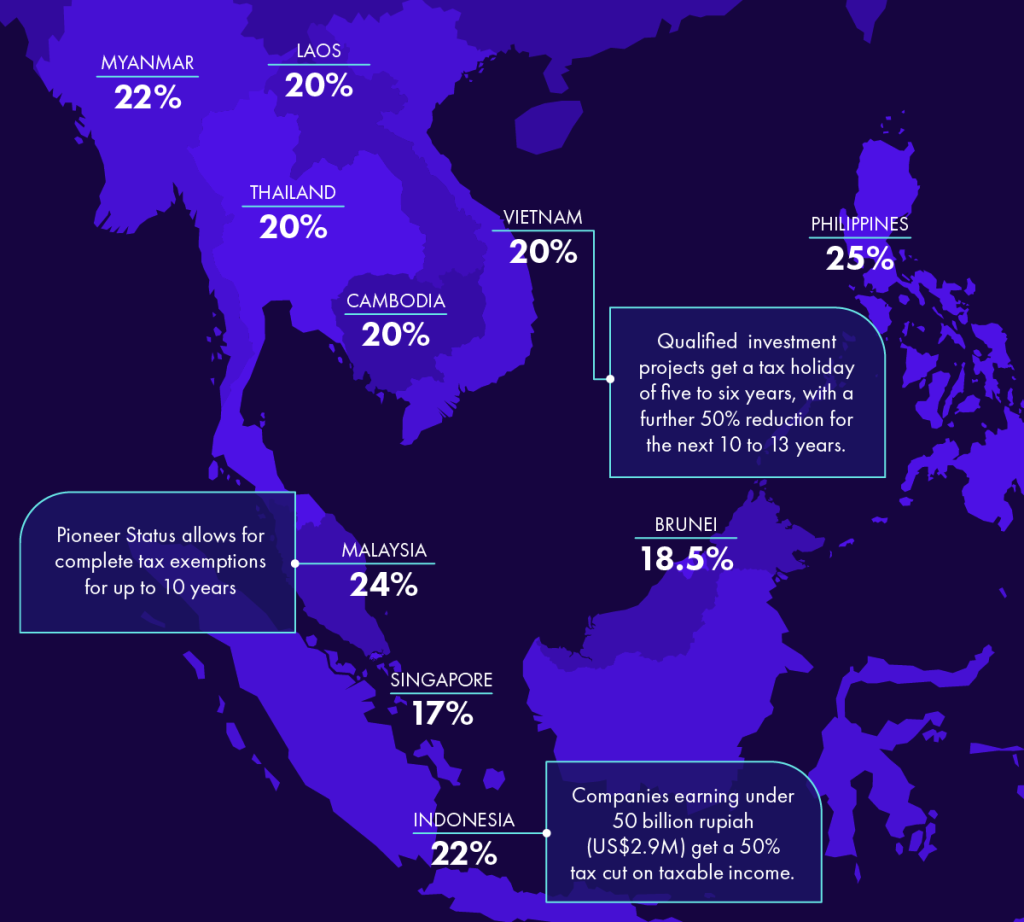
Some of the attractive corporate tax structures in SEA / Visual credit: Lim Chae Huah
There are two things in the world nobody can escape from: death and taxes.
While it’s theoretically possible for businesses to prevent the first, there’s no way they can avoid the second.
In Southeast Asia, countries have generally had attractive corporate tax rates to attract businesses and stimulate economic growth.
For example, Malaysia’s standard corporate income tax rate is 24%. However, firms granted Pioneer Status can apply for complete tax exemptions for up to 10 years if they meet certain requirements – like being in “high-tech” verticals like biotechnology or alternative energy.
Beyond corporate income tax, many member countries of the Association of Southeast Asian Nations (ASEAN) either do not levy a capital gains tax or have it at minimal rates.
For example, both Malaysia and Singapore do not impose it on sales of shares. Meanwhile, Indonesia has a 0.1% tax on the gross sale value of shares listed on the local bourse.
These attractive tax rates have been in place for many years. However, the region could face an upheaval due to the global minimum tax (GMT), a framework proposed by the Organisation for Economic Co-operation and Development (OECD).
The GMT is to be applied to a multinational company (MNC) whose ultimate parent entity has consolidated financial statement revenues of 750 million euros or more in at least two out of the past four fiscal years.
This means in most ASEAN countries, large businesses will always expect to pay a minimum of 15% in corporate income tax. If they fall below the 15% threshold, they will have to pay a top up.

Photo credit: Shutterstock
Vietnam, Thailand, Indonesia, Malaysia, and Singapore have implemented the GMT since February. Brunei and the Philippines are still preparing to levy it, while Myanmar, Cambodia, and Laos remained uncommitted to enacting it as of January 2024.
Beyond the GMT’s impact on businesses, it could potentially affect foreign direct investment inflows. This could lead to job losses or a slower economic growth.
MNCs might also look to prioritize non-tax advantages – such as social stability or the local workforce – more strongly in Southeast Asia.
That said, it could give regional governments more tax revenue, which could help fund public needs such as healthcare and education.
Some governments are already exploring ways to mitigate the GMT’s impact. But whether these measures are effective remains to be seen.
Scratching each others’ backs
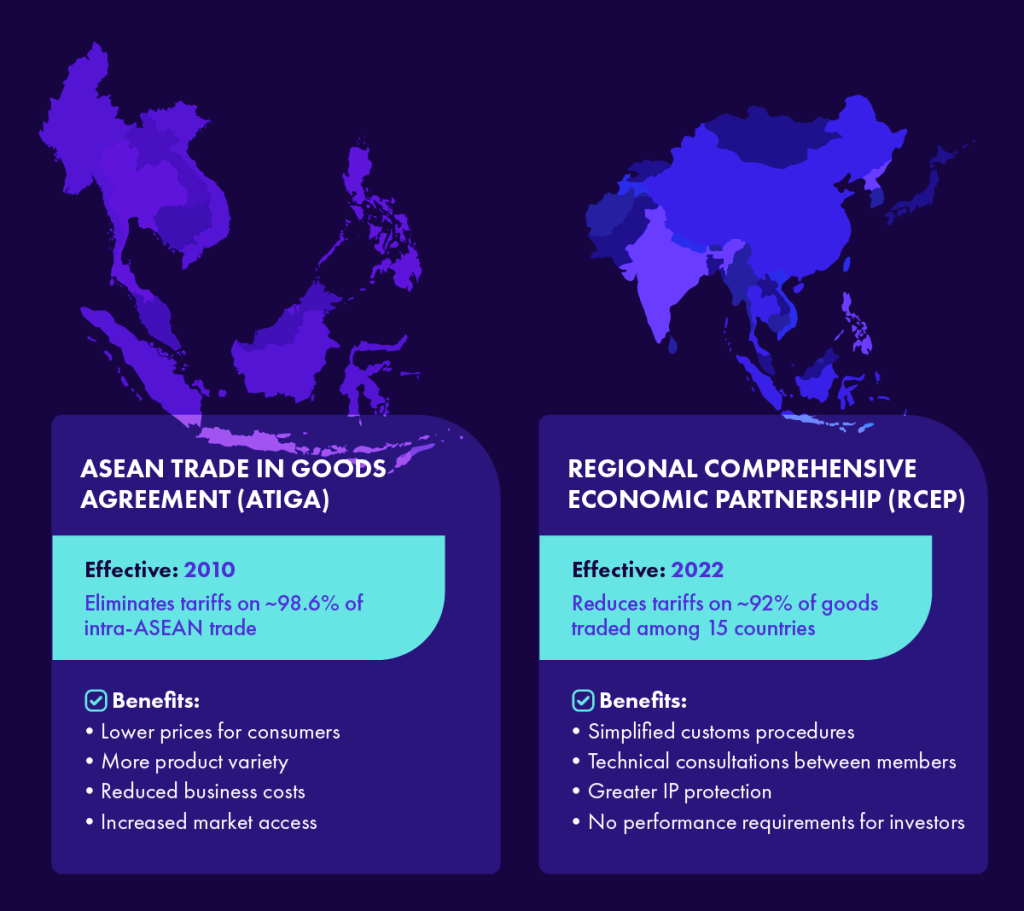
Two of the major trade agreements that businesses in Asia can capitalize on / Visual credit: Lim Chae Huah
What better way to celebrate your friendship than with special deals? That’s basically the idea behind regional trade agreements, and in Southeast Asia, there are a number of them to take note of.
The first major one is the ASEAN Trade in Goods Agreement (ATIGA), which came into effect on May 17, 2010.
The ATIGA’s main purpose is to eliminate tariffs on basically all product lines traded within ASEAN – more specifically, 98.6% of them. This helps simplify and increase trade within the region.
ASEAN isn’t some closed-off club either. Besides the ATIGA, there’s also the Regional Comprehensive Economic Partnership (RCEP), which came into force on Jan 1, 2022.
The RCEP is composed of the 10 ASEAN member countries as well as Australia, China, Japan, South Korea, and New Zealand. It reduces tariffs on about 92% of the goods traded among these countries, and the agreement is in place for the next 20 years.
Beyond that, there are several non-tariff-related benefits. The international agreement simplifies and improves transparency in customs procedures and regulations to encourage trade within the RCEP countries.
Photo credit: Shutterstock
It also enables stronger intellectual property protection and enforcement and commitments to prohibit performance requirements, among others
Ultimately, these agreements are supposed to lower prices for consumers, increase trade, and therefore increase product variety. They should also reduce costs and increase market access for businesses.
The increased usage of the ATIGA – along with other free trade agreements – led to a 35% increase in intra-ASEAN trade in 2018, compared to before the ATIGA’s implementation, according to a report by the Economic Research Institute for ASEAN and East Asia.
More than the bottom line
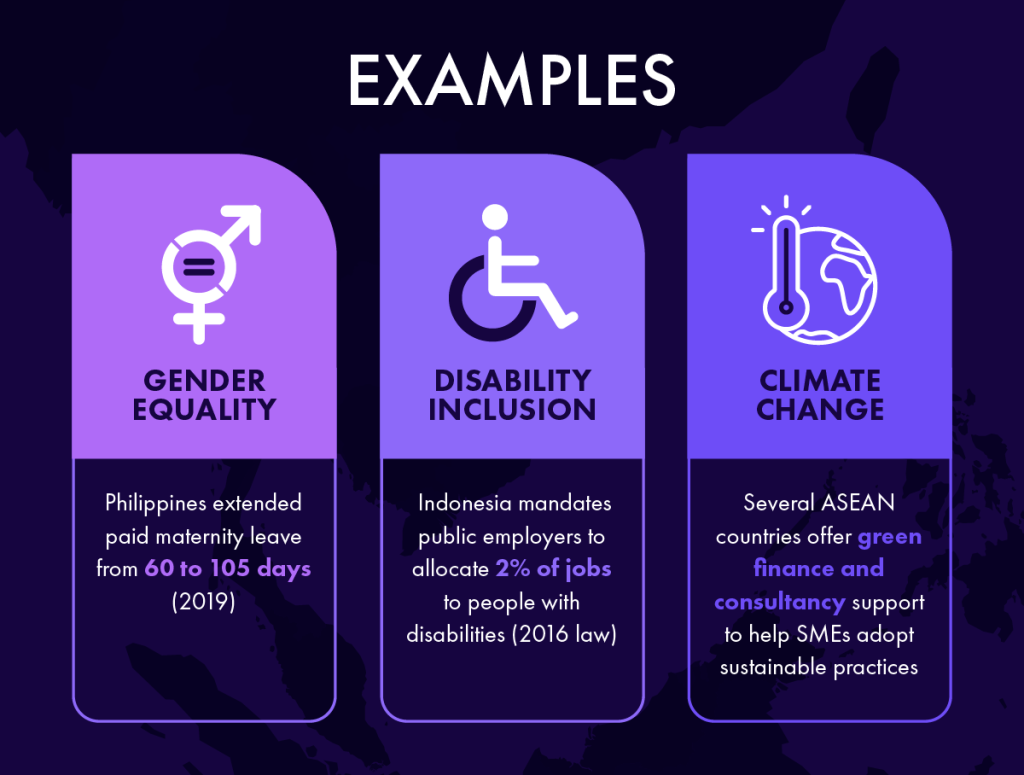
Various ESG policies have already been put in place in the region / Visual credit: Lim Chae Huah
Some policies incorporate environmental, social, and governance (ESG) factors. Southeast Asia may not seem to push for them as hard as its Western counterparts do, but ASEAN has a number of them.
When it comes to to gender equality, all ASEAN member countries have either ratified or acceded to the Convention on the Elimination of All Forms of Discrimination Against Women, an international treaty adopted by the United Nations.
Further, an OECD report found that from 2019 to 2023, Southeast Asian countries implemented 33 legal or regulatory reforms related to gender equality, although not all of them were specific to the workplace.
For example, in 2019, the Philippines increased the length of paid maternity leave from 60 days to 105 days. That same year, Vietnam enacted a new labor code that recognized sexual harassment in the workplace as grounds for dismissal.

Photo credit: Shutterstock
Besides gender equality, several ASEAN member countries have specific legislation to ensure the inclusion of people with disabilities.
In 2016, Indonesia introduced a law mandating that public employers allocate 2% of their workforce to people with disabilities, while private employers have a quota of 1%.
Thailand has a similar quota, and it stipulates that both public and private sector employers must employ one person with disability for every 100 employees without disabilities.
Employers failing to meet this requirement have to contribute to the Fund for Empowerment of Persons with Disabilities, which supports vocational training and rehabilitation programs, among other initiatives.
Finally, there’s the matter of climate change management. Several ASEAN countries are implementing policies to help SMEs adopt green practices. These include improving access to green finance, creating financial incentives through tax privileges, grants, and free consultancy services.
Shaping Southeast Asia’s economic landscape
These are just some of the main policies that business leaders have to keep in mind when operating within Southeast Asia. Clearly, we’ve barely scratched the surface.
In fact, there are a lot more policy-related considerations, and many of them interact with each other in a way that creates huge opportunities for firms.

In line with this, Tech in Asia’s upcoming Asia Economic Summit will bring together some of the top policymakers and thought leaders to share more about the region’s economic landscape.
The event will take place in Jakarta on June 26. It will be packed with keynote speeches, fireside chats, networking opportunities, and other informational content on policy effects and more.
Grab your tickets early here.
This content was produced by Tech in Asia Studios, which connects brands with Asia’s tech community. Learn more about partnering with Tech in Asia Studios.
Stay updated on the go with our mobile app.
Get latest insights with smoother, more personalized experience through TIA mobile app.
Recommended reads
 Forrest Li on scaling Sea, building smarter bots, and founder grit
 SGX’s CEO says it doesn’t need a unicorn to win
 SMEs want AI too, but not the kind Big Tech is selling
 Oatside’s alt-milk rise hits a profitable gear
 Alibaba’s financial health in 12 charts
 Asia’s telcos bundle AI into mobile plans. Will it pay off?
 M-Daq chases bigger clients as revenue falls, losses grow
 VC tracker: Accel raises US$3.5b, including US$550m for India
 Graas buys Temasek-backed Trustana in agentic commerce push
 Doctor Anywhere posts healthier operations in 2025





Editing by Winston Zhang and Mina Deocareza
(And yes, we’re serious about ethics and transparency. More information here.)





