- Premium Content It takes our newsroom weeks - if not months - to investigate and produce stories for our premium content. You can’t find them anywhere else.
 Elyssa Lopez · · 5 min read
GCash trims IPO ambitions to meet market realities
GCash operator Mynt has set its debut share price at 6.60 pesos (US$0.11), it said in a notice to the Philippine Stock Exchange (PSE) filed on October 1.
This marks an over 30% discount from the maximum share price it set in its preliminary prospectus, reflecting pragmatism at a time when the Philippine peso is at a record low against the US dollar and liquidity on the PSE is falling.
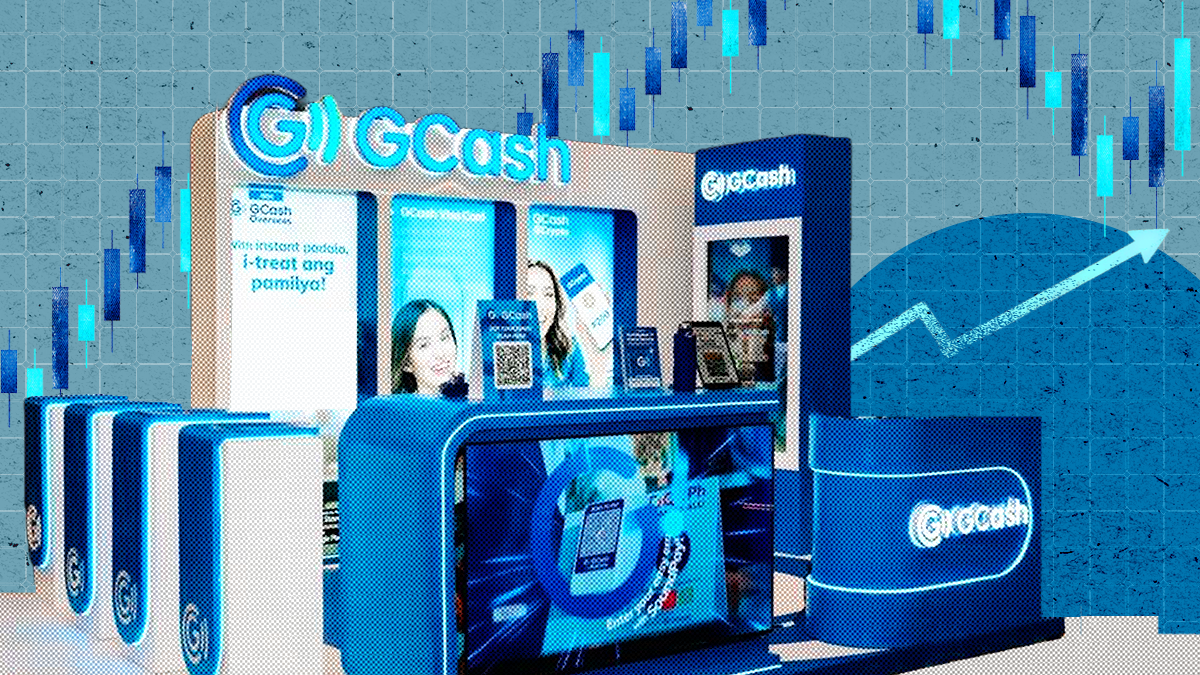
Digital collage by Ulla, photo courtesy of GCash
The firm will begin trading on October 20 with an expected valuation of at least US$7 billion. It is expected to raise at least 53 billion pesos (US$847 million).
“For GCash, this is a more realistic price, a way to have more Filipino retail investors to take part in their growth story,” Paolo Manansala, equity analyst at local stockbroker COL Financial, tells Tech in Asia.
By the end of September, average daily turnover at the PSE was 6.7 billion pesos (US$107 million) for the month, based on Tech in Asia’s calculations. This is down from the daily average of 7.7 billion pesos (US$123 million) recorded in the first half of the year.
Is it fairly priced?
BlackRock, one of Mynt’s cornerstone investors, has already expressed that it will commit to participate in the IPO only at a price no higher than 6.60 pesos, as revealed in the Philippine firm’s preliminary prospectus.
This gives Mynt little wiggle room in pricing its stock beyond that, notes Filbert Tsai, managing director at Manila-based consulting firm Equity Labs.
See also: GCash owner Mynt lines up BlackRock, others for up to $1.3b IPO
However, analysts are divided on whether 6.60 pesos is a fair share price for Mynt.
At this price, the company will have a valuation comparable to a mid-sized bank, Tsai notes. Yet, it is “nothing as special as a bank.”
While 6.60 pesos is a “good starting point,” he believes it’s overvalued given GCash neither operates as a bank, nor is it able to offer lending products without outside financing or partnerships that eat into its margins.
GCash holds an e-money license, which requires it to keep about 50% of deposits in its wallets to be held in a trust for liquidity purposes. In contrast, big banks are required to keep a reserve requirement ratio – or the amount that banks cannot use for lending and investment – at just 5% of their total deposits.
“For GCash’s lending business, it would have to rely on credit, with proceeds from the IPO to sustain it,” Tsai says. “That is expensive.”
Payments-driven business
Tricky balancing act
Stay ahead in Asia’s tech landscape
This is premium content. Subscribe to read the full story.
GCash has set its IPO share price at a discount. Still, analysts are divided if this is a fair valuation.
We know this is not ideal. ⌛ Sign up in 20 seconds. Cancel anytime.
Our subscriber community includes professionals from these companies:





Stay updated on the go with our mobile app.
Get latest insights with smoother, more personalized experience through TIA mobile app.