Mary-Anne Lee · · 5 min read
Why Chinese table tennis players still get more attention than Singaporean eSports pros
Singapore is well known for importing sporting talent. Our podium finishes for table tennis have, as far as I can remember, been achieved by naturalized China-born Singapore citizens. And this is something that other countries are starting to realize—and reject.
Just last weekend, Australian table tennis player William Henzell, who faced off and lost against Singapore’s Gao Ning, said that Singapore only had two “token” Singaporeans in the team, while the rest were born in China. He said that Singapore had “decided it was much easier and quicker to buy a team rather than produce a team.”
It’s unfortunate that Henzell’s crushing words are unavoidably accurate. Singapore has an active Foreign Sports Talent Scheme that is, according to Wikipedia, used to “scout and facilitate the migration of non-Singaporeans deemed to possess sports talents to play in Singapore colors in sporting events,” and is aimed at boosting “local sporting standards by importing sporting expertise.”
But with the rapid growth of the eSports industry, the speed at which it is becoming known to the mainstream audience, and most importantly, the growing sustainability of a career as a competitive gamer, you must wonder: why isn’t Singapore embracing the abundant local, homegrown talent available in the eSporting world?
We’ve got some really good players

Press shot of Xian and Gackt, taken when they were sponsored by Razer.
Singapore has three podium finishers—Jovian Chan (“Shen Chan”), Ho Kun Xian (“Xian”), Eng Ghim Kee (“Gackt”)—at the Evolution Championship Series (EVO) for fighting games, two of whom were placed first and second in 2012 and 2013’s contests. EVO is best explained to the layman as the Olympics of fighting games, and as an annual international event well-attended by the best players across the world, winning it is no small feat.
(See: EVO 2014: Asia still best at what it does)
Singapore is also the birthplace of renowned Dota 2 player Daryl Koh (“iceiceice”), who isn’t just one of the best players in the world. Apart from placing third at The International 2011 with team Scythe Gaming, iceiceice was also crowned the world’s best solo mid at The International 3 tournament in 2013. His latent talent and unorthodox yet entertaining play style went on to cement his reputation and led to his getting headhunted by China’s Team DK.
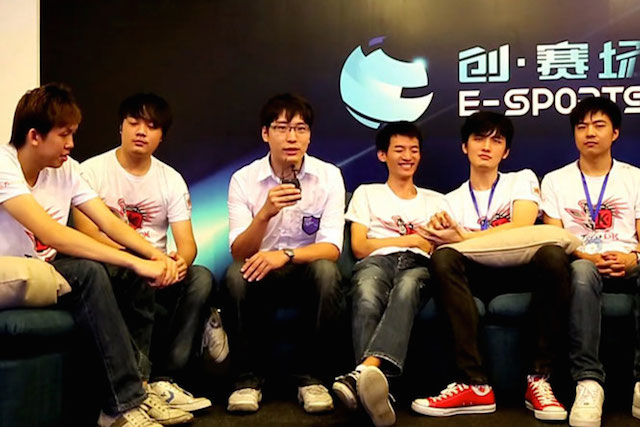
iceiceice, second from right, in an interview with Team DK.
Wong Xinglei (“Chawy”), who was part of the International-winning Scythe Gaming, moved on to League of Legends, where he was a salaried player for Singapore’s only professional League of Legends team, the Singapore Sentinels, for a good two years before moving on to greener pastures: in this case, the team Taipei Assassins.
Further back in history, we’ve got Jonathan “duckie” Tan, who was invited to the Blizzard Worldwide Invitational in 2004 when he was just 16. According to a community forum post, Duckie defeated international favorites like Manuel Schenkuizen (“Grubby”), who is also known for being one of the best players in the world.
In spite of her five million odd population, her relative small size in comparison to the rest of the world, Singapore has a fair share of eSports prodigies, more than talented enough to hold their own against international heavyweights. Yet she does not support them.
Singapore may be a host city for 2015’s World eSports Championship Games





Stay updated on the go with our mobile app.
Get latest insights with smoother, more personalized experience through TIA mobile app.