
Photo credit: SAM.
I ask about President Trump; I ask about Brexit. All I get are canned responses that dodge my queries. Typical politician!
But SAM, who I’m talking to over Facebook Messenger, is far from being a regular lawmaker. She is touted as the world’s first virtual politician.
And this isn’t just some prank. SAM’s creator wants the robo-representative to run for office in 2020.
“There is a lot of bias in the ‘analogue’ practice of politics right now,” says Nick Gerritsen, who unveiled SAM last week. “There seems to be so much existing bias that countries around the world seem unable to address fundamental and multiple complex issues like climate change and equality.”
“That is without even entering the discussion around fake news and the global decline in journalism,” the New Zealander tells Tech in Asia.
It turns out that SAM wasn’t dodging my questions – Gerritsen is still teaching the AI how to respond, so for now she – that’s the gender its inventors decided upon – is focused on issues specific to New Zealand, like policies around housing, education, and immigration.
When I ask SAM about those, it offers detailed responses, and sometimes even solicits my opinion:
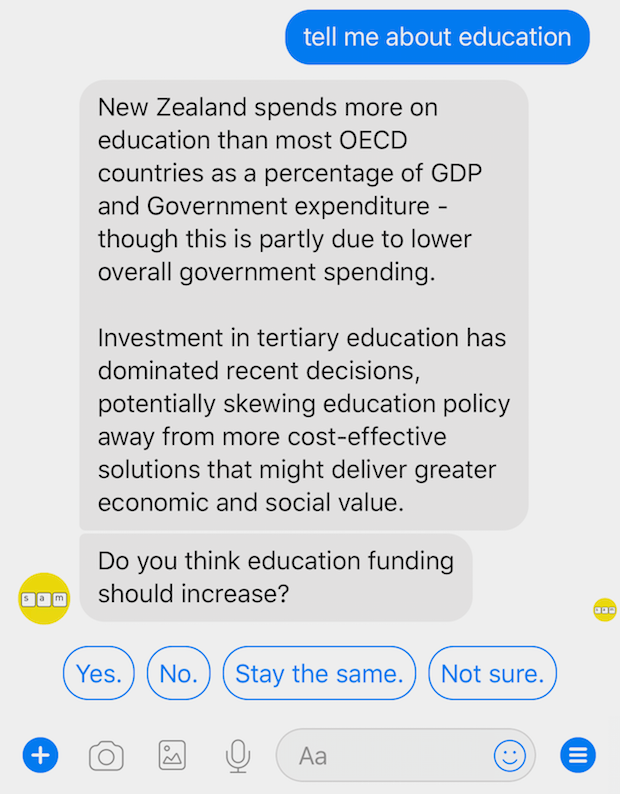
Image credit: Tech in Asia.
Biased bots
As well as learning within Messenger, the virtual politician is being shaped by a survey on her homepage.
Gerritsen, 49, acknowledges that humans can bake their biases into the algorithms they create – a study earlier this year found AI exhibited racist and sexist tendencies. “We do not view bias as just a challenge to technology solutions,” he says. And so AI, while imperfect, still has something to offer in terms of bridging what seems to be a growing political and cultural divide in many countries.
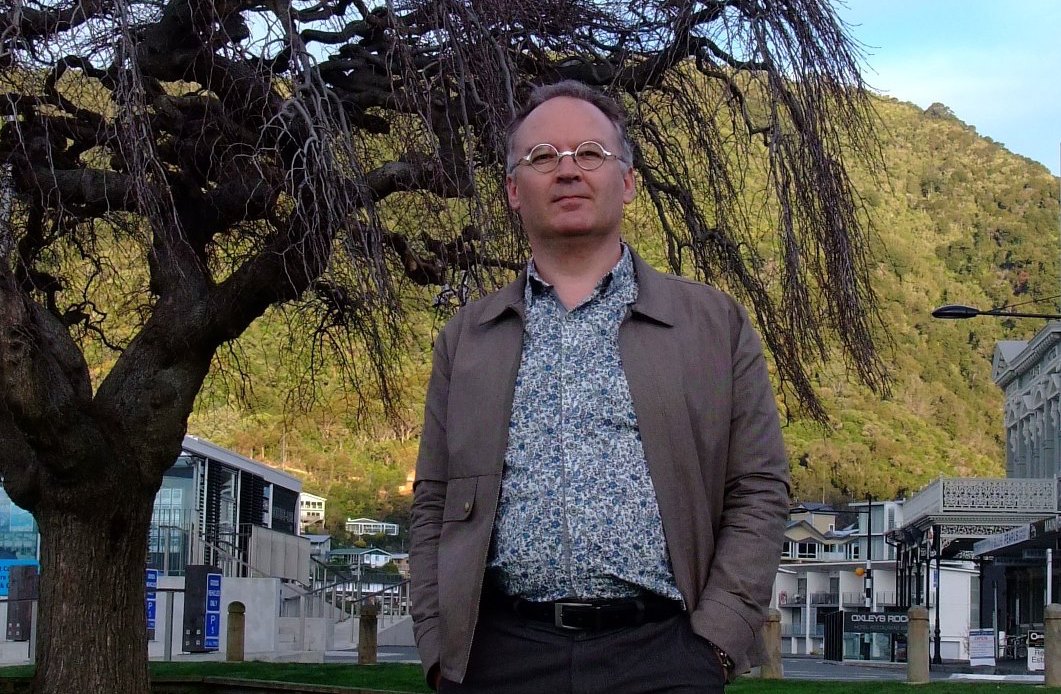
Nick Gerritsen. Photo credit: Nick’s Facebook.





Stay updated on the go with our mobile app.
Get latest insights with smoother, more personalized experience through TIA mobile app.









📅 Upcoming Events
22 October 2026
Payoneer x CSPN Summit 2026