 Samantha Cheh · · 7 min read
Fundamentals, not fiction: This fund wants to help startups scale with AI

Startups have evolved into engines of economic growth. Faster and more agile than traditional companies, they are more willing to experiment with bleeding-edge technology.
However, these firms also have a well-earned reputation for burning through cash quite quickly.
As the scale of startup growth has soared over the last five years, founders have gotten locked into an endless search for funding. Investment rounds are getting larger, and startups need more cash to accelerate and justify their valuations. What’s become clear is that startups need more innovative forms of financing and more working capital to scale their businesses, says Ron Daniel, chief executive and board member at AI-powered debt fund Mars Growth Capital.
Generally, aside from bootstrapping, startups have only two routes when it comes to funding: private equity financing and debt financing. Both are traditional financial instruments that haven’t changed much since the ’70s.
Private equity is a popular method, but it’s expensive because taking this path means companies risk diluting the value of their own stock – especially those owned by founders and early backers – and ceding overall control of their business over time.

Ron Daniel, chief executive and board member at Mars Growth Capital / Photo credit: Mars Growth Capital
On the other hand, debt financing has historically required assets like real estate or inventory to be put up as collateral or a track record of positive cash flow. As a result, many growth-stage startups don’t qualify for debt financing because they tend to oscillate between positive and negative cash flows as they work to establish themselves.
Since debt funds also tend to be conservative in their approach and require extensive due diligence, it’s not a fast and flexible means of raising cash, says Ryutaro Hiroshima, chief commercial officer and board member at Mars Growth Capital.
More than science fiction
In response to the need for alternative financing tools, Israeli fintech firm Liquidity Capital joined forces with Japan’s Mitsubishi UFJ Financial Group (MUFG) to set up Mars Growth Capital, which uses AI to assess and fund tech startups in the Asia Pacific. Established in 2020, the debt fund’s goal – with the support of Liquidity’s pioneering data integration tool Dynamics – is to put over US$500 million of growth capital on offer for startups.
The partnership started when Daniel – who is also the CEO of Liquidity – was introduced to Masakazu Osawa, managing corporate executive of MUFG, through a close friend. Daniel describes that first conversation with Osawa, who is also the group head of digital services business group and chief digital transformation Officer at MUFG, as a meeting of like minds: Not only did Osawa understand his vision of AI-enabled debt funding, he saw the opportunity to expand across various verticals and change the face of the corporate credit industry.
Hiroshima explains that MUFG had been searching for a way to enter Asia’s burgeoning startup scene, and Liquidity emerged as the perfect partner because of its deep roots in the region’s technology industry. The bank also understood that there was a need for innovation in the credit space and immediately latched on to the potential to disrupt the debt-funding process.
Liquidity and MUFG began exploring a partnership that would enable them to combine the Israeli firm’s agile, out-of-the-box technology with MUFG’s global reputation for trustworthiness, expertise in building solid business structures, extensive resources, and vast network.
“Together, we found a unique DNA that has enabled Mars to become the fastest-reacting debt fund in the world,” Daniel says, adding that the firm has a turnaround time of only 24 hours. “We basically introduced a solution that was just science fiction until less than a year ago. It’s a game changer for growth startups since all other funds take at least three months, which, for growth startups, is like three years in a traditional corporation.”
An objective source of truth
Six years ago, Daniel had serendipitously created Dynamics, an alternative funding platform that uses machine learning to make smarter investments and improve startups’ access to credit. Dynamics erases lenders’ worries by making predictions about a startup’s potential for growth based on its performance to date. It can also quickly perform assessments and deploy capital, removing a lot of the overhead and risk associated with debt deployment.
Dynamic’s machine-learning algorithm is the key to the platform’s success. The algorithm is constantly collecting information in real time and analyzing it to maintain up-to-date and accurate models of performance. Daniel says this continual process of revising and updating predictions ensures that Mars Growth Capital’s algorithmic models are able to produce the most accurate forecasts possible to guide smarter investing.
To give lenders the information they need to make decisions, the system relies on two kinds of data: outbound data, which is information gathered from publicly available, open-source data sets; and companies’ inbound data, which is accessed through billing and banking integrations.
At any given time, Mars Growth Capital tracks 120 different parameters. However, once a company feeds an initial set of data to Dynamics, the platform narrows its focus down to 15 parameters depending on the “class” of a startup. The system then begins mapping and grading the startup’s data against a set of benchmarks, returning an average score of between 200 and 800.
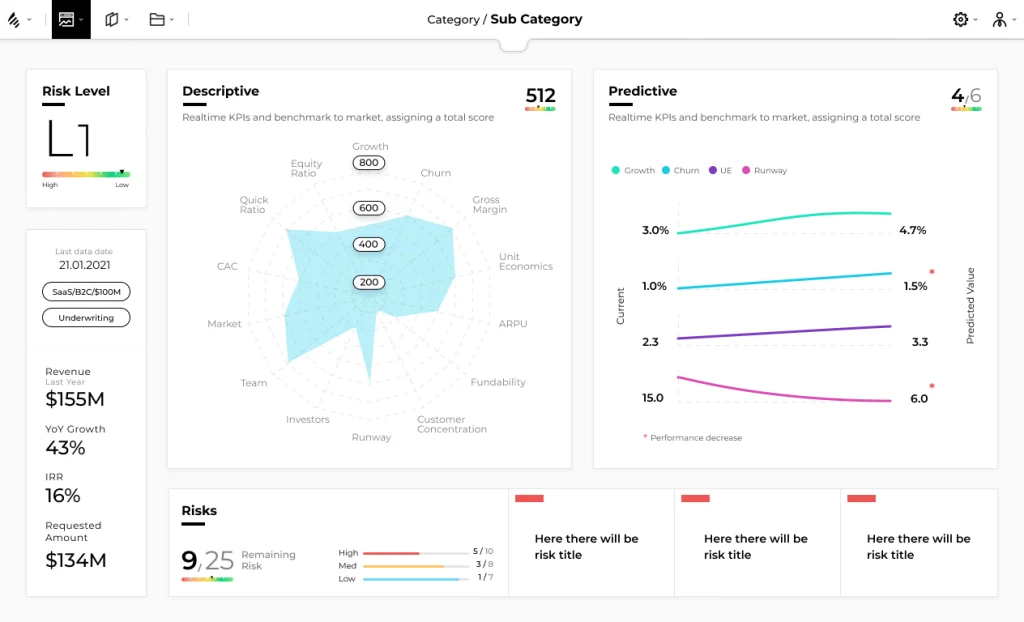
Photo credit: Mars Growth Capital
This first stage of the process helps paint a picture of the company’s performance, which is then used to make a two-year forecast of the startup’s potential growth trajectory. Next, analysts will test the forecast under different “credit scenarios” to get a sense of how the startup might perform if it were funded. The system will also create a term sheet to help assist investors in making funding decisions.
The algorithm’s predictions have thus far proven to have an accuracy rate of over 90%, which Hiroshima says is a source of comfort for investors. This is true even when lenders are dealing with a startup that’s still facing negative cash flows because they are able to see the room for potential growth.
Additionally, Liquidity’s Dynamics system is also rewriting the conversation around how debt funding works by replacing lenders’ need for collateral with a tool that is able to conduct ongoing, real-time due diligence.
Daniel explains that Mars Growth Capital’s investors would essentially have a “source of objective truth” regarding the performance of every company they are looking to invest in. He adds that it would give them the assurance they need to be “very agile” with their funding. The fund also doesn’t need its borrowers to provide them with collateral because the algorithm already does that.
Fundamentals, not fiction
The Dynamics system can also act as a kind of monitoring and early warning system in the event of a potential default. In one scenario with Liquidity, the algorithm was able to flag a downward trend in one startup’s products quite early on, enabling the partner company to react quickly and save itself.
Most importantly, the Dynamics system enables Mars Growth Capital to act as a “mirror” that amplifies the strengths and weaknesses of each company’s business model. which Daniel refers to as their “engines.”
If a company’s financials make a strong case for a robust growth trajectory, the system will reflect that. There is no hiding behind baseless business plans or exaggerated stories, Hiroshima says, because the “machine learning AI platform is growing every day to become more accurate by learning real-time numbers – and numbers never lie.”

Ryutaro Hiroshima, chief commercial officer and board member at Mars Growth Capital / Photo credit: Mars Growth Capital
However, Daniel stresses that these reports aren’t intended to chew out companies for bad performance but to enable both parties – investors and startups – to start from a place of mutual understanding.
“The more trust we gain in a company, the more money we’re willing to give it over time. We are not afraid to see the bad things. We are afraid of only what we do not understand,” he says.
In the short eight months since it began operating, Mars Growth Capital has already funded six firms across a wide range of sectors, with deal values ranging from US$2 million to US$30 million. Thanks to the quick uptake of its offerings since it launched in Singapore, the company has decided to increase its fund size – from US$80 million to US$200 million – starting from September 2021. The fund also has plans to deploy a further US$500 million in funding over the next couple of years.
However, Mars Growth Capital says this is only the beginning of the fund’s odyssey toward becoming a major supporter of growth-stage startups in the Asia Pacific. The fund is working toward expanding its opportunities in other verticals – even in industries that it has no prior experience dealing with, as in the case of its recent US$30 million foray into supply chain startups.
Daniel says the fund’s focus will always be on tech because it’s a massive market that keeps renewing itself. “We have an appetite and we want to do exactly what we are doing now, just bigger. We want to be the number one big player in Asia Pacific, but we’re not in a rush anymore – we’re planning for the long run.”
Mars Growth Capital is a joint venture between Israeli fintech firm Liquidity and Japan’s Mitsubishi UFJ Financial Group that aims to fund US$500 million in growth capital for tech startups across the Asia Pacific. By leveraging Liquidity’s proprietary AI-powered data integration tool, the debt fund offers an alternative funding solution that could rewrite how corporate credit works.
To find out more about how Mars Growth Capital can help your startup access funding, visit its website.
This content was produced by Tech in Asia Studios, which connects brands with Asia’s tech community. Learn more about partnering with Tech in Asia Studios.
Stay updated on the go with our mobile app.
Get latest insights with smoother, more personalized experience through TIA mobile app.
Recommended reads
 Life’s a game, and AI agents are Animoca’s new play
 Indonesian AI startup goes global
 Forrest Li on scaling Sea, building smarter bots, and founder grit
 An AI assistant that joins sales calls and scores team skills
 Beyond the check: Why VCs need more than capital
 SGX’s CEO says it doesn’t need a unicorn to win
 SMEs want AI too, but not the kind Big Tech is selling
 Oatside’s alt-milk rise hits a profitable gear
 Alibaba’s financial health in 12 charts
 Asia’s telcos bundle AI into mobile plans. Will it pay off?





Editing by Nathaniel Fetalvero, September Grace Mahino, Arpit Nayak, and Jaclyn Tiu
(And yes, we’re serious about ethics and transparency. More information here.)








