 C. Custer · · 6 min read
Fruit Ninja Dev Visits Beijing, Talks China Plans and Game Development
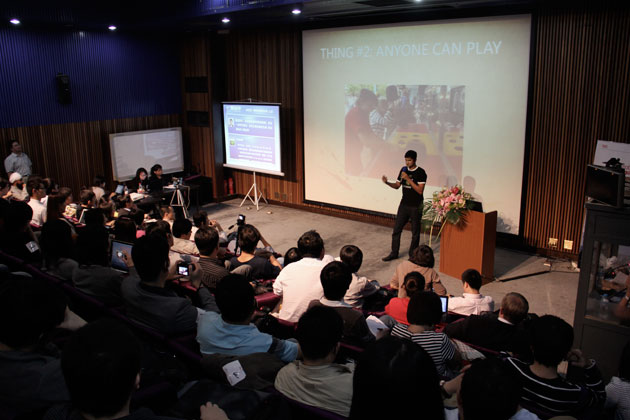
Shaniel Deo, the CEO of Halfbrick Studios (developers of Fruit Ninja), sliced his way into China for the first time a couple weeks ago and hasn’t stopped moving since. Last night at a mobiTalk event at the Great Wall Club in Beijing, the CEO spoke about Halfbrick’s plans for China and shared his formula for making a great mobile game with an audience of eager Chinese developers and tech geeks.
China Plans
 In an inteveriew before his keynote speech, Mr. Deo said that as far as Fruit Ninja was concerned, China is “our number one market going forward.” Already, China accounts for more than 30 percent of all Fruit Ninja downloads, with over 20 million downloads that Halfbrick is aware of. But, Deo pointed out, “probably fifty percent of users in China are playing pirated games,” so the actual number of fruit ninjas in China is probably much higher.
To combat piracy, Halfbrick plans to focus on ad-supported free versions of the game in China, rather than selling a paid version like they do in other areas. And they’re definitely optimistic: “Over the next six months, we want to hit another 70 million downloads here,” Deo said. The number sounds high — crazy high — but Fruit Ninja clocks over 600,000 downloads a day globally, so it just might be doable. “The way things are going, I think it’s definitely achievable,” smiled Deo.
Fruit Ninja will also be rolling out some China-themed updates. Deo was vague about what, exactly, users are likely to see, but said the next five or more updates of the game will be created especially for the China market and may include things like China-themed fruit or blades. Unsurprisingly, they’re also working on replacing the game’s Twitter and Facebook integration with Weibo and Renren integration for the Chinese market.
Fruit Ninja — of which there is also an Xbox Kinect version — may also be expanding onto new platforms for the China market. When asked if Halfbrick had plans to bring the game to Lenovo’s motion-gaming eedoo iSec console, Deo did not mention specific plans for that device, but did tell Penn-Olson, “We’re working on taking the Kinect version to smart TVs and other gesture-based devices.”
How to Make a Great Mobile Game
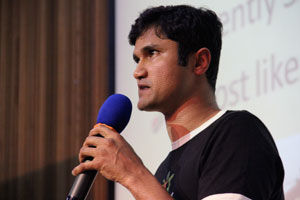
"I am a ninja."
In his keynote speech, Mr. Deo focused on lessons Halfbrick has learned over its ten-year history as a games company that’s worked mostly for mobile platforms (before mobile phone gaming was a thing, they did several titles for the GameBoy Advance). Fruit Ninja has been a worldwide smash hit, and the mobiTalks audience was eager to hear how Halfbrick did it.
Deo laid out a number of factors he thinks played a role in Halfbrick’s success. First, Halfbrick creates a relaxed, and fun working environment where employees have time to work on their own projects through a program called Halfbrick Fridays. Any employee can pitch a game to the team, which then groups into smaller teams that spends some time over the next six weeks working on their games. Because these ideas come from the employees themselves, people are always excited about working on them. At the end of the six weeks, everyone plays each others games, and they even give out awards for fun. “There’s no failure in this process,” Deo says, “it’s just about exploring ideas.”
And some of the ideas end up being pretty great. Fruit Ninja itself, now the company’s flagship product, came out of a Halfbrick Fridays pitch.
He didn’t mention it in his keynote, but in an interview beforehand, Deo also noted that they choose their team very carefully. “We’re very mindful of not growing rapidly; we want to make sure each new person we add to the team adds a lot of value,” he said. That’s a lesson that some of China’s group buy sites probably should have heard before they hired — and then fired — their gigantic staffs.





Stay updated on the go with our mobile app.
Get latest insights with smoother, more personalized experience through TIA mobile app.








📅 Upcoming Events
22 October 2026
Payoneer x CSPN Summit 2026