- Premium Content It takes our newsroom weeks - if not months - to investigate and produce stories for our premium content. You can’t find them anywhere else.
 Putra Muskita · · 5 min read
Grab’s AI leap began with a cold stop on engineering
In 2024, Grab did the unthinkable for a Southeast Asian tech giant: It told its entire engineering team to stop shipping – for nine weeks.
No new features, no growth targets. Instead, Grab engineers were instructed to just figure out how to apply generative AI across the business in a way that’s “transformational,” according to Grab president and COO Alex Hungate.
“Nine weeks in our world is a lot,” the executive said at last week’s Asia Economic Summit hosted by Tech in Asia in Jakarta. “It was kind of a crazy thing to do for a company of our scale, with so many [daily] issues to deal with.”
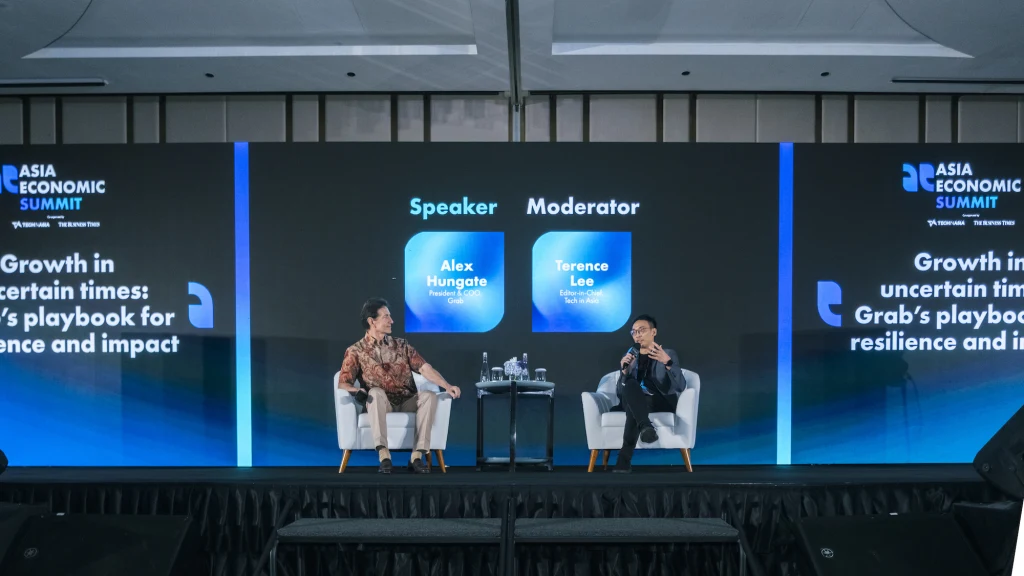
Grab president and COO Alex Hungate (left) onstage at the Asia Economic Summit / Photo credit: Tech in Asia
After first announcing a US$150 million budget for AI research in 2019, Grab launched an AI center of excellence in Singapore in May 2025 – a bid to deliver AI solutions across the region.
At that point, CTO Suthen Thomas said over 1,000 AI models powered the Grab platform. That meant one model per 11 employees.
But to be clear, the super app isn’t building foundational AI models from scratch. Instead, it partners with AI tech giants like OpenAI and Anthropic, launching AI tools for merchants and drivers with them.
Grab can’t afford to sit out the AI race. Innovation is its best shot at defending Southeast Asia, which remains its only stronghold.
AI as the C-suite for small Grab merchants
So far, much of Grab’s AI initiatives revolve around its core ecosystem.
For instance, it has a driver “copilot” that suggests where to head next, maximizing back-to-back jobs, reducing idle time, and boosting earnings. There’s also a system called “hyper-batching,” which lets drivers pick up and drop off multiple food delivery orders in sequence.
This isn’t just about squeezing out more efficiency.
See also: Grab COO breaks down ‘triple pivot’ strategy for profit
Grab’s platform, Hungate said, is built to be counter-cyclical. When the economy dips, the gig worker supply surges. AI keeps the flywheel spinning by matching the supply with enough demand.
These tools help keep prices low for customers without significantly cutting into driver earnings, he added.
Drivers as data collectors
Stay ahead in Asia’s tech landscape
This is premium content. Subscribe to read the full story.
Southeast Asia’s mom-and-pop shops don’t have CMOs or data teams. Grab thinks AI can fill that gap – and it’s opening its internal toolbox to prove it.
We know this is not ideal. ⌛ Sign up in 20 seconds. Cancel anytime.
Our subscriber community includes professionals from these companies:





Stay updated on the go with our mobile app.
Get latest insights with smoother, more personalized experience through TIA mobile app.