 Dilshan Senaratne · · 5 min read
Facebook has trapped us with one hilariously simple oversight
Sometime in mid-2006, Zuckerberg and his team at Facebook came out with what today is arguably the cornerstone of global information dissemination — the news feed. The move at the time created such an uproar that Zuck himself penned (keyed?) a blog post titled “Calm down. Breathe. We hear you.” in a bid to pacify public rage.
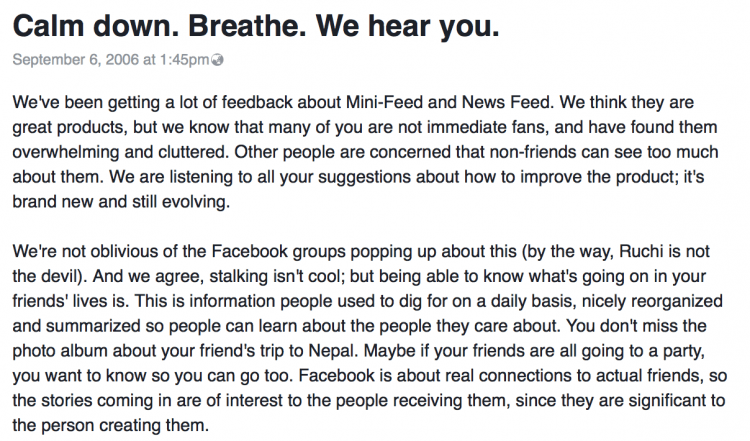
A screenshot of Mark Zuckerberg’s post.
A decade down the line, the outcries are no more, and Facebookers hardly remember a pre-news feed era. The news feed today, for many of us, is the strongest link to what is going on in the community we live in and the world as a whole. As a result, Facebook today is the most powerful media tool at the disposal of politicians, marketers, and artists alike.
Over the years as Facebook grew its user base, its users also grew their personal networks exponentially. In 2014, Statista reported an average 650 friends per user in the 18 to 24 age category, illustrating the kind of connections we are dealing with. Considering that an average Facebook user reportedly generates 90 pieces of content per month, simple math tells us that the typical Facebook user is dealt with something in the range of 58,500 individual items of content on a monthly basis.
The growth of content itself plays right into the strategy envisioned by Zuckerberg in his college dorm many years ago, but this success yields a pretty obvious complication — priority content.
It’s critical for engagement’s sake to maintain this kind of content (we are presented first with what interests us most). In order to address this deceiving and critical issue, Facebook came out with a complex algorithm.
You see, Facebook in its earliest days was driven by a motto which read in the boldest of fonts — “Move fast and break things,” and that’s exactly what they did. They moved fast enough to extend their data capture perimeter to include our preferences. Unknown to us for many years now, a team of data scientists based out of the company’s headquarters in California is analyzing the way we like, comment, share, and engage with the content we see.
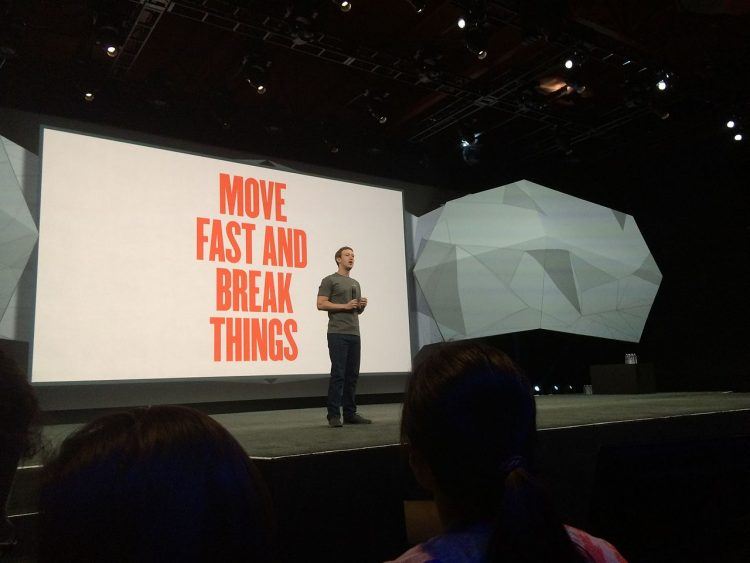
Mark Zuckerberg on Facebook’s motto at a conference in 2014.
The result is an algorithm smart enough to know what we might like and prefer to see on top of our news feeds. In essence, Facebook is gently nudging the right content in our direction to help us see what we want to see.
Relevance is the name of the game and while the concept is not without noble merit, Zuckerberg hasn’t quite let go of his self-serving, intellectual property robbing Harvard days. The advertising revenue that Facebook is rolling in right now is also heavily dependent on relevance for its effectiveness.
The commercial targeting efficacy offered by Facebook is unparalleled at this point and the ROI is completely transparent and based on engagement. This ability to know who might potentially buy something is the ace up Facebook’s sleeve and it hasn’t cost us too much. Not till now at least.
The hilariously simple oversight
The year is 2016, and Donald Trump, the least likely candidate to have arisen to presidential consideration in USA’s modern history triumphed over Hillary Clinton, former first lady and secretary of state. The turmoil and chaos are ringing through America, and the blame game has only just begun.
The Trump victory caught many off guard. In the age of connectivity, could blatant public sentiments such as presidential preferences stay largely unknown? When most of us know what our on average 650 connections had for lunch, it’s strange to imagine that we didn’t know the same people’s political standpoints. Were they concealing this?
More room for unbiased facts





Stay updated on the go with our mobile app.
Get latest insights with smoother, more personalized experience through TIA mobile app.










📅 Upcoming Events
22 October 2026
Payoneer x CSPN Summit 2026