
Photo credit: Dennis Jarvis
With China reaching digital maturity, companies on the mainland have started looking elsewhere for the next frontier. The most obvious contender is India. This year has been a busy one for Chinese investment in Indian startups, but the country is still behind China’s digital savviness.
To address this, the government has put in place their flagship Digital India project, a program aimed at catapulting the country forward digitally. Based on nine pillars, ranging from building broadband highways, to manufacturing, and free flow of information for all, it’s still too early for us to judge its success. This hasn’t stopped Chinese companies from ramping up their efforts in India, all looking to corner the next billion consumers.
Baidu opens office in India with a long term Indian focus
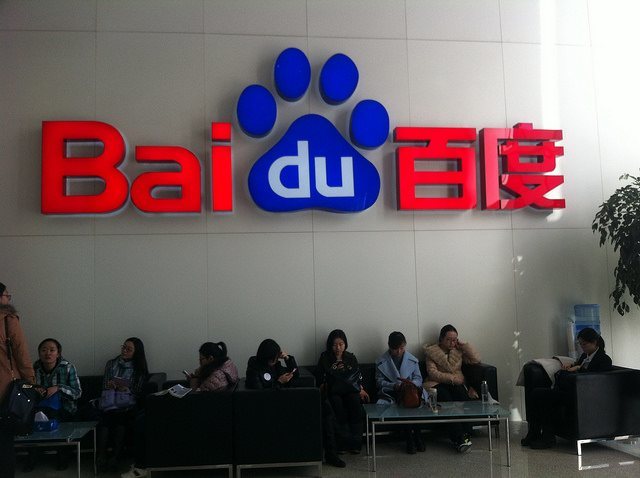
Photo credit: Jon Russell
Similar to Baidu’s plan in Indonesia, the company has entered India with a mobile strategy, leaving their main search focus at home. Baidu’s putting its apps (DU Battery Saver, DU Speed Booster, and ES File Explorer) and app store (MoboMarket) in front of the user, leaving search with a smaller piece of the Baidu pie outside of China.
“The potential size of the mobile market in India is absolutely immense and we’re in store for a lot of growth for the next few years,” says Tim Yang, head of Baidu India. Having worked in the country for the last four years with Alibaba and now Baidu, he echoes the prevailing sentiment about India.
“GSMA’s recent report puts the number of unique mobile subscribers in India at 500 million, which confirms what we all more or less already knew: India […] is second only to China when it comes to size and momentum.”
Entering India brings with it some uniquely Indian challenges though.
“Our Android app store MoboMarket was already doing quite well in India,” explains Tim. “Then we realized that we were missing a huge contingency of users who are more comfortable reading Hindi than English. So we released Hindi language support for MoboMarket right away.”
Multilingualism aside, India’s challenges run much deeper. A democratic country where the government changes every five years is very different from Baidu’s home ground. And while most Indians would agree that nothing can stop the digitization of the country, the Digital India initiative is very much tied to the current administration. So what happens if the government changes in four years time?
“We’re committed to being in India for the long term and making it work,” says Tim. “At the end of the day its success will largely rely upon Indian citizens taking their digitization into their own hands. Even with a better internet infrastructure and online social services, there still needs to be additional compelling reasons for people to buy smartphones and get online.”
What kind of compelling reasons? “A strong ecosystem of platforms and services will give people that extra push and make the prospect of going online a lot more exciting,” says Tim. “We’re working to add social elements to MoboMarket, and it could eventually be host to verticals in online-to-offline or ecommerce.”
Alibaba bets big on Indian ecommerce

Photo credit: Kristina D.C. Hoepnner
Ecommerce is booming in India, and Alibaba was quick to capitalize on it this year. With huge competition brewing between India’s Flipkart and Snapdeal, along with the behemoth Amazon, consumers are spoilt for choice with the best deals online. While Alibaba chose to back Snapdeal this year, it also, more tellingly, pushed into payments startup Paytm, which is also pushing mobile commerce heavily. Paytm could eventually become India’s Alipay, and Alibaba looks keen on getting a slice of that pie.
Tencent invests in Indian healthcare
Tencent’s largest push into India this year came with its investment in Indian healthcare startup Practo. A wide ranging app that allows doctors and patients to book appointments, compare healthcare professionals, and track tests, it’s a fundamentally different approach to their very gaming-heavy focus in China. Perhaps Tencent believes that healthcare is a better bet in India rather than gaming, especially considering that India spends only four percent of their GDP on health.
Xiaomi is made in India
Tying in with India’s big manufacturing push, Xiaomi now assembles handsets in India. To boost their profile this year, Xiaomi is no longer just selling phones online in the country, but making them as well. It’s a huge commitment to the Indian market, and one that transcends simple investment. Its smartphones are now being made in the Indian state of Andhra Pradesh, neighboring India’s startup hub of Bangalore. Xiaomi’s not the only company manufacturing in the state though; One Plus recently set up shop to target the Indian market as well.
What India can learn from China
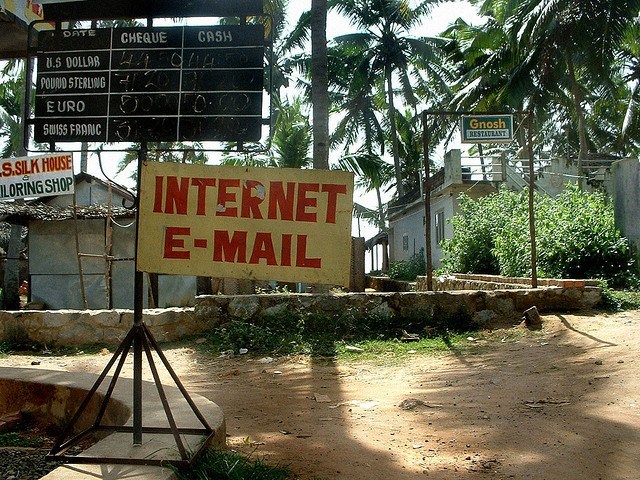
Digital infrastructure in India is still lacking. Photo credit: twitter.com/mattwi1s0n
While India and China share a common border, the countries are culturally and economically quite different. But Baidu’s Tim Yang believes these differences aren’t quite as stark as we would imagine.
“The overlying concept behind building an online ecosystem is the same no matter where you are: users, platforms, services, monetization. […] In China, the state-owned telecoms were able to very quickly put up cell towers throughout the country. The infrastructure situation in India is obviously very different,” explains Tim.
“But there are also similarities between the two markets. In China, we’ve seen a meteoric rise in smartphone users over the past 10 years, and online ecosystems have been built from the ground up to serve those users. All signs point to the same scenario repeating itself in India.”
Baidu is the leading Chinese language Internet search provider. As a technology-based media company, Baidu aims to provide the best and most equitable way for people to find what they’re looking for.
Baidu’s products in India include its mobile apps DU Battery Saver, DU Speed Booster and ES File Explorer, as well as its Android app store MoboMarket. Cumulatively, Baidu’s products in India have tens of millions of frequent users.
Stay updated on the go with our mobile app.
Get latest insights with smoother, more personalized experience through TIA mobile app.
Recommended reads
 🇮🇳 Roundup: GlobalBees buys fitness brand Reach, more
 Nykaa’s financial health in 5 charts
 Revolut to invest $45m in India, hire 300 employees
 Letter to readers: Does Patrick Grove know something we don’t?
 Twitter’s SG employees told to vacate office
 US tags Tencent, Alibaba platforms as ‘notorious markets’
 Amazon India begins laying off 1,000 staff
 This Bangladeshi startup wants to be the Tencent of the country
 India’s digital potential is staggering, but access remains limited
 Patrick Grove co-founded platform partners with Indonesian rental firm





Editing by Terence Lee and Malavika Velayanikal
(And yes, we’re serious about ethics and transparency. More information here.)