Nathaniel Fetalvero · · 5 min read
How Standard Chartered Bank is tackling digital disruption

The concept of modern banking has been around since the 13th century, when wealthy Florentine families set up institutions that funded trading operations and stored the finances of Italy’s rich and powerful.
More than 700 years later, banks have evolved from an exclusive high-society perk to a service provider for the everyman, with capabilities that include wealth and investment management, financial protection, and money lending.

Photo credit: 123RF
While banks have not been immune to the technology bug that has spread in the last few decades, digitization in the industry has only largely been implemented “for purpose in the back end,” according to Michael Gorriz, group chief information officer at Standard Chartered Bank.
“Fifty years ago, we introduced mainframes. We took paper ledgers and put them into computers,” the CIO explains.
But the emergence of a tech-savvy millennial generation is bringing about “the first real massive change in banks since the inception of banking,” he says. As such, banks like Standard Chartered have to digitize front-facing processes or risk losing their customers.
“We have to be aware that there are people getting into jobs who don’t know a world without the internet,” stresses Gorriz. “They see how things work on the internet in roughly five to 10 seconds and expect everything to be done the same way.”
Offering fully digital services
One example of Standard Chartered’s efforts in reaching this demographic can be seen in Hong Kong, where the bank has applied for a virtual banking license. Once the Hong Kong Monetary Authority approves and issues the license, Standard Chartered will be able to offer fully mobile phone-capable banking services.
“It will be an offering specifically for the millennials who want to have a full bank in their mobile phones, not just for basic storing and transferring, but also for savings and, potentially, lending purposes,” says Gorriz.
Standard Chartered clients in Hong Kong and Singapore, for instance, can use the SC Mobile banking app to purchase travel insurance on their way to the airport, instead of having to go through a bank representative to get insurance coverage. All this can be done at the touch of a button.
Reaching unbanked customers
Offering digital services is also crucial in reaching the unbanked. KPMG estimates that in Southeast Asia alone, around 438 million people – 78 percent of the region’s population – don’t have a bank account.
This opens up opportunities for Standard Chartered to provide banking services to unbanked populations in emerging markets, without needing extensive networks of brick-and-mortar branches.

Photo credit: 123RF
“These customers’ banking needs can only be satisfied by true, fully digital offerings, because human intervention is simply too expensive,” Gorriz observes.
To reach this potential customer base, Standard Chartered launched a “package of digital services for onboarding and ongoing servicing” in Côte d’Ivoire in March 2018. The bank seeks to roll out similar offerings across its footprint in Africa in the first quarter of 2019.
“It gives you everything you need in banking terms. But because it’s specifically crafted and designed for a main banking need, it has the right cost attached to it,” says Gorriz.
Real talent for real innovation
But digitizing processes across an organization of Standard Chartered’s scale isn’t easy.
To be able to provide these services across its different target markets, the bank has stepped up its efforts in attracting “real technical talent” by positioning itself as a tech company with a banking license rather than just a bank with tech aspects.
“We try to create an environment that is more fintech-like with fully agile development spaces, so we can come as close to a fintech company as we can be,” notes Gorriz. He adds that the agile spaces are a departure from the “traditional cubicles” that were a staple for the bank’s offices in the past, and have already been implemented in its offices in Singapore and Bangalore.
Gorriz emphasizes that “having a good pool of resources” in the form of a strong tech team is integral to Standard Chartered’s efforts to better serve clients and customers.
“We have external partners who help us realize our goals, but much of the innovative and important initiatives, we do that inhouse,” he says.
Successful digital transformation in a traditional industry
Aside from Standard Chartered’s internal efforts to beef up its digital offerings, Gorriz says that it has established partnerships with fintech companies to find and “use the best ideas that are out there.”
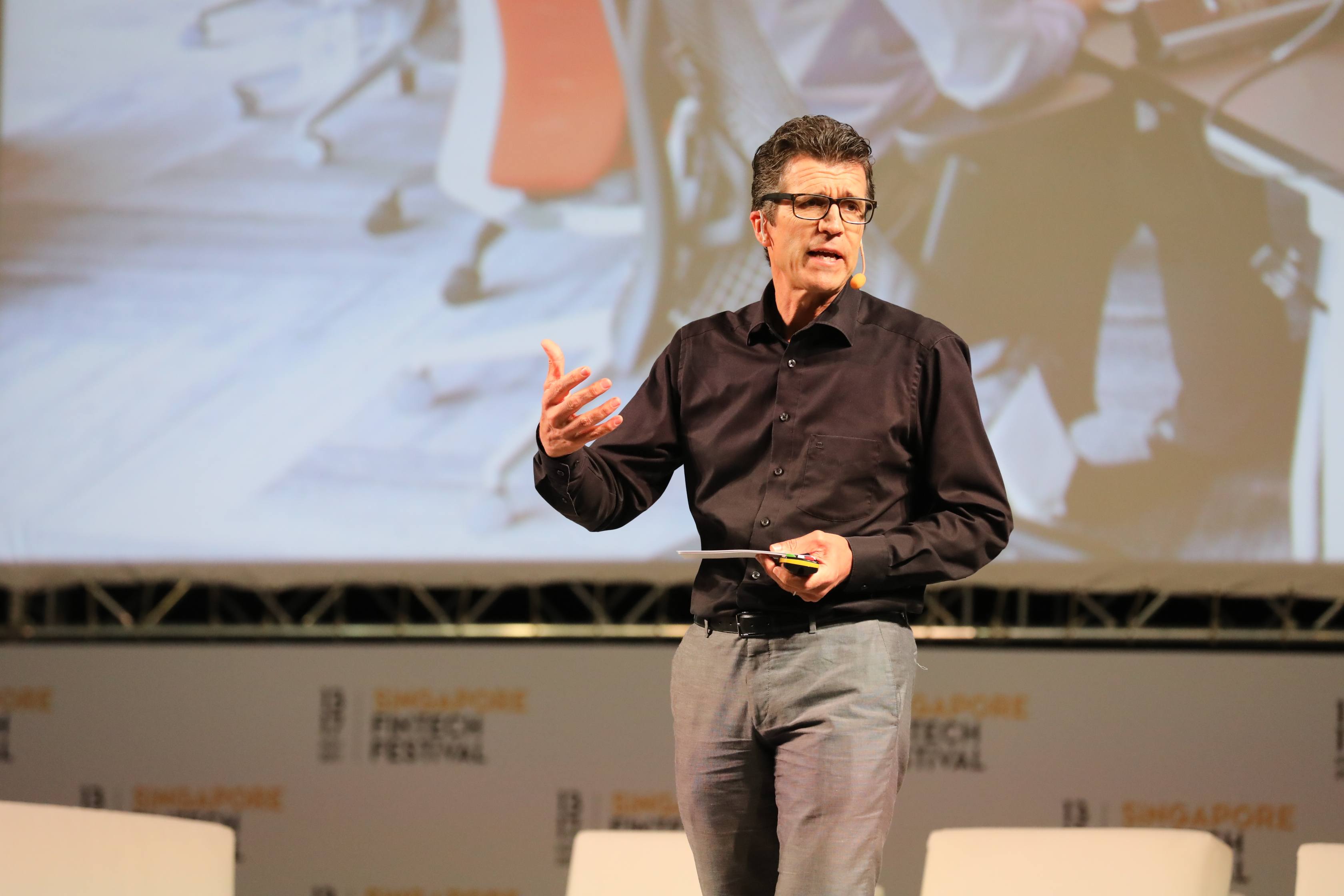
Standard Chartered Bank group CIO Michael Gorriz at Singapore Fintech Festival 2017 / Photo credit: Standard Chartered Bank
“The way we engage them is within an environment which is very similar to their own,” he adds. This environment is achieved through the bank’s eXellerator innovation lab, which was inaugurated in Singapore in 2016, and recently expanded into Hong Kong and London.
See: What corporations really want in startups for successful partnerships
But even with all those strategies, Gorriz contends that becoming “a tech company with a bank license and a proven track record in trust and risk management” is not likely to happen overnight.
“Technology is evolving so fast,” he explains. “I don’t think that we’ll be done in three or four years – the journey will continue. What we are most focused on is delivering banking to our clients the way they want to be served.”
Standard Chartered Bank aims to simplify banking by providing digital solutions that make it easy for millions of customers across Asia, Africa, and the Middle East to gain access to banking services.
Join Standard Chartered on its journey towards seamless banking experiences. Test, build, and innovate with the bank’s APIs here.
Stay updated on the go with our mobile app.
Get latest insights with smoother, more personalized experience through TIA mobile app.
Recommended reads
 SG’s crypto brain drain and India’s new digital rupee
 Meet the company bringing cybersecurity solutions under one umbrella
 Indonesia bans PayPal, Yahoo Search, and other tech platforms
 SG crypto firm allows debit, credit payments for token purchases
 How fintech firms can develop great products to stay ahead of the curve
 Taiwan to bar use of credit cards for purchasing crypto
 GoTyme Bank gets go signal to set up Philippine digital bank
 SG exchange gets nod from MAS to offer crypto services
 Australia to roll out trial program for CBDC
 Will more regulation help or hurt Indonesia’s online lenders?





Editing by Eileen C. Ang and Steven Millward
(And yes, we’re serious about ethics and transparency. More information here.)