Stefanie Yeo · · 6 min read
Financial inclusion has come far – but there’s more to be done

Summary:
- Despite advancements in digital payments and banking apps, there are still major unmet needs in fundamental infrastructure, SME financing solutions, and financial services for the growing gig and informal economies.
- While the fintech sector receives substantial funding overall, early-stage startups building for underserved populations typically don’t get a slice of that pie, leaving them struggling to get off the ground.
- NextFin Asia aims to bridge this by offering an accelerator program and funding to support emerging startups that have strong business models around inclusive finance.
- Learn more about NextFin Asia.
These days, you can pay for a bowl of noodles at a small warung outside of Jakarta by scanning a QR code. Through an app on your phone, you can create a bank account, apply for a loan, or even invest small sums equivalent to a cup of coffee. It’s never been easier to buy, pay, and transact in Southeast Asia – a sign of the vast improvements the region has seen around financial inclusion.

Photo credit: Daniel Pawer / Shutterstock
However, despite this growth, there are still significant gaps when it comes to achieving true financial inclusion in Southeast Asia.
“Every country has its own solutions around payments, loans, and such. However, there is still quite a lot of room for improvement.” says Saijai “Kia” Pongsripetch. She leads NextFin Asia, a fintech-focused fund at ADB Ventures, which is the venture capital arm of the Asian Development Bank (ADB).
Unmet needs
According to Pongsripetch, there are several areas where existing financial services and solutions fall short.
The first is the fundamental infrastructure that underpins financial services, which includes things such as know-your-customer processes, payment processing, and credit scoring.
Pongsripetch points to credit bureaus in Southeast Asia as an illustration of this need.

Saijai “Kia” Pongsripetch, NextFin Asia Lead / Photo credit: ADB Ventures
“Some of the credit bureaus are not as active or updated as frequently as they should be, which makes them a less consistent reference for lending,” she explains. “It’s an issue for both lenders and borrowers, as the people who really need the money can’t access it.”
Another area where Pongsripetch observes a gap lies in SME financing and related solutions.
“In Southeast Asia, we have one similar characteristic – we have a lot of SMEs,” she says. “And somehow these SMEs, on some level, will always have difficulty accessing financing from banks.”
A survey, conducted by SME financing platform Funding Societies found that 70% of respondents relied on seed money from personal savings and friends and family networks to start their businesses. Only 23% had obtained funding from traditional banks, and the remaining 7% of respondents used alternative sources.
The same survey found that issues around access to financing and fulfilling payments were among some of their top concerns, highlighting a significant opportunity in this area.

Photo credit: Mang Kelin / Shutterstock
Existing fintech solutions have also not kept pace with evolutions in the digital economy. The rise of gig work and the growing “informal economy” – such as housewives running side hustles from their living rooms – have created new challenges around income stability, financial planning, and access to products like loans and savings.
“This is a growing opportunity, but it’s still very underdeveloped,” Pongsripetch says.
These gaps continue to persist for several reasons, the chief of which is funding.
“Funding is decreasing across the board, but fintech is one of the sectors that is still getting the most funding” Pongsripetch shares. “However, if we drill deeper, the startups in fintech who have received funding are at the later stage. They are also mostly solution providers, providing services to enterprises.”
This creates a kind of self-perpetuating cycle. Startups seeking funding and growth will build for a customer base that has money to spend, which leads to the development of more solutions targeted at enterprises and those living in Tier 1 cities. With investors navigating an uncertain economic situation that demands more caution, they will prioritize safer bets with clearer routes to returns, which in turn leads to more startups building for the same audiences.
Ultimately, it means startups operating outside of these parameters often struggle to get off the ground.
Bridging the gaps
This is the gap that NextFin Asia is aiming to bridge.
Launched in partnership with The Luxembourg House of Financial Technology (LHoFT) and the Luxembourg Ministry of Foreign and European Affairs, Defence, Development Cooperation and Foreign Trade, NextFin Asia aims to advance financial inclusion by supporting startups at the early stages of their journeys.
The program involves two components. The first is Catapult: Inclusion SE Asia, an accelerator program offering tailored acceleration, mentorship, and institutional partnerships. The second is NextFin Asia’s fund, which provides early-stage financing of up to US$400,000 to companies looking to drive financial inclusion.
NextFin Asia supports startups working in areas such as the informal economy, agriculture and rural financing, supply chain financing, MSME-related solutions, fintech infrastructure, and green fintech, though Pongsripetch notes that the fund is open to startups in other areas as long as they align with its goal of furthering financial inclusion.
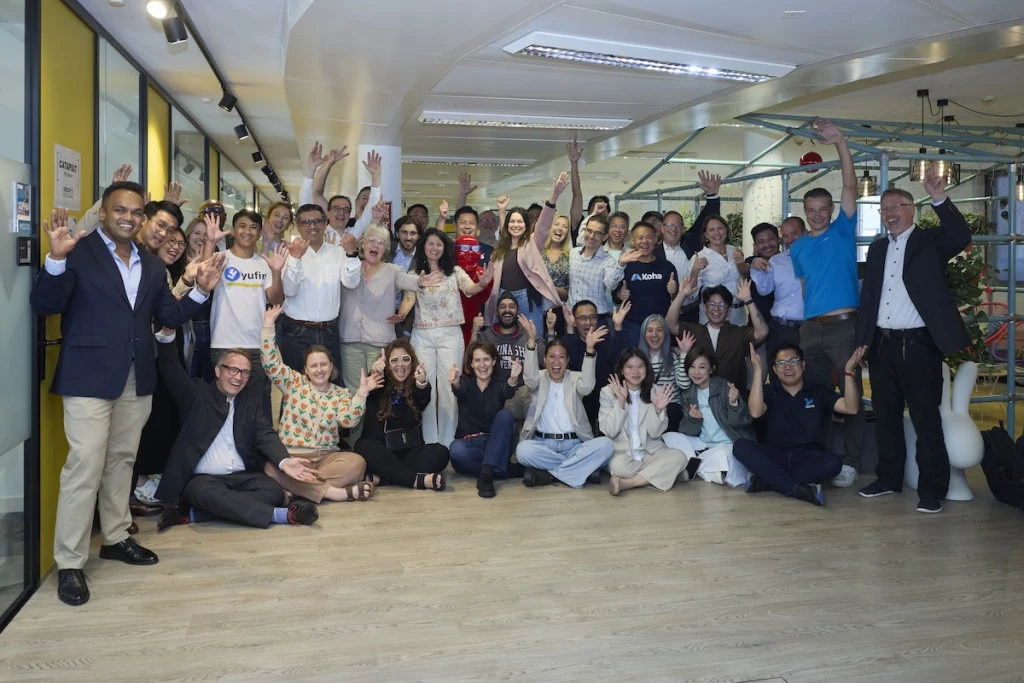
Participants at Catapult: Inclusion SE Asia / Photo credit: ADB Ventures
“We are focused specifically on inclusive finance,” she explains. “It’s not just any fintech – that inclusion angle is particularly important.”
While advancing financial inclusion is central to NextFin Asia’s thesis, Pongsripetch emphasizes that that is not all it looks for – having a sound business model is also essential.
“We believe that when these fintech startups have a good commercial proposition and can scale, they will also scale their impact exponentially and change many things,” she notes.
NextFin Asia aims to serve as a catalytic investor – with the goal of derisking and scaling innovation through its investments into companies. Considering the larger role that ADB plays, these investments serve as a signal of credibility to the broader market, which will enable these startups to attract additional capital to drive further growth.
“We want to support these businesses and enable them to commercialize their solutions and make it into a long-term, sustainable business,” Pongsripetch adds.
The future is an inclusive one
NextFin Asia is currently preparing for the second edition of the Catapult: Inclusion SE Asia bootcamp, which will take place in November at the Singapore Fintech Festival. Pongsripetch shares that there are a lot of interesting startups working on a number of exciting ideas, ranging from improving insurance and loan access to fraud detection.
The fund is also planning to engage with more startups through events, with the Singapore Fintech Festival being a prime example. Moreover, it is exploring future investments beyond Southeast Asia.
Ultimately, NextFin Asia wants to help drive greater financial inclusion in Asia by giving startups the leg up they need to build their solutions.
“Some sectors – even those we’ve known about for a long time, such as lending – are evolving, and new ones, such as the gig economy, are emerging,” Pongsripetch says. “The startups, ultimately, are coming in to help create new work for a new economy and supporting this growth in the region.”
ADB Ventures backs early-stage technology companies driving climate and development impact across emerging Asia. NextFin Asia is its dedicated platform for inclusive fintech, providing seed funding, acceleration support, and ecosystem access to startups advancing financial inclusion across Southeast Asia.
Learn more about NextFin Asia on its website.
This content was produced by Tech in Asia Studios, which connects brands with Asia’s tech community. Learn more about partnering with Tech in Asia Studios.
Stay updated on the go with our mobile app.
Get latest insights with smoother, more personalized experience through TIA mobile app.
Recommended reads
 Grab insiders buy in as Uber overhang weighs on stock
 Gobi-backed Bitsmedia lays off 21 employees
 They built AI agents on WhatsApp. Then Meta entered the chat
 TikTok creator agencies turn to AI to cut costs
 Tracking AI hiring in Singapore: OpenAI, Anthropic, and more
 Last to board: why travel may be AI’s final frontier
 Why ‘cheaper’ no longer wins dev deals for Vietnam
 Alibaba’s capex isn’t the full story
 Forget startups. Buy the business running on Excel
 Life’s a game, and AI agents are Animoca’s new play





Editing by Jonathan Chew and Lorenzo Kyle Subido
(And yes, we’re serious about ethics and transparency. More information here.)