- Premium Content It takes our newsroom weeks - if not months - to investigate and produce stories for our premium content. You can’t find them anywhere else.
 Thu Huong Le · · 9 min read
Vietnam’s e-wallet war has just begun, and it will be brutal
Colorful stickers and placards of popular digital wallets are plastered all over stores and coffee shops in downtown Hanoi and Ho Chi Minh City. Not only do they scream for attention, but they also promise goodies. 30% discount. 10% cashback. Earn more reward points. All you need to do is scan a QR code.
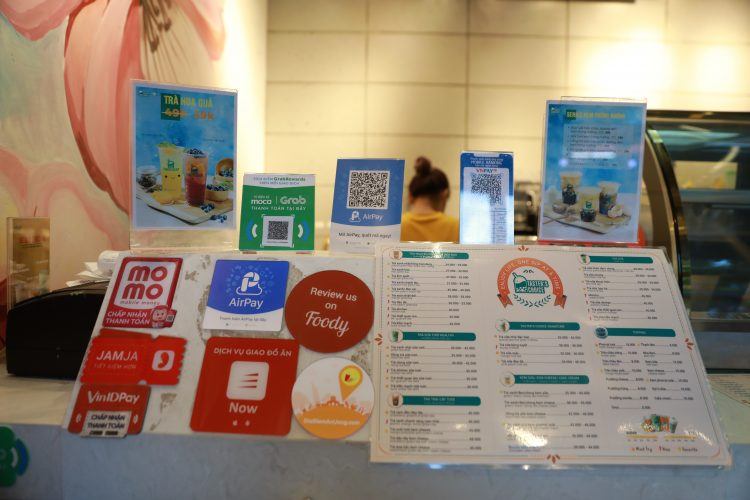
Advertisements from e-payment and tech companies adorn a shop in Vietnam. / Photo credit: Truong Van Vi
With all the choices out there, it’s easy to get confused about which app to use to get the best deals. Feeling overwhelmed, some people might just end up going back to the basics – paying in cash.
Cash is still king in Vietnam, accounting for about 80% of transactions in the country, according to various estimates by industry stakeholders. That’s far below the government’s ambitious goal of achieving 90% cashless transactions by this year.
But the potential of Vietnam’s fledgling fintech sector is too lucrative to miss out on. Transaction value is expected to grow to US$22 billion by 2025 from the current level of US$9 billion, according to an estimate by Asia-focused consulting firm YCP Solidiance. At present, digital payments account for the largest chunk of Vietnam’s fintech sector.
With the State Bank of Vietnam (SBV) granting a license to 37 service providers, it’s no wonder that this space is crowded. Of this number, 34 provide e-wallet services, perhaps harboring dreams of replicating the success of Alipay and WeChat Pay, which are indispensable in China.
A burgeoning sector
They have reasons to believe they have a shot.
For one, Vietnam’s banked population is among the lowest in Southeast Asia.
At the same time, the country is one of the fastest-growing adopters of smartphones in the region. Smartphone penetration in Vietnam has doubled since 2014 to reach about 51 million users, according to a Google report released in 2019.
Like China a decade ago, Vietnam could be in the early phase of a digital payments revolution.
Huy Pham, a finance lecturer from RMIT University’s School of Business and Management, believes that the stage is set for “an arms race of e-wallet players” in the country. “The competition in this market is quite stiff and leaves [only] a tiny opportunity for newcomers to gain traction,” he adds.
Vietnam’s fintech sector, particularly the e-payments segment, has drawn a significant amount of interest from foreign investors. Last year, Momo and VNPay got two mega deals, propelling them into the ranks of highest valued companies in the region, according to the Southeast Asia Tech Investment H1 2020 report from Cento Ventures.
Lack of a dominant ecosystem
Hampered by regulations
Stay ahead in Asia’s tech landscape
This is premium content. Subscribe to read the full story.
Like China a decade ago, Vietnam could be at the start of an e-payments revolution, with players aiming to replicate the success of Alipay and WeChat Pay.
We know this is not ideal. ⌛ Sign up in 20 seconds. Cancel anytime.
Our subscriber community includes professionals from these companies:





Stay updated on the go with our mobile app.
Get latest insights with smoother, more personalized experience through TIA mobile app.