Jack Ellis · · 3 min read
Personal mobility startup nets $45m to make its vehicles available on demand
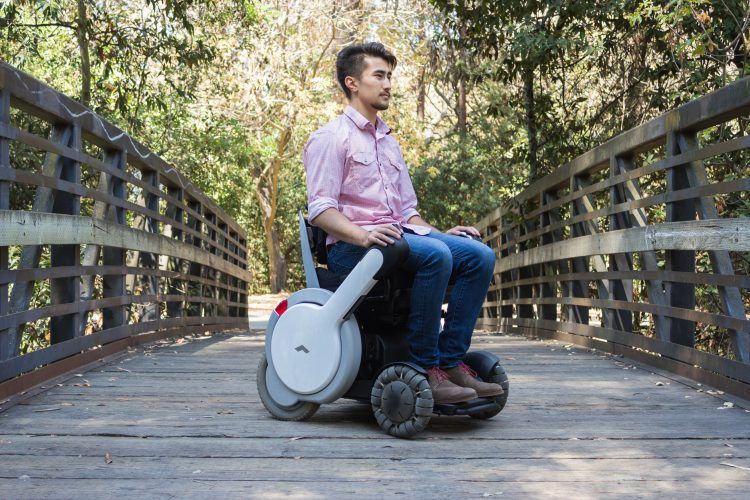
Photo credit: Whill
The initial idea for Whill came about in 2010, when a friend of the Japanese startup’s co-founders told them about the everyday trials and tribulations of being a wheelchair user. “I’ve even given up going to the convenience store just two blocks away,” the friend said, adding that his use of a wheelchair made other people assume he was ill, weak, or dependent, and in constant need of assistance.
This inspired Whill co-founders Sugie Satoshi, Junpei Naito, and Muneaki Fukuoka – who have engineering experience at Nissan, Olympus, and Sony between them – to develop a new kind of personal mobility device (PMD) for people who have difficulty walking.
Whill’s PMDs – or personal electric vehicles (PEVs), as the startup prefers to call them – are more maneuverable and more powerful than traditional wheelchairs, and are able to navigate difficult terrain at speed – giving users more convenience and confidence.
Satoshi, Naito, and Fukuoka exhibited their first prototype at the 2011 Tokyo Motor Show. They launched their startup the following year, and ran a Kickstarter campaign in 2014 to generate funds and publicity for their PEVs.
Whill today announced that it has just banked US$45 million in its latest funding round, taking its total venture funding to date to over US$80 million. SBI Group’s SBI Investment co-led the round with Daiwa Securities Group, Whiz Partners, and Endeavor Catalyst.
The startup – already present in Europe and North America, in addition to Japan – plans to use the funding to boost its global expansion. The capital will also be invested in developing its “mobility-as-a-service” platform, which aims to connect a range of different personal, private, and public transport options into a single service accessible on demand, in order to make travel more efficient.
See: Wheelchair alternative raises $17.5m, now one of the most well funded startups in Japan
In this regard, Whill – while still serving the disabled community – is extending its focus more generally to personal transportation, a spokesperson told Tech in Asia.
“Whill aims not only to develop and sell personal mobility devices for those who have difficulty walking but as mobility everyone can share, just like public transportation or ride-sharing services,” the company representative said. “Specifically, it aims to construct a new mobility service system, such as sharing Whill devices in various venues like airports, stations, sports facilities, and amusement parks.”
After analyzing passenger data from the Port Authority of New York & New Jersey and the US Bureau of Transportation, Whill found that over 20 million passengers requested wheelchair assistance at US airports in 2016, representing a compound annual growth rate of 4.1 percent since 2013. With the growth of aging populations worldwide, these figures can be expected to go up at an increased pace, and Whill is looking to ride the so-called “silver tsunami.”
Whill’s spokesperson did not provide financial performance data when asked by Tech in Asia. However, the representative said that the startup has sold 1,000 units from its first set of devices – the Model A/M family, which includes the Model A medical version for the Japan and UK markets, the non-medical version for the US market, and a US Food & Drug Administration-cleared Model M for the US market.
Existing investors that participated in Whill’s latest round include government-backed Innovation Network Corporation of Japan, as well as Eight Road Ventures, Mitsui Sumitomo Insurance Venture Capital, Nippon Venture Capital, DG Incubation, and Mizuho Capital.
Editing by Terence Lee and Eileen C. Ang





Stay updated on the go with our mobile app.
Get latest insights with smoother, more personalized experience through TIA mobile app.