 Nathaniel Fetalvero · · 5 min read
How to leverage partnerships to boost revenue growth

“How can I boost my business’ revenue growth?”
As an entrepreneur or marketer, you’ve probably asked yourself this question at least once. And it doesn’t help that there are several answers: expanding into a new market, stepping up sales efforts, offering discounts, or raising the price of your product.
One surefire way for businesses to drive revenue growth, though, is to engage in partnerships. According to a 2019 Forrester study commissioned by partnership management platform Impact, 77% of businesses said that partnership development was key to their sales and marketing strategies in 2019. What’s more, for over half of the surveyed businesses, more than 20% of their revenue came from such collaborations.

Photo credit: rawpixel / 123RF
Partnership programs can open doors for businesses to organically introduce themselves into the user experience through a wide range of partnership types, including business-to-business partners, affiliates, influencers, media publishers, and more. These partners connect brands to their audience via warm introductions – in almost the same way that a friend might introduce you to someone at a party – which can be accomplished automatically and at scale.
And they come in various forms. In traditional affiliate marketing, brands pay a commission for another business – or in some cases, an individual – to market their products. Some examples of these types of partners might include cashback or coupon sites, where a brand will offer a special discount to incentivise consumers to make a purchase.
Other strategic tie-ups, such as content partnerships, leverage platforms like Tech in Asia to promote a company to its audience by writing about its products or services. Contextual partnerships, on the other hand, entail working in tandem with a complementary business to reach customers when they’re most likely to purchase. An example of this would be partnerships between a hotel and a car rental company, where the former might market the latter’s services to its guests.
According to Antoine Gross, general manager of Impact’s Southeast Asia operations, these strategies are growing in appeal because the amount a business spends is determined by how successful that partnership is.
“If I’m Apple and I sell you a phone, and I know that the phone was referred from a specific partner, I only pay [that partner] once I know that the phone has been purchased, shipped, and will not come back to my warehouse,” he explains. “It’s not like other kinds of digital marketing campaigns where I need to buy impressions or clicks; I pay based on true performance.”
But creating, managing, and optimizing these partnerships successfully isn’t so straightforward. Gross shares some tips for businesses looking to get started on their partnership journey.
1. Strategize your approach
Blindly entering into partnerships without first knowing what your objectives are isn’t an effective way to achieve results. Before anything, businesses should first define what success looks like for them.
“What is your goal? What are you trying to achieve? Most people would say it’s revenue or bookings, but it’s really important to make it clear,” says Gross. Knowing these details will help inform how a partnership can be executed in a way that benefits both parties.
In the context of a hotel, for instance, not all rooms will be difficult to sell: It’s much easier to market budget rooms during peak periods vs. high-end accommodations during slow seasons. “Why should I pay a partner the same commission for all these rooms? Rather than paying 10% commission for every room they sell, I would pay maybe 3% for the easier-to-sell rooms and slightly more for the harder ones,” explains Gross.
By specifying the objectives of a partnership engagement, companies will be better able to drive the right growth for their business.
2. Avoid working in silos
Sometimes, companies delegate the management of different types of partnerships to separate departments. Affiliate partnerships, for example, might come under the charge of the marketing team, while sourcing contextual collaborations might be tasked to the business development team. However, Gross warns that this approach could be inefficient.
“If you work in silos, you can’t stitch together all the data from your partnership efforts, and you might even end up spending double or triple what you could be spending if you had everything under the same roof,” he says.
When this process is handled by a single team, campaigns can then work in tandem to drive the right business objectives. This also makes for more holistic post-campaign insights to justify partnership execution costs, Gross points out.
3. Keep tabs on performance
At the end of a campaign, it can be easy to pat yourself (and your partners) on the back for a job well-done and move on to the next campaign. But just because a partnership has successfully driven sales to your business doesn’t mean that the work is done.
“You need to review what’s been done, understand what worked well, and try to replicate that success,” says Gross. “Maybe you realize that you’re seeing really good results with a certain type of partner because they drive more conversions. Now, you can find look-alike partners to engage with for another partnership to drive even more success.”
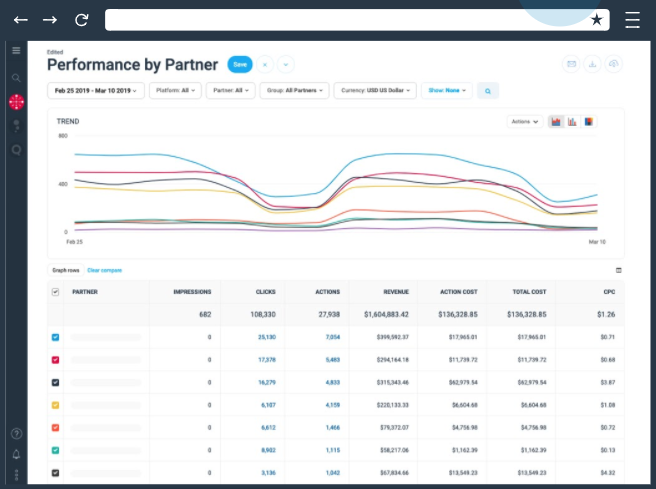
Tools like Impact’s Partnership Cloud allow businesses to keep track of their partnerships’ performance. / Photo credit: Impact
On the other hand, if tie-ups don’t achieve their goals, Gross advises businesses to first conduct a review with the partner in question rather than just moving on directly to the next opportunity.
“If a partnership doesn’t work as well as expected, I’d give the partner a call and ask, ‘Hey, how do you feel we can do a better job together?’ Then, you can iron out the kinks together, and the partnership might work,” he says.
Being able to identify what exactly works and what doesn’t can inform businesses’ strategies when approaching future collaboration opportunities. Once a partnership has been optimized to its maximum potential, replicating that success with the next one will be a much smoother experience.
Impact is transforming the way enterprises manage and optimize all types of partnerships. Its Partnership Cloud provides businesses with an integrated end-to-end solution for managing their collaborations across the entire partnership lifecycle to activate rapid growth.
To learn more about how you can make your partnerships drive more revenue, ROI, and overall business performance, download the report “Smooth the partnership journey by learning from high maturity companies” on Impact’s website.
This content was produced by Tech in Asia Studios, which connects brands with Asia’s tech community. Learn more about partnering with Tech in Asia Studios.
Stay updated on the go with our mobile app.
Get latest insights with smoother, more personalized experience through TIA mobile app.
Recommended reads
 How Indonesia’s small businesses can export globally
 Indonesian D2C beauty brands build foundation for regional expansion
 So you think you know startup growth
 Lessons from the demise of two Chinese grocery delivery pioneers
 As inflation bites, Indonesia’s warungs and low-income workers may have most to lose
 SEA food delivery spending tops $16.3b in 2022: report
 Foodpanda slashes jobs in SEA to chase profitability
 Baby boom: SEA’s mom and babycare startups meld content with commerce
 Can Sociolla become the AWS for smart retail?
 Shopee rights the ship – for now





Editing by Jaclyn Teng and September Grace Mahino
(And yes, we’re serious about ethics and transparency. More information here.)






