- Insights This article was written by a TIA community member. Insights pieces undergo the same rigorous editorial process that newsroom-produced articles have.
 Nathan Thompson · · 4 min read
NFT buying behavior: a surprising trend
This article is part of Crypto Insights, a segment by major crypto exchange Bybit that dives into the latest and most pertinent issues in the crypto space.
At the start of 2021, if you offered to sell someone a jpeg image for a month’s salary, you’d be taken as a fool. But by the end of the year, it seemed that everyone was feverishly buying land in unreleased computer games and swapping selfies of an Indonesian teenager. Maybe people had spent far too long in lockdown.
Everyone from Mark Zuckerberg to Gucci has jumped on the bandwagon, and the NFT market is worth over US$90 billion at the time of writing. As with any lucrative new asset, people are trying to figure out how it behaves in relation to macro and micro factors so they can get an edge on other investors.
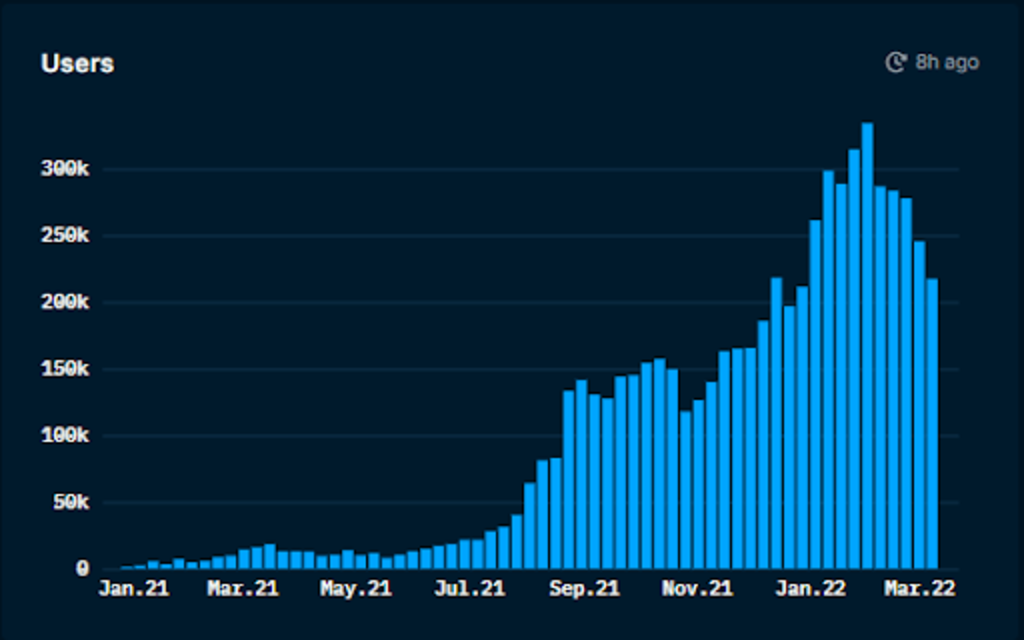
The number of NFT users has grown exponentially since the second quarter of 2021. / Image credit: Nansen
Initial research found that larger cryptocurrencies influenced the comparatively tiny NFT market. “We expect cryptocurrencies to influence NFT pricing, as, in general, larger markets tend to spill over into smaller related markets,” reads a paper by Michael Dowling, full professor of finance at Dublin City University. The research also found “strong evidence of co-movement” between the crypto and NFT markets.
However, the paper only took data from March 2019 to March 2021, when the NFT market was still nascent. After sales and volume took off in July 2021, NFTs have been behaving differently compared to their crypto parents.
By November last year, NFTs cooled off and their value fell while Bitcoin and other cryptocurrencies were seeing new all-time highs. But as soon as the crypto markets trended down, NFTs exploded. The market saw a record US$6 billion worth of weekly volume in January when Bitcoin was roughly 40% down from its previous high.
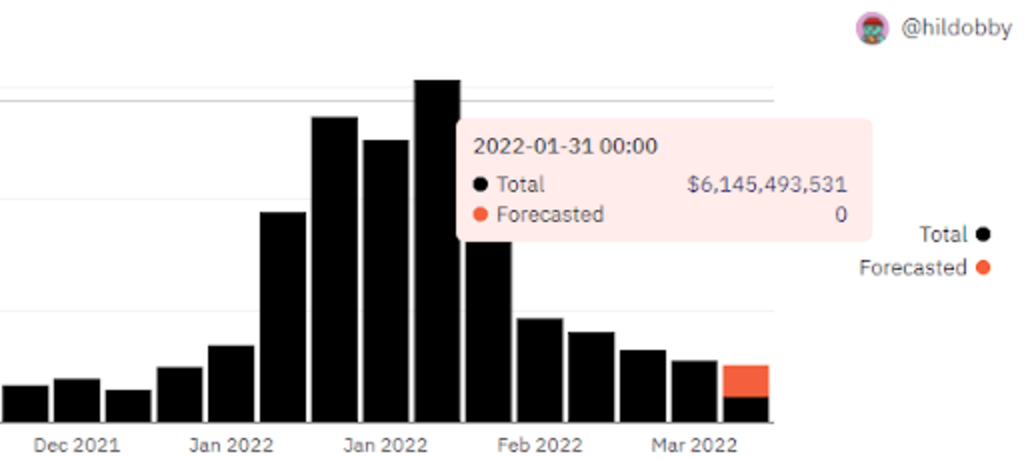
Weekly totals of NFT volume in US dollars / Image credit: @hildobby / Dune Analytics
Perhaps it’s unsurprising that a Coin Metrics report from February 2022 found that the correlation between the two markets was “not constant,” which meant that the markets didn’t always move together.
“Although it’s still early, it appears that NFTs are a relatively independent market and may for the most part move separately from the rest of the crypto market,” the report said.
But what if the connection doesn’t have anything to do with price but rather with volatility? This measures the amount an asset’s price deviates from the median; if volatility is high, it means the price is strongly fluctuating up or down.
As the majority of NFTs are denominated in Ether (ETH), the native cryptocurrency of the Ethereum blockchain, it could be the case that people are reluctant to trade NFTs when ETH’s price is unstable.
Dr. Lennart Ante, co-founder of the Blockchain Research Lab, compared ETH volatility compared with the sales volume of OpenSea, the largest NFT trading site. “Before 2021, OpenSea volume had no relevant relationship with the volatility of ETH … [and] there were no relationships or patterns worth mentioning,” Ante says.





Stay updated on the go with our mobile app.
Get latest insights with smoother, more personalized experience through TIA mobile app.