Samantha Cheh · · 5 min read
The evolution of AI: From bronze automatons to enabling humanity’s future

The concept of artificial intelligence has its roots all the way back to the ancient Greeks, who came up with the idea of intelligent automatons – bronze sculptures that could move, speak, and cry, and had blood vessels beneath their metal exteriors.
They were meant to protect cities or even to serve as a means of human punishment. Today’s technology is more practical in nature, and AI has become ubiquitous, embedded into just about every available digital service.
Thanks to the leaps in areas like natural language processing – the branch of AI that deals with teaching computers to understand human language – AI is now being used to quickly decode reams of data, translate bank statements and doctor referrals, and even improve speech-to-text software. Its potential is seemingly limitless.
Over the last decade, the AI space has experienced a “complete transformation every 18 months,” says Sri Satish Ambati, CEO and founder of H2O.ai, which offers an end-to-end AI cloud-based platform. The shifts in the industry have been driven mainly by the improvement of AI hardware and software, as well as factors like the Covid-19 pandemic.
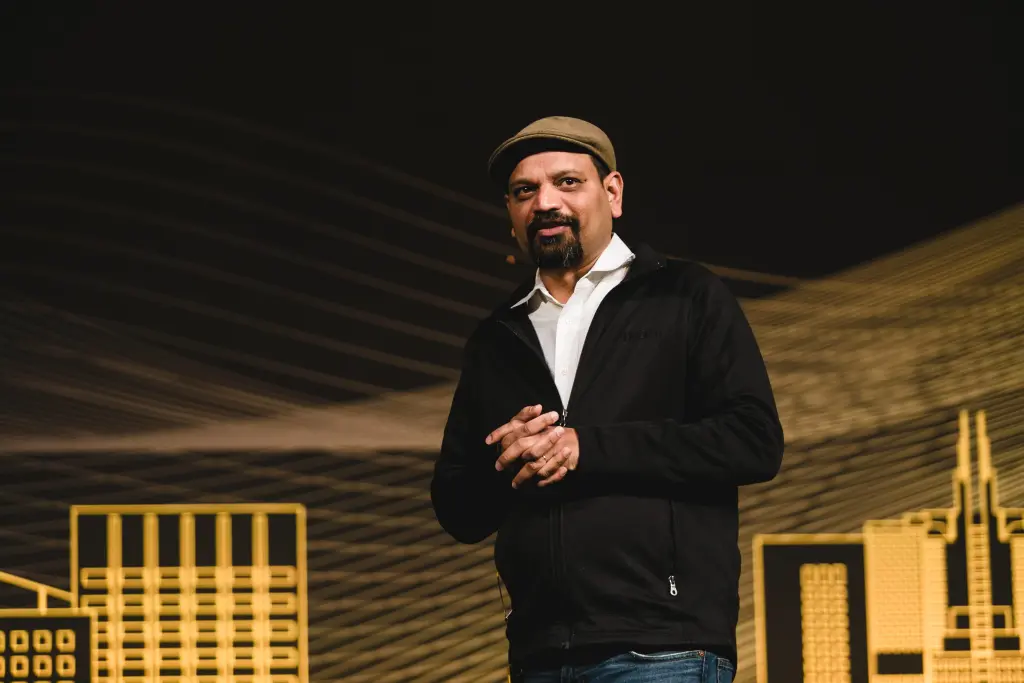
Sri Satish Ambati, CEO and founder of H2O.ai / Photo credit: H2O.ai
“If you think about what happened in the last year, we absolutely had to digitalize,” he says. “That kind of dramatic shift has accelerated the event horizon by at least five to 10 years.”
The bumpy road of history
The emergence of the AI technology we know today owes much to two events: British mathematician Alan Turing’s creation of the “Turing Test” as well as the 1956 Dartmouth College Workshop where the term “artificial intelligence” was first coined.
While these marked the beginning of the AI boom, soon after, the industry experienced two so-called “AI Winters” – periods of time during which funding for research was cut due to the limitations of available hardware and a perceived lack of progress in the space. But as innovations such as expert system software and social networks emerged and as data systems grew more centralized, the pace of development of AI technology ramped up.
It wasn’t long before these innovations were put to work in the business world. Page rank and search technology by internet-native leaders like Google and Yahoo, along with the influx of data science physicists into industries like banking and marketing, were the catalysts, says Ambati. These industries required big data collection methods, which led to the need for the ability to interpret huge amounts of data quickly – a task AI was suited for.
Now, the focus is turning from the speed of analyzing data to automation.
Automated machine learning models are perhaps the most well-known form of AI thanks to their use cases in banks and insurance firms, which rely on these models to automate numerous processes, detect fraud, recommend financial products, and even perform accurate underwriting tasks.
For example, one New York-based rental insurer, which is a client of H2O, used the service to build data models to help it re-strategize its approach after the devastation of hurricane Sandy.

Photo credit: H2O.ai
The disaster led to a change in tenant preferences: Apartments on higher floors – even in traditionally less attractive districts – became more popular. With the information from the AI model, the insurer was able to reduce policy prices for these apartments, helping it claim significant market share.
“From grandmasters to grandmas”
H2O’s solutions are a continuation of early AI innovations. The firm builds on concepts such as time-series predictions and random forest algorithms to improve its AI technology to be more efficient, safe, and accessible.
It’s an evolution that Ambati feels will continue: Future AI innovations will also be able to “explain AI,” making it even easier for laypeople to use the technology, he says. H2O’s platform, for instance, isn’t designed to just give clients access to basic AI software, but it also involves machine learning technologies that can build complex models in their stacks within minutes.
Even as AI has become more commonplace, it’s still not the easiest technology for people to use; 41% of respondents to a McKinsey survey said that finding the right talent to properly harness AI’s potential is the biggest challenge their organizations face. Ambati’s focus: Figuring out how to simplify AI so that people – from grandmasters to grandmas – can use it.
To do that, his firm takes a “maker-first” approach, chipping away everything that’s not an efficient use of users’ resources, such as time spent on mending and deploying models and even making auto-generation of code in low latency environments possible.
“We focused on tinkering all the things that made users’ lives easier, and soon, many realized that they didn’t need a Ph.D. to build a model,” Ambati explains. “We then looked at connecting bridges between the scientific and business worlds within companies; this helped everyone realize the value to be tapped into, and that’s where democratization started taking off.”
A more human future
AI has come a long way, and Ambati believes that it has the potential to help humankind face the next age of challenges, such as intelligent and sustainable city design and optimized healthcare. That’s why H2O continues its work to democratize technology through open-access initiatives.
“We chose open source because we wanted to be on the roadmap of every company in the world,” Ambati says.
The firm also has an AI app marketplace that gives platform users access to thousands of design patterns created by the company’s data science “grandmasters” or other customers. These patterns – what Ambati refers to as “recipes” – work like modular add-ons for a variety of use cases like fraud prevention, voice recognition, or image classification.
By making these widely available, the CEO says H2O’s AI platform would hopefully play its part in lightening the load on people and businesses by getting rid of operational inefficiencies and errors so everyone can focus on what really matters.
“The growing ubiquity of AI will eventually erase the menial tasks that clutter everyday life and allow us to focus on our humanity,” Ambati says.
H2O.ai is a leader in AI and automatic machine learning technology that is driving toward a future where AI technology is more accessible, scalable, and safe for people, communities, and businesses.
Learn more about how H2O is simplifying the use of AI technology by checking out how its hybrid AI platform can easily integrate into your stack on its website.
This content was produced by Tech in Asia Studios, which connects brands with Asia’s tech community. Learn more about partnering with Tech in Asia Studios.
Stay updated on the go with our mobile app.
Get latest insights with smoother, more personalized experience through TIA mobile app.
Recommended reads
 Indonesian AI startup goes global
 Forrest Li on scaling Sea, building smarter bots, and founder grit
 An AI assistant that joins sales calls and scores team skills
 SGX’s CEO says it doesn’t need a unicorn to win
 SMEs want AI too, but not the kind Big Tech is selling
 Oatside’s alt-milk rise hits a profitable gear
 Alibaba’s financial health in 12 charts
 Asia’s telcos bundle AI into mobile plans. Will it pay off?
 M-Daq chases bigger clients as revenue falls, losses grow
 VC tracker: Accel raises US$3.5b, including US$550m for India





Editing by Winston Zhang, Nathaniel Fetalvero, and Jaclyn Tiu
(And yes, we’re serious about ethics and transparency. More information here.)